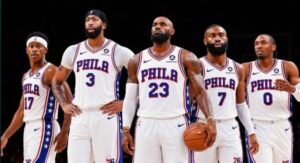





There are developmental prospects, and then there is Jalyx Hunt.
The Philadelphia Eagles did not draft Hunt in the third round in 2024 because he was a polished pass rusher. They drafted him because almost everything about his athletic profile suggested that he could become one.
That distinction matters.
Hunt had been an edge defender for only two seasons when Philadelphia selected him 94th overall. Before that, he was a safety at Cornell. Before Cornell, he was a high school wide receiver and defensive back. Go even further back and you find a Junior Olympic athlete competing in the long jump and triathlon.
His football career has been less a straight climb than a continuous reconstruction.
Receiver.
Defensive back.
Safety.
Linebacker.
Edge rusher.
And now, entering the 2026 season, potentially something considerably bigger: one of the next young stars of the Eagles’ defense.
That may sound ambitious for a player whose career high is 6.5 sacks. But Hunt’s 2025 season becomes substantially more impressive when examined beyond one number. He led Philadelphia in sacks, tied for the team lead in tackles for loss, led the Eagles with three interceptions, generated 57 pressures and delivered 24 quarterback hits, tied for 11th in the NFL according to the Eagles. He became the first player in franchise history to lead the team in both sacks and interceptions in the same season and only the ninth NFL player to accomplish that combination for his team. (philadelphiaeagles.com)
And somehow, those three interceptions have given Hunt one of the strangest statistics on the entire Eagles roster.
Through two NFL regular seasons, Jalyx Hunt has three career interceptions.
Cooper DeJean has two.
Quinyon Mitchell has zero.
DeJean and Mitchell were both first-team AP All-Pros in 2025. They are two of the best young defensive backs in football. (philadelphiaeagles.com)
That does not mean Hunt is a better coverage player than either of them. Of course he isn’t. Mitchell and DeJean spend hundreds of snaps defending NFL receivers, and Mitchell’s zero-interception season actually illustrates why interceptions are an incomplete way to judge cornerback play: quarterbacks can simply stop challenging elite coverage.
The comparison matters for another reason.
A 250-pound edge defender having more regular-season interceptions than two All-Pro defensive backs from his own draft class combined is ridiculous.
It is also a perfect entry point into understanding Jalyx Hunt.
Because the player Philadelphia now unleashes from the edge still carries pieces of every player he used to be.
Before the Pass Rusher, There Was the Athlete
Long before anybody imagined Hunt chasing NFL quarterbacks, his athleticism was already apparent.
Hunt grew up in a family that moved through several states during his childhood, including Maryland, South Carolina and Florida. His father, James, had played college football at Alcorn State and Mississippi, while his mother, Jaaqua, worked in education. Athletics were important in the household, but so was the expectation that Hunt prepare himself for life beyond sports. (cornellbigred.com)
At the 2011 AAU Junior Olympic Games, Hunt competed in the boys’ bantam division and won national championships in both the long jump and triathlon. Cornell’s official biography also lists him as an All-American in the high jump. (cornellbigred.com)
That background matters more than it might initially appear.
Jumping events demand explosiveness, coordination, balance and the ability to generate force rapidly through the lower body. Those qualities eventually became part of the athletic foundation that made Hunt such an unusual edge prospect.
But nobody knew that was where he was headed.
Hunt wanted to play football.
He just had not grown into the body that would eventually tell coaches what position he should play.
High School: The Late Bloomer Nobody Was Quite Sure How to Use
Hunt played his freshman season at Dutch Fork High School in South Carolina before his family returned to Florida. He finished his high school career at University High School in Orange City, where he played football, basketball and participated in track and field.
On the football field, he was still a skill-position athlete.
Hunt played defensive back and eventually became an all-county wide receiver. As a senior, he caught 20 passes for 475 yards and two touchdowns, averaging 23.8 yards per reception, while serving as a team captain and earning Offensive MVP honors. (cornellbigred.com)
Those are good numbers.
They did not turn Hunt into a major recruit.
His old recruiting profile provides an unusually honest snapshot of how he viewed himself at the time. As an 11th grader, Hunt listed himself at 6-foot-1 and 182 pounds and called himself a “late bloomer,” writing that he hoped college coaches would not overlook him because he had only recently begun growing. He also wrote that his priority was obtaining a degree and preparing himself financially for adulthood, acknowledging that the chances of playing professional football were slim. (ncsasports.org)
Read that again knowing what happened next.
A 182-pound high school player was asking coaches not to overlook him while conceding that professional football probably wasn’t realistic.
Less than a decade later, he would be sacking Patrick Mahomes in a Super Bowl.
There is something very Philadelphia about the distance between those two points.
Hunt was not a five-star recruit whose NFL future had been discussed since adolescence. He wasn’t even close. His father later told The Philadelphia Inquirer that he sent Hunt’s film to more than 100 schools trying to generate interest. Hunt received some opportunities from smaller programs and walk-on interest elsewhere, but there was no national recruiting battle. (inquirer.com)
Cornell gave him something much more valuable.
It wanted him.
Cornell Saw a Safety
Cornell offered Hunt the combination of Division I football and an Ivy League education.
For a family that valued academics, that mattered.
Hunt later explained to The Cornell Daily Sun that he had not been heavily recruited and viewed Cornell as an opportunity to play Division I football while exposing himself to a high academic standard. (cornellsun.com)
There was one catch.
Cornell did not see a wide receiver.
It saw a defensive back.
Hunt arrived in Ithaca and began the first major positional transformation of his career.
As a freshman in 2019, he appeared in seven games as a reserve safety and special-teams player, recording three tackles. Then came 2020, when the Ivy League canceled its football season because of the COVID-19 pandemic. Hunt lost an entire season during a developmental stage when young defensive backs ordinarily accumulate hundreds of practice repetitions. (cornellbigred.com)
When Cornell football returned in 2021, Hunt returned with a very different body.
The former high school receiver who had once listed himself around 182 pounds was now 6-foot-3 and 236 pounds.
Cornell still listed him at safety.
That alone tells you how strange his development had become.
Hunt played all 10 games that season and recorded 26 tackles, a pass breakup, a fumble recovery and a blocked punt that resulted in a safety against Brown. (cornellbigred.com)
The statistics were not spectacular.
The experience would become incredibly valuable.
Playing safety required Hunt to understand football backward from the way most edge defenders learn it. He learned route concepts. He learned how quarterbacks manipulate defenders. He played in space. He dropped into zones. He tracked receivers. He had to locate the football while moving backward.
Those are not typical formative experiences for an NFL pass rusher.
Hunt was essentially learning the passing game from the secondary before he ever learned to attack it from the line of scrimmage.
His body, meanwhile, was becoming less and less compatible with the position.
He was a 236-pound safety.
Something eventually had to change.
Leaving the Ivy League Was a Gamble
Hunt entered the transfer portal following the 2021 season.
From the outside, what happened next made little sense.
He left Cornell — an Ivy League university — for Houston Christian, then known as Houston Baptist, a small FCS program without a history of sending players to the NFL.
Hunt has acknowledged how strange the move appeared. He later called the transfer a gamble, but said Houston Christian’s staff was crucial in recognizing his potential as an edge rusher. (cornellsun.com)
The transfer also demanded considerable work away from football. During a 2026 return to Cornell, Hunt publicly discussed needing to catch up academically in order to remain eligible. He said he completed 27 credits between May and August while taking classes through three colleges. (cornellsun.com)
It is an important part of his story because the easy version of Hunt’s rise focuses exclusively on the physical transformation.
The actual path was messier; his football position was uncertain, his academic path needed repair, and his transfer destination was a tiny program.
During portions of his college career, The Inquirer reported that Hunt worked jobs ranging from DoorDash deliveries to overnight library security to help cover expenses associated with training and football. In high school, he had even worked as a janitor at the urgent-care facility where his father worked. (inquirer.com)
This was not the infrastructure surrounding a future first-round superstar.
It was a player trying to create an opportunity wherever he could find one.
Houston Christian provided it.
More importantly, the coaches there finally figured out where his body belonged.
Closer to the football.
Houston Christian Built an Edge Defender
Moving Hunt from safety to edge rusher sounds obvious in retrospect. It wasn’t.
Playing edge is not simply playing defensive back after gaining 50 pounds. Almost everything changes.
Instead of avoiding offensive linemen, Hunt had to attack them. Instead of reading routes from depth, he had to diagnose blocking schemes in an instant.
He needed to learn hand placement, leverage, rush angles, run fits, how to set an edge, how to counter a tackle’s punch and how to maintain enough lower-body strength to survive collisions with 320-pound men.
Hunt had spent years learning how to move in space. Now he had to learn how to fight. The fascinating part is how quickly it worked.
In 2022 — his first season playing edge — Hunt started all 11 games for Houston Christian and finished with seven sacks, 11.5 tackles for loss and three forced fumbles. He earned second-team All-Southland honors. (inquirer.com)
One year. That was all it took for the experiment to start looking legitimate. Then came 2023!
Hunt recorded 46 tackles, nine tackles for loss, 6.5 sacks, two forced fumbles, two fumble recoveries, two pass breakups, a blocked kick and an interception returned for a touchdown.
He was named the Southland Conference Defensive Player of the Year, earned first-team all-conference honors and collected multiple FCS All-America selections. He was also named a finalist for the Buck Buchanan Award, given to the top defensive player in FCS football. (hcuhuskies.com)
Across two seasons at Houston Christian, Hunt accumulated 13.5 sacks, the second-highest career total in school history, and tied the program record with five forced fumbles. (hcuhuskies.com)
The former Cornell safety had become one of the best defensive players in his conference after just two seasons playing his new position.
NFL scouts had to pay attention. But Jalyx Hunt suffered from a competition problem.
The Senior Bowl and Combine Changed the Conversation
The concern surrounding Hunt was obvious.
Houston Christian is not Georgia, Alabama or Michigan.
Teams could see the athletic traits on film, but they needed to know whether those traits would survive when the talent level increased.
Hunt became the first Houston Christian player invited to the Reese’s Senior Bowl, providing an opportunity to compete around prospects from major programs.
Then he went to Indianapolis.
And the measurements explained why NFL teams were fascinated.
Hunt checked in at 6-foot-3 3/4, 252 pounds, with 34 3/8-inch arms and an 82 3/4-inch wingspan. He ran the 40-yard dash in 4.64 seconds, jumped 37 1/2 inches vertically and posted a 10-foot-8 broad jump. (nfl.com)
Those are not normal numbers for a 252-pound defender.
NFL.com’s Lance Zierlein nevertheless described exactly why Hunt remained a projection. His speed was obvious, but he needed additional strength and a better anchor against NFL running games. The question was whether he could become more than an athletic designated pass rusher. (nfl.com)
That was the gamble.
The physical tools belonged in the NFL but the technical development had not caught up yet.
For many teams, that might have pushed Hunt down the board, but for the Eagles, it may have made him more interesting.
Howie Roseman Bet on the Development Curve
Philadelphia’s 2024 draft class began with Quinyon Mitchell at No. 22.
Then the Eagles traded up for Cooper DeJean at No. 40.
Those two selections would become franchise-changing almost immediately.
Philadelphia’s next pick did not carry the same name recognition.
After trading down and accumulating additional draft capital, the Eagles selected Jalyx Hunt at No. 94 overall in the third round, making him the first Houston Christian player ever drafted by an NFL team. (philadelphiaeagles.com)
At first glance, it looked aggressive.
Hunt was older than some prospects while simultaneously being younger in football experience at his position.
That apparent contradiction is essential to understanding the pick.
Philadelphia was not betting that Hunt already knew how to be an NFL edge defender.
It was betting that he could learn.
And the traits that Hunt lacked were largely teachable.
You can teach hand usage and a pass-rush counter.
You can add functional strength, improve run recognition and develop a rush plan.
What you cannot teach is a 252-pound man to suddenly develop 34-inch arms, a 37-inch vertical and the movement history of a defensive back.
The Eagles were drafting the athletic history, the track athlete, the receiver, the safety and the newly created pass rusher.
All of it came in the same body. It belonged to Jalyx Hunt!
2024: Philadelphia Let the Project Develop
The Eagles did not need Hunt to become a star immediately.
That was one of the advantages of the situation he entered.
Vic Fangio could develop him while Philadelphia’s established defensive front handled the heavier workload.
Hunt appeared in 16 regular-season games as a rookie and played 241 defensive snaps, only about 23 percent of the team’s total. He recorded 1.5 sacks and forced two fumbles. His first NFL sack came against Drew Lock and the New York Giants in October. (static.www.nfl.com)
Then his role began growing.
Philadelphia’s developmental prospect became increasingly useful during the postseason. Hunt recorded eight postseason pressures and 1.5 sacks during the Eagles’ four-game playoff run. (philadelphiaeagles.com)
That run ended on the biggest stage in American sports.
Super Bowl LIX.
Patrick Mahomes.
Kansas City trying to win a third consecutive championship.
And suddenly the former zero-star high school receiver from University High School was part of the pass rush terrorizing the best quarterback of his generation.
Hunt was officially credited with a half-sack of Mahomes as Philadelphia overwhelmed Kansas City’s offensive line in a 40-22 victory. The Eagles’ official retelling of the play described Hunt beating Joe Thuney before combining with Josh Sweat to bring Mahomes down. (static.www.nfl.com)
Think about that sequence.
A player entered Cornell as a defensive back in 2019, his entire 2020 season disappeared, he was still playing safety in 2021, and he became an edge rusher in 2022.
And by February 2025, he was sacking Patrick Mahomes in the Super Bowl.
That’s not normal development, that’s accelerated evolution.
2025: The Project Became One of Philadelphia’s Most Productive Defenders
If 2024 proved Hunt belonged, 2025 changed expectations entirely. Initially, his season started slow, but his workload exploded.
Hunt played 62 percent of Philadelphia’s defensive snaps, the highest percentage among Eagles edge defenders who remained on the 2026 roster. He started nine games and became a central piece of Fangio’s front. (philadelphiaeagles.com)
The production came with it.
Hunt finished the regular season with:
52 tackles
6.5 sacks
9 tackles for loss
57 quarterback pressures
24 quarterback hits
3 interceptions
2 forced fumbles
1 defensive touchdown
Those numbers are impressive individually.
Inside the context of the Eagles’ defense, they become even better.
Hunt vs. the 2025 Eagles’ Front
| Player | Sacks | Tackles for Loss |
|---|---|---|
| Jalyx Hunt | 6.5 | 9 |
| Moro Ojomo | 6.0 | 6 |
| Jordan Davis | 4.5 | 9 |
| Nakobe Dean | 4.0 | 7 |
| Zack Baun | 3.5 | 7 |
| Jalen Carter | 3.0 | 5 |
| Nolan Smith | 3.0 | 1 |
Hunt led the Eagles in sacks and tied Jordan Davis for the team lead with nine tackles for loss. (philadelphiaeagles.com)
That is an important distinction. This was not simply a young player benefiting from a few splash plays.
Hunt was creating negative plays at a rate comparable to anyone on Philadelphia’s defense, and yet the most unusual part of his season had nothing to do with rushing the passer.
The Edge Rusher Who Has More Interceptions Than Two All-Pro Cornerbacks
The 2024 Eagles draft produced Quinyon Mitchell, Cooper DeJean and Jalyx Hunt with Philadelphia’s first three selections.
By the end of 2025, Mitchell and DeJean were first-team All-Pros.
And Hunt had more regular-season interceptions than both of them combined.
Career Regular-Season Interceptions Through 2025
| Player | Position | INT |
|---|---|---|
| Jalyx Hunt | EDGE/OLB | 3 |
| Cooper DeJean | CB/Slot | 2 |
| Quinyon Mitchell | CB | 0 |
The NFL’s career statistics confirm Hunt at three, DeJean at two and Mitchell at zero through two seasons. (nfl.com)
Again, context matters.
Mitchell having zero regular-season interceptions does not diminish his play in the slightest. He defended 29 passes across his first two seasons, including 17 in 2025, and opposing quarterbacks had increasingly little incentive to challenge him. (nfl.com)
DeJean had two interceptions in 2025 while thriving in one of football’s most difficult positions from the slot. (nfl.com)
Both were rewarded with first-team All-Pro selections. (philadelphiaeagles.com)
The point is not to compare their coverage ability with Hunt’s.
The point is that edge rushers aren’t supposed to do this.
Hunt intercepted three passes in 2025, including a 42-yard pick-six against Minnesota.
And if you’ve followed his path, suddenly it doesn’t seem quite as inexplicable.
This is a 250-pound defender who spent years learning how to play safety.
He has tracked footballs, dropped into zones, played with receivers in space, and carried the ball before.
When Fangio asks another edge defender to drop into coverage, that player may be operating outside his natural football upbringing.
When Hunt does it, he is revisiting an old job.
The Three Interceptions Explain What Makes Hunt Different
Hunt’s versatility is sometimes described as a bonus.
It may be more important than that.
Modern defensive football revolves around creating uncertainty for quarterbacks.
Who is rushing, dropping and where is the pressure coming from?
Can the defense show five potential rushers and send four or an edge defender disappear from the line of scrimmage and unexpectedly occupy the passing lane a quarterback thought was open?
Hunt gives Fangio options because dropping him does not automatically create a mismatch.
That does not mean Philadelphia wants him spending half the afternoon playing safety again.
The Eagles drafted him to rush quarterbacks.
But the old defensive back allows the new edge defender to function differently from a conventional one-dimensional pass rusher.
That becomes obvious when examining what Hunt accomplished in 2025.
He did not merely lead Philadelphia with 6.5 sacks.
He led Philadelphia with three interceptions too. (philadelphiaeagles.com)
The Eagles say no player in franchise history had ever led the team in both categories during the same season.
Only eight players in NFL history had previously done it. (philadelphiaeagles.com)
For a franchise that has employed Reggie White, Clyde Simmons, Hugh Douglas, Trent Cole, Brandon Graham, Haason Reddick and generations of great defensive players, Hunt already owns a statistical distinction none of them produced.
That is remarkable.
The Number That Should Excite Eagles Fans Most Isn’t 6.5
If Hunt is going to make another jump in 2026, the statistic worth watching may not be sacks.
It’s pressures.
Philadelphia credited Hunt with 57 quarterback pressures and 24 quarterback hits in 2025. His 24 hits tied for 11th in the NFL. (philadelphiaeagles.com)
That tells us something the sack total cannot.
Hunt was getting near quarterbacks frequently.
He simply was not always finishing the play.
Sacks are volatile. A quarterback can escape a clean win by a pass rusher. He can throw the football an instant before contact. Another defender can finish a pressure created by someone else.
Pressures reveal whether a defender is consistently disturbing the pocket.
Hunt did that.
This is where the breakout case becomes much more interesting.
Philadelphia does not need Hunt to magically become twice as disruptive in 2026 to produce 10 sacks.
If he generates another 50-plus pressures and 20-plus quarterback hits but finishes a slightly larger percentage of those opportunities, the sack total can rise significantly without requiring some unbelievable transformation.
And remember: the player doing all of this still entered the NFL with only two years of edge experience.
He Was Still Improving at the End of 2025
Another reason for optimism is how Hunt’s season developed.
His production accelerated late.
He did not spend the entire year operating as a polished star. Like most young players, he was learning while playing.
That matters because development occurring in November and December is potentially more meaningful than a hot September followed by stagnation.
The larger story of Hunt’s football career has always been improvement through repetition.
At Cornell, he was learning defense.
At Houston Christian, he was learning edge.
As an Eagles rookie, he was learning professional football.
In 2025, he was learning how to function as a starting-caliber NFL pass rusher.
The question entering 2026 is what happens when the learning curve finally begins catching up to the physical tools.
Philadelphia Has Given Him Another Teacher
The Eagles added another significant piece to their edge room in April 2026 when Howie Roseman traded for Jonathan Greenard.
Greenard recorded 12 sacks in 2023 and 12.5 in 2024 before battling injuries in 2025. Philadelphia acquired him from Minnesota to bring proven pass-rush production and veteran experience into a young group. (philadelphiaeagles.com)
Greenard had already noticed Hunt.
He saw Hunt’s pick-six against Minnesota in 2025 and said after joining Philadelphia that Hunt’s development did not surprise him because he had watched him from afar.
“He’s been as advertised,” Greenard said. (philadelphiaeagles.com)
More importantly, Greenard has openly discussed helping Hunt and Nolan Smith develop.
For Hunt, that could be enormously valuable.
The next phase of his career is less about learning what an edge defender does and more about understanding how accomplished NFL edge defenders construct games.
What does a veteran notice in an offensive tackle’s stance?
How does he attack a tackle differently after showing speed twice?
When does he counter inside?
How does he recognize protection?
How does he create a sack on the third quarter move he actually began setting up in the first?
Those details separate athletes who can rush the passer from pass rushers who control matchups.
2026 Training Camp: The Rush Plan Is Catching Up to the Athlete
That brings us to the present.
And this may be the most encouraging development of Hunt’s summer.
On August 9, the Eagles published a profile describing Hunt as one of their best-performing players during the opening portion of Training Camp.
Hunt’s explanation for his progress was revealing.
He said he was “extremely confident in my rush plan.” (philadelphiaeagles.com)
For Hunt specifically, those words matter.
Nobody has ever questioned whether he is athletic enough.
The question going back to his pre-draft evaluation was whether the technical player could catch the physical player.
Having a rush plan means more than knowing a couple of moves.
A sophisticated pass rusher is playing a game inside the game.
Show the tackle speed.
Force him to widen his set.
Attack underneath.
Convert speed to power.
Threaten the inside shoulder.
Attack the hands.
When the tackle changes his response, counter the response.
The elite players are not simply moving faster than offensive linemen.
They are manipulating them.
For a player as naturally explosive as Hunt, that level of technical understanding is where things could become dangerous.
Then He Went to New England and Started Taking the Football Away Again
If Eagles Training Camp hype existed in isolation, it would be easy to dismiss.
August creates stars every year.
But what Hunt did during joint practices with New England on August 20 looked suspiciously familiar.
He stripped a Patriots ball carrier and recovered the fumble.
Then later, after Riq Woolen broke up a Drake Maye pass intended for A.J. Brown, Hunt flew toward the deflection, dove and secured the interception.
The Eagles called it one of the best plays of their entire 2026 Training Camp. (philadelphiaeagles.com)
His hand-skills are divine!
Of course he intercepted another pass.
Because apparently this is what Jalyx Hunt does now.
The significance is not that a Training Camp interception should be added to his NFL résumé.
It shouldn’t.
The significance is that the same versatility showing up in games is continuing to show up as Hunt becomes a better pass rusher.
He is not trading away the defensive-back instincts as he develops at edge.
He is adding edge technique on top of them.
That is a very different proposition.
Why 2026 Could Be the Year Hunt Becomes a Star
Technically, Hunt already broke out.
Going from 1.5 sacks as a rookie to 6.5 sacks, 57 pressures, 24 quarterback hits, nine tackles for loss and three interceptions is a breakout.
So 2026 should be framed differently.
This could be the year Hunt goes from breakout player to recognized NFL star.
There are several reasons to believe that possibility is real.
First, his workload has already proven he can function as more than a situational rusher.
Second, his pressure production suggests the sack ceiling is higher than 6.5.
Third, his versatility makes him unusually valuable in Fangio’s defense.
Fourth, Philadelphia has surrounded him with an elite interior talent in Jalen Carter and experienced edge help in Greenard, making it more difficult for offenses to devote all their attention to Hunt.
And fifth — perhaps most important — he still has relatively little experience playing the position.
Hunt’s age can be misleading.
He was born in March 2001. He is 25 entering the 2026 season.
But his positional age is much younger.
He did not begin playing edge until 2022.
This season will be only his fifth year learning how to rush quarterbacks from the position.
Many NFL edge defenders arrive after playing defensive end in high school and then spending three, four or five years doing it in college.
Hunt arrived after two.
Philadelphia drafted a player whose athleticism was years ahead of his technique.
Every NFL season gives the technique another opportunity to catch up.
The Final Mountain: What Hunt Must Do to Chase Myles Garrett and the NFL’s Elite
And this is where the conversation gets really interesting.
If Hunt takes another substantial step in 2026, eventually comparing him only with the other edge defenders on the Eagles will no longer be enough.
The standard changes.
At the top of the mountain are players such as Myles Garrett — defenders who do not simply defeat blocking schemes but cause offenses to restructure them.
Garrett provides an almost absurd standard.
In 2025, he set the NFL single-season record with 23 sacks, led the league with 33 tackles for loss, produced 39 quarterback hits and unanimously won his second AP Defensive Player of the Year award. (nfl.com)
And the production becomes more ridiculous when considering how opponents tried to stop him.
NFL Next Gen Stats tracked Garrett being chipped or double-teamed on 186 pass-rush snaps, the most for an edge defender since at least 2018. Even on those extra-help snaps alone; he still generated a league-high 32 pressures and eight sacks. (nfl.com)
That is what Hunt is ultimately chasing.
Not necessarily 23 sacks.
That is an unfair expectation for virtually anyone.
The goal is reaching the level where the offense enters Sunday knowing No. 58 must be accounted for on every passing down.
That requires several more steps.
Turn Pressures into Sacks
The first is obvious. Finish!
Hunt’s 24 quarterback hits and 57 pressures tell us he is already getting into the neighborhood.
The next step is owning the house.
If 6.5 sacks becomes nine or 10 while the pressure numbers remain strong, the national conversation around Hunt will change dramatically.
If that eventually becomes consecutive double-digit sack seasons, Philadelphia is no longer talking about a promising player.
It is talking about one of the league’s premier young edge defenders.
Build Counters to the Counters
The second requirement is technical evolution.
NFL offensive tackles study too.
Whatever Hunt put on film in 2025 has been dissected.
Tackles know where he wins, what he prefers, and when he wants to use speed.
The great pass rushers survive because there is always another answer.
The speed rush sets up power, the power rush forces the tackle to anchor, which creates the inside counter, and the inside threat opens the outside shoulder again.
Eventually the tackle isn’t reacting to one move, he’s paralyzed since he’s worried about four.
That is why Hunt talking about confidence in his rush plan should excite Eagles fans so much. The athlete has always been there. Now the chess player is emerging.
Become Impossible to Scheme Away
The third step is the hardest.
Great edge defenders affect offenses even when they don’t record statistics.
When a coordinator adds a tight end to Hunt’s side, a running back forced to chip him before entering a route, or the protection slides toward him and creates a one-on-one matchup for Jalen Carter, that matters!
The best players create production for teammates simply by existing. That is the Garrett standard.
Everybody knows where he is and what he wants to do.
Everybody knows the Browns want him attacking the quarterback, yet offenses still struggle to stop him.
Hunt is not there. Yet!
But he doesn’t need to be there in 2026.
He needs to start forcing offenses to think about him differently.
Become Complete Against the Run
There is another step that won’t generate nearly as many highlights. Run defense.
Hunt’s lighter frame and limited experience taking on NFL offensive linemen were legitimate concerns when he entered the league. That area must continue improving.
The best edge defenders cannot be players opponents are happy to run toward on first down.
They have to set edges, defeat tight ends, recognize split flow and down blocks, and turn runners back toward the strength of the defense.
Hunt tied the Eagles’ team lead with nine tackles for loss in 2025, which suggests real progress.
The next step is consistency.
If offenses cannot run at him and cannot comfortably throw when he is rushing, there is nowhere left to hide.
And Then Do It Again
This is what separates good seasons from great careers.
Consistency.
One double-digit sack season gets attention.
Three or four change how offensive coordinators prepare.
The elite defenders are not elite because everything works once.
They are elite because opponents spend entire offseasons studying them and still cannot erase them.
That part can only come with time.
And strangely, time may be the most exciting part of Hunt’s projection.
Every Version of Jalyx Hunt Is Still in There
There is an easy way to tell Hunt’s story.
A receiver became a safety, a safety became an edge rusher, an edge rusher made the NFL.
But the more interesting version is that none of those players entirely disappeared.
The receiver’s hands are still there when the football arrives, the safeties’ instincts are there when Fangio asks him to drop into coverage, the track athlete‘s burst is there when Hunt explodes off the snap, the linebacker’s pursuit is there when he has to chase a ball carrier through space, and the edge rusher’s mindset is slowly learning how to weaponize all of them.
Philadelphia didn’t erase Hunt’s old positions. It stacked them!
That is how you end up with a 252-pound defender who leads a football team in sacks and interceptions, an edge rusher ends up with more regular-season interceptions than Cooper DeJean and Quinyon Mitchell combined and a player from Houston Christian ends up sharing a Super Bowl sack of Patrick Mahomes.
And that is why Jalyx Hunt entering 2026 is more interesting than simply looking at 6.5 sacks and projecting whether that number becomes eight.
The Eagles might still not know what they have.
They know they found a starting edge defender.
They know they found a player capable of affecting the quarterback, that Fangio can trust him with unusual responsibilities.
What they do not know yet is where the ceiling ends. And for Eagles fans, that’s the fun part.
A few years ago, Hunt was an Ivy League safety. A few years before that, he was an overlooked high school receiver asking college coaches not to forget about the “late bloomer.”
Now we’re discussing what he needs to do to start chasing Myles Garrett.
That sentence alone tells you how extraordinary the development has been.
There is still a considerable distance between Jalyx Hunt and the best edge defenders in football. There should be.
Garrett has built a Hall of Fame résumé and just produced the greatest official sack season in NFL history.
Hunt has started 10 regular-season games in his career.
But Philadelphia isn’t asking him to catch Garrett overnight.
The Eagles need the next step, then the next one.
Turn 57 pressures into more sacks. Keep improving against the run. Develop the counter when tackles take away his first move. Force offenses to start changing protections. Become the player quarterbacks identify before the snap. And then prove he can do it again.
Hunt has spent his entire football career being told, directly or indirectly, that the next level was probably too far away.
Too lightly recruited. Too big for safety. Too inexperienced at edge. Too small a college. Too raw for the NFL. He keeps reaching the next level anyway.
Maybe 2025 was the breakout.
Maybe 2026 is when the rest of the NFL is forced to learn his name.
And if the same developmental curve that carried Jalyx Hunt from overlooked high school receiver to Cornell safety, from Cornell safety to FCS Defensive Player of the Year, from Houston Christian to the third round, and from developmental rookie to the Eagles’ leader in sacks continues for another season?
Then Philadelphia might have something considerably bigger than a nice young pass rusher.
It might have the next great Eagles edge defender. The Eagles have not had a first-team All-Pro since Hugh Douglas in 2001.
And considering everything Jalyx Hunt has already done to get here, betting against another leap is getting harder every year.
While Jalyx Hunt is soaring and the Eagles’ fans love him, Sean Mannion needs to get the offense going before the Philadelphia fans start sharpening their knives.
Jalyx Hunt will be an Eagle going into the 2027 season but find out why Jalen Hurts will be on a different team’s roster in 2027.
If you liked this article about Jalyx Hunt, you should enjoy this article about Eagles offensive spark plug Carson Steele.
Sources and Further Reading
Primary background information comes from Hunt’s official Philadelphia Eagles biography and career statistics, Cornell’s official player biography, Houston Christian’s athletics department, NFL Draft and Combine records, and Hunt’s own interviews. Jalyx Hunt — Philadelphia Eagles player profile Jalyx Hunt — Cornell Athletics biography Houston Christian — Hunt named 2023 Southland Defensive Player of the Year NFL 2024 Draft profile and measurements
For Hunt’s path from Cornell to Houston Christian and the personal circumstances surrounding his development, see The Cornell Daily Sun and The Philadelphia Inquirer. Cornell Daily Sun — From Schoellkopf to the Super Bowl Philadelphia Inquirer — How Jalyx Hunt went from an Ivy League safety to an Eagles pass rusher
For the 2025 Eagles comparisons and 2026 outlook, see the Eagles’ official team statistics, Jeremiah Washburn’s coaching biography, Philadelphia’s 2026 edge-rusher preview, and current Training Camp reporting. Eagles 2025 team statistics Jeremiah Washburn — Eagles coaching biography and Hunt’s 2025 production Eagles 2026 edge-rusher preview Jalyx Hunt: “I’m extremely confident in my rush plan” August 20, 2026 Eagles-Patriots joint-practice report
For the comparison with Philadelphia’s All-Pro cornerbacks and the standard established by Myles Garrett, see NFL career statistics, the Eagles’ All-Pro announcement and NFL Next Gen Stats. Cooper DeJean career statistics — NFL.com Quinyon Mitchell career statistics — NFL.com DeJean and Mitchell named first-team AP All-Pros Myles Garrett wins 2025 Defensive Player of the Year after record 23-sack season NFL Next Gen Stats — Garrett’s 2025 pass-rush dominance