



Updated: August 31, 2026. The season recap covers 2025; personnel sections look ahead to 2026. Added the Projection section and Standings image.
Leadership and Coordinators
- Owner: Robert Kraft (Kraft Group) Kraft’s decision to hire Mike Vrabel produced an immediate return to contention. Ownership again expects championships after New England’s rapid leap from four wins to the Super Bowl. Fun Fact – Prefers the tug more than the rub.
- Decision Maker: Eliot Wolf – EVP of Player Personnel Wolf is New England’s senior personnel executive even though he does not carry the GM title. His aggressive 2025 spending helped build an AFC champion, and his 2026 moves show that the club views its window as open now.
- Head Coach: Mike Vrabel Vrabel changed the team’s standards, physical identity and game management in his first season. The challenge in Year 2 is sustaining that culture after a 14-win breakthrough creates much higher expectations. Fun Fact – Best Media Relations in Sports!
- Offensive Coordinator: Josh McDaniels McDaniels’ return helped accelerate Drake Maye’s development. His system gave the young quarterback answers while preserving freedom for Maye’s movement and downfield aggression.
- Defensive Coordinator: Zak Kuhr Promoted into the coordinator role, Kuhr works within Vrabel’s defense and must integrate another wave of veteran additions without losing the cohesion that carried New England through the AFC playoffs.
- Special Teams Coordinator: Jeremy Springer Springer oversees a phase Vrabel treats as a core part of roster construction rather than an afterthought. Field position and situational discipline remain essential to the team’s style.
2025 Season Recap
No NFL team changed its trajectory more dramatically in 2025 than New England. One year after finishing 4–13, the Patriots went 14–3 under first-year head coach Mike Vrabel, won their first AFC East title since 2019 and advanced to Super Bowl LX. The season ended with a 29–13 loss to Seattle, but that disappointment should not obscure the scale of the transformation: New England improved by 10 wins, finished tied for the league’s best regular-season record and re-established itself as an AFC power years ahead of most rebuilding timelines.
Drake Maye was the catalyst. In his second season, the quarterback developed from a promising young player into the MVP runner-up and a second-team All-Pro. His arm strength, deep accuracy and scrambling ability gave the offense answers even when protection broke down. Maye was not merely carried by a strong roster; he became the reason New England could win shootouts, convert difficult third downs and recover from negative plays. His growth gave every other personnel decision more value because the Patriots suddenly had an elite-level quarterback on a rookie contract.
Vrabel and offensive coordinator Josh McDaniels built structure around that talent. The offense scored 490 points, the most in the AFC East, and blended Maye’s vertical passing with a more credible running game and improved protection. Free-agent receiver Stefon Diggs gave the young quarterback an experienced route winner, while rookies Will Campbell and Jared Wilson earned starting roles on the line. The roster was not flawless—Maye absorbed too many sacks, a problem that became especially visible in the playoffs—but it was functional enough to let the quarterback’s strengths determine games.
The defense and the team’s situational personality made the turnaround sustainable. New England allowed 320 points, best in the division, and embraced Vrabel’s preference for size, versatility and matchup-specific game plans. Free-agent investments such as Milton Williams helped reset the front, while the secondary and linebacker groups played with greater cohesion. The Patriots also went 8–0 on the road, evidence that their success was not built solely on favorable conditions in Foxborough. They finished 5–1 in division play and swept Miami and New York, taking control of an AFC East Buffalo had ruled for five years.
New England’s three regular-season losses prevented it from securing the AFC’s No. 1 seed because Denver won the tiebreaker, so the Patriots had to play through the wild-card round. They defeated the Chargers, survived Houston and then traveled to Denver for the AFC Championship Game. In snow and difficult passing conditions, the defense dominated and Maye used his legs to help secure a 10–7 victory. That performance summarized the season: New England could win without ideal offensive rhythm because its quarterback, defense and situational execution all offered alternate paths.
Super Bowl LX exposed the remaining gap. Seattle’s defense pressured and confused New England, while an injured Maye completed 27 of 43 passes for 295 yards, two touchdowns and two interceptions. The Seahawks won 29–13, denying the Patriots a championship in their first post-Brady Super Bowl appearance. Maye’s shoulder and the offensive line’s protection issues mattered, but Seattle was the more complete team on the night. The loss supplied a clear offseason agenda rather than invalidating the run.
The 2025 Patriots proved the rebuild has moved into a contention phase. Vrabel restored identity, Wolf’s aggressive roster work paid off, and Maye established himself as a franchise quarterback capable of taking New England through the AFC. The danger for 2026 is assuming a 14-win season will repeat automatically. The schedule, injury luck and close-game outcomes can change quickly. Still, the Patriots enter the new year with the league’s most valuable foundation: a young star quarterback, a coach whose program already works and an organization willing to add premium veterans around them.
2025 AFC East Standing
- 1. New England Patriots — 14–3 (5–1 division) — Lost SB PF: 490 · PA: 320
- 2. Buffalo Bills — 12–5 (4–2 division) — Lost DR PF: 481 · PA: 365
- 3. Miami Dolphins — 7–10 (3–3 division) — Missed Playoffs PF: 347 · PA: 424
- 4. New York Jets — 3–14 (0–6 division) — Missed Playoffs PF: 300 · PA: 503
New England ended Buffalo’s five-year division-title streak. Its 5–1 AFC East record and division-best plus-170 point differential reflected a team that controlled both its local competition and most of the league.
Notable 2026 Player Additions
- WR A.J. Brown (trade, Eagles): Brown is the true No. 1 receiver Maye lacked even during the Super Bowl run. His strength, vertical ability and production against press coverage can reshape the entire passing hierarchy.
- WR Romeo Doubs: Doubs profiles as a high-quality second option rather than the player every coverage must stop. Pairing him with Brown creates clearer roles throughout the receiver room.
- G Alijah Vera-Tucker: The former Jet adds high-end talent and multi-position flexibility to a line that still allowed too much pressure in 2025.
- DL Dre’Mont Jones: Jones provides interior/edge versatility and another experienced pass-rush option for Vrabel’s multiple front.
- S Kevin Byard III: The veteran safety supplies communication, instincts and ball production to a defense preparing for another championship push.
Notable 2026 Player Losses
- WR Stefon Diggs: Diggs played an important transitional role for Maye, but Brown and Doubs give New England a younger, more physically imposing receiver plan.
- EDGE K’Lavon Chaisson: Chaisson’s departure removes speed from the rush rotation and increases the importance of rookie Gabe Jacas.
- TE Austin Hooper: Hooper’s reliable veteran snaps must be replaced by younger tight ends, including third-round pick Eli Raridon.
- DT Khyiris Tonga: Tonga’s early-down size leaves the defense, though New England’s deep front can redistribute those snaps.
- LB Jahlani Tavai and LB Anfernee Jennings: Both were useful, scheme-aware defenders. Their exits test whether the Patriots can refresh the second level without losing assignment discipline.
- OT Vederian Lowe: Lowe’s departure keeps offensive tackle depth on the list of concerns despite another first-round investment.
- WR Kayshon Boutte: Trading Boutte removes a trusted vertical target who caught 33 passes for 551 yards and six touchdowns in 2025. His departure reduces proven depth behind A.J. Brown and Romeo Doubs.
2026 Draft Class
- Round 1, Pick 28 — OT Caleb Lomu, Utah
An athletic left-tackle prospect who gives New England another premium investment in protecting Maye. He may start early or develop behind the existing group. - Round 2, Pick 55 — EDGE Gabe Jacas, Illinois
A powerful, high-upside rusher with an immediate role in the rotation after Chaisson’s departure. - Round 3, Pick 95 — TE Eli Raridon, Notre Dame
A 6-foot-6 target with blocking experience who can grow into a two-way complement in McDaniels’ offense. - Round 5, Pick 171 — CB Karon Prunty, Wake Forest
An experienced ballhawk who recorded 17 college interceptions and can compete for sub-package and special-teams work. - Round 6, Pick 196 — OT Dametrious Crownover, Texas A&M
A huge, experienced right-tackle prospect who strengthens developmental depth. - Round 6, Pick 212 — LB Namdi Obiazor, TCU
A productive college tackler with coverage and pressure experience; special teams provides his clearest early route. - Round 7, Pick 234 — QB Behren Morton, Texas Tech
An accomplished college passer who can be developed as an inexpensive backup behind Maye. - Round 7, Pick 245 — RB Jam Miller, Alabama
A compact runner with receiving experience competing for a depth role. - Round 7, Pick 247 — EDGE Quintayvious Hutchins, Boston College
A local developmental rusher whose power and special-teams effort will determine his roster chances.
2026 Spotlight Watch
- Hot Seat — Zak Kuhr: Kuhr earned the full-time coordinator job after taking over play-calling during Terrell Williams’ cancer treatment and guiding an excellent playoff run. That success creates a demanding baseline: with more veteran talent added, any major defensive regression will fall on the first-year coordinator’s scheme and deployment.
- Breakout Watch — Will Campbell: Campbell already started as a rookie. The breakout would be a jump from capable young lineman to high-end cornerstone, reducing the pressure rate on Maye and allowing the offense’s new receivers time to separate downfield.
- Bust Watch — Caleb Lomu: Selecting another tackle in Round 1 is sensible, but it raises the evaluation stakes. If Lomu cannot claim a long-term starting role, New England will have spent premium capital without solving its most persistent offensive weakness.
- Team Superstar — Drake Maye: Maye’s MVP-caliber second season changed the franchise’s timetable. His rare combination of aggressive passing and athletic escape ability makes New England a contender; protecting him is now the organizing principle of the roster.
Prediction
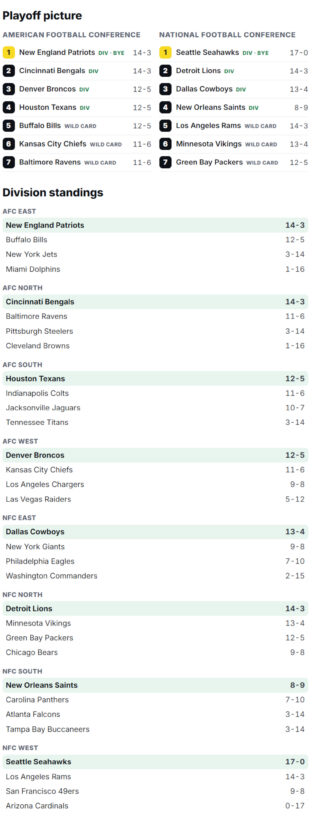
We have the New England Patriots winning the AFC East and winning the tiebreaker over the Cincinnati Bengals for the 1-seed in the AFC with a 14-3 record.
Below is the complete 2026 regular season projections.
Sources
- NFL: Final 2025 division standings
- New England Patriots: Franchise history and 2025 result
- New England Patriots: 2026 coaching staff
- New England Patriots: 2026 draft class
- New England Patriots: 2026 transactions
- New England Patriots: Eliot Wolf’s 2026 role
- AP: Seattle defeats New England in Super Bowl LX
- CBS Sports: 2026 AFC offseason review