



Jalen Hurts could have a great season in 2026.
He could throw for 4,000 yards. He could be an MVP candidate. He could win another NFC East title. He could even take the Eagles back to the Super Bowl.
It won’t matter.
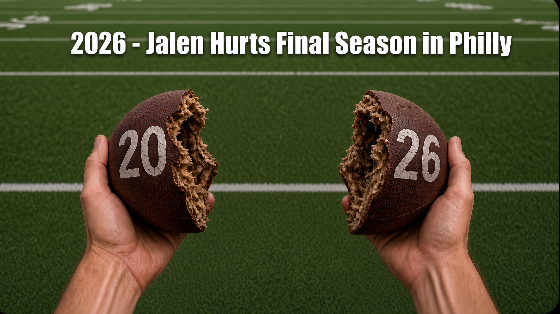
Jalen Hurts is playing his final season as the Philadelphia Eagles’ quarterback.
That sounds ridiculous on its face. Hurts is only 28. He has already taken the Eagles to two Super Bowls, won one, and was named Super Bowl LIX MVP. He owns one of the best winning percentages among active quarterbacks. Jeffrey Lurie publicly gushes about him. Howie Roseman defends him.
But that is precisely why the argument requires looking beyond wins, losses and quarterback statistics.
The question isn’t whether Hurts is good enough to play quarterback for the Eagles.
The question is whether the Eagles still trust Jalen Hurts enough to give him the power, money and organizational leverage that keeping him beyond 2026 will eventually require.
*Spoiler Alert* They don’t!
And once Jeffrey Lurie reaches that point with someone, history suggests the résumé doesn’t matter nearly as much as people think it does.
The Eagles Weren’t Sold on Hurts Before 2022
It is easy to rewrite history after Hurts’ brilliant 2022 season and pretend the Eagles always knew what they had.
They didn’t.
Entering that season, Philadelphia explored replacing him.
The Eagles contacted both Seattle and Houston about Russell Wilson and Deshaun Watson and also explored whether either quarterback would be willing to come to Philadelphia. Both quarterbacks possessed no-trade clauses, making their willingness essential to any deal. The Eagles’ interest in Wilson appears to have been particularly serious; subsequent reporting indicated Philadelphia made a viable offer, but Wilson would not waive his no-trade clause to come here. (inquirer.com)
Meanwhile, the Eagles preserved future draft capital in a way that gave them another avenue to replace Hurts if 2022 didn’t work.
This isn’t revisionism. At the time, Jeffrey Lurie publicly described the team’s commitment to the 23-year-old Hurts and then added, essentially, that nobody knew what the future would hold. Days later, Philadelphia converted some of its 2022 draft capital into a 2023 first-round pick. (inquirer.com)
Then Hurts forced their hand.
He nearly won MVP. The Eagles went to Super Bowl LVII. Hurts was spectacular against Kansas City.
Philadelphia rewarded him with a five-year, $255 million extension carrying a then-record $51 million annual average. It included $179.3 million in total guarantees, with $110 million fully guaranteed at signing. (nfl.com)
It was a franchise-quarterback contract.
But it was also a Howie Roseman contract.
Later deals for Justin Herbert and Joe Burrow pushed guarantees considerably higher. Herbert’s deal contained nearly $194 million in salary guarantees and Burrow’s more than $219 million. (cbssports.com)
The Eagles paid Hurts handsomely while structuring the back end in a way that preserved an eventual escape hatch.
At the time, that looked like prudent cap management.
Four seasons later, it looks much more important.
Something Changed After 2022
Here is where fact ends and reading the tea leaves begins.
The 2022 season changed the power dynamic between Jalen Hurts and the Philadelphia Eagles.
Call it confidence. Call it stubbornness. Call it an inflated ego if you want.
Hurts had just gone from a quarterback whose own team had considered replacing him to an MVP runner-up with a $255 million contract. He had nearly beaten Patrick Mahomes in the Super Bowl.
He was no longer trying to prove he deserved a voice, he had become convinced his voice deserved weight.
And 2023 is where the trouble becomes visible.
The Eagles promoted Brian Johnson to offensive coordinator after Shane Steichen left for Indianapolis. Johnson wasn’t simply another assistant coach. He had known Hurts and his family since Hurts was a child. He had been coached by Hurts’ father and had a decades-long relationship with the family.
That relationship wasn’t inherently a problem.
The blurred lines became the problem.
ESPN’s later reporting on the 2023 collapse described Sirianni, Johnson and Hurts as having visions for the offense that never completely aligned. Hurts increasingly searched for answers beyond the game plan when those lines of authority became unclear. (espn.com)
And then came Seattle.
The Seattle Play Matters More Than People Realized
Late in the Eagles’ December 2023 Monday night loss to Seattle, Hurts launched a deep pass toward A.J. Brown that was intercepted.
Nick Sirianni took the heat.
He publicly defended the decision and even explained that part of the thinking involved potentially drawing a pass-interference penalty.
Except that wasn’t the whole story.
Brown later acknowledged that he and Hurts had improvised. ESPN subsequently reported that Hurts and Brown had gone outside the intended script and described the episode as an example of Hurts deviating from what had been installed. (espn.com)
That distinction matters.
Jalen Hurts has never admitted to changing the play. This was his first example of lacking accountability for his actions on the field.
The head coach stood in front of the cameras and accepted responsibility for something his quarterback and star receiver had changed.
Two days later, Sirianni made another statement that was interpreted at the time primarily as a defense of Brian Johnson.
“This offense is my offense.”
Sirianni said criticism should come to him because Johnson merely called the plays within the offense Sirianni had built. (eagles.1rmg.com)
There was another audience for that statement.
Jalen Hurts.
Sirianni re-establishing the chain of command: This is my offense.
Not Brian Johnson’s.
And not Jalen Hurts’.
Johnson was fired after the season.
The conventional explanation was straightforward: the offense had become stale and the Eagles needed fresh ideas.
The implications go further.
Brian Johnson had become part of an authority problem. Whether intentionally or not, his relationship with Hurts created an environment in which the quarterback had an ally sitting between himself and the head coach. Firing Johnson eliminated that dynamic.
The Eagles didn’t fire Hurts. They couldn’t. He was insulated by his contract.
So they removed the person closest to him.
Then the Eagles Brought in an Outsider
Philadelphia’s next move was telling.
They hired Kellen Moore.
Moore had no longstanding relationship with Hurts and no deep personal history with Sirianni. Philadelphia was bringing in an outside offensive voice, and Sirianni publicly ceded significant control of the offense to him.
There would no longer be a question about whether the coordinator was Hurts’ guy or Sirianni’s guy.
He was the offensive coordinator.
Then the 2024 season started poorly.
Philadelphia stumbled into its Week 5 bye at 2-2, and what happened afterward might be the most important football development in this entire story.
The Eagles changed.
The offense increasingly ran through Saquon Barkley. The offensive line and running game became the identity. The defense became dominant with Cooper DeJean making his first start in week 6. Hurts was asked to protect the football, make selective throws, use his legs when necessary and stop trying to carry the offense every week.
ESPN’s retrospective on the championship season noted that the offense became substantially more Barkley-focused during the bye-week reconciliation between Hurts and Sirianni. (espn.com)
And consider this remarkable statistic: Pro Football Reference’s advanced charting credits Hurts with two RPO plays for the entire 2024 season — two pass attempts for eight yards.
TWO!

For a quarterback whose running ability and post-snap decision-making had once been defining features of the offense.
Philadelphia didn’t bench Jalen Hurts.
It narrowed his jurisdiction. They castrated him!
The Eagles reduced the number of decisions he had to make within the offense. Runs could still be adjusted based on defensive looks. Protections and appropriate audibles remained part of playing quarterback. But the offense increasingly became something Hurts was expected to execute rather than reinvent.
The result?
A championship.
Hurts played brilliantly when it mattered most and won Super Bowl MVP.
From the outside, that should have ended every debate.
Instead, the underlying problem returned almost immediately.
Kevin Patullo Inherited More Than an Offense
Kellen Moore left Philadelphia after the championship to become head coach of the New Orleans Saints.
Sirianni then promoted Kevin Patullo.
Patullo was not Brian Johnson. He had existing relationships with Eagles players, including Hurts.
But organizationally, Patullo was unmistakably Sirianni’s guy.
Their relationship went back to Indianapolis. Sirianni once said there wasn’t a decision he made in the building without Patullo. (espn.com)
That made Patullo’s job more difficult from the moment he became coordinator.
Brian Johnson had already been fired after one season. Now the quarterback was coming off a Super Bowl MVP performance under an outside coordinator and was being handed Sirianni’s longtime lieutenant.
The offense struggled badly in 2025.
Patullo was eventually fired.
But the April 1, 2026 ESPN report about what happened inside that offense was devastating because it went far beyond blaming the coordinator.
ESPN interviewed more than a dozen sources. Multiple team sources described Hurts as resistant to certain changes. He reportedly pushed back on increased under-center work, diverted from game plans and changed calls to a degree some inside the organization believed excessive. One source said Hurts “continually fights” playing under center. Another described “poor body language, not always bought in, not the most coachable.” (espn.com)
A source close to Hurts offered perhaps the most revealing observation of all: Hurts needed coaches willing to challenge him and had too many people around him who simply agreed with him.
The same ESPN report went backward through the history.
It described tension even between Hurts and Moore during the championship season. It revisited 2023 and the blurred authority involving Hurts, Johnson and Sirianni. It described organizational efforts to get Hurts to connect more effectively with coaches and teammates.
This wasn’t one anonymous complaint.
It was a pattern.
The ESPN Story Was a Message
ESPN did its own reporting. The Eagles officially declined to comment.
But when more than a dozen people are willing to discuss the same quarterback’s adaptability, communication, decision-making and coachability, that is not merely random gossip escaping a locker room.
People inside the organization were trying to reach Jalen Hurts.
They had run out of private ways to do it.
If direct conversations hadn’t worked, if coaching changes hadn’t worked, if narrowing the offense hadn’t worked, if bringing in outsiders hadn’t worked, and if respected people inside the building had already been used to help repair relationships, what was left?
The message became public.
Then Hurts responded.
Or, more accurately, he said he wasn’t responding.
June Changed Everything
On June 10, Hurts was given an opportunity to address ESPN’s reporting.
Asked whether he had requested the four-verticals call that ended Philadelphia’s 2025 playoff loss, a play, ESPN reported, he had recommended or suggested before Sirianni approved it — Hurts answered:
“Nah. No.”
Asked more broadly about responding to the ESPN report, Hurts said, “he had never asked for an opportunity to respond and would rather. Let it live and go do my job.” (inquirer.com)
Four days later came Joseph Santoliquito’s piece for Bleeding Green Nation.
That article cited people around Hurts who believed Philadelphia had not supported him publicly the way the organization had once rallied around Carson Wentz. Most conspicuously, Santoliquito explicitly wrote:
“Some around Hurts—not Hurts—feel…”
Those people were particularly bothered by suggestions that Hurts was difficult to coach. The article also raised the possibility that Hurts could be gone after the season and questioned whether he would even want to return to Philadelphia in 2027. (bleedinggreennation.com)
Maybe that was entirely independent.
You shouldn’t believe it was.
Hurts is famously private. ESPN itself describes him as maintaining a tight circle. He also happens to have earned a bachelor’s degree in public relations and later a master’s degree in human relations. (dailyjournalonline.com)
It is difficult to believe that people close enough to speak as Hurts’ camp would make such a pointed public case without Hurts knowing what was being communicated.
Hurts did respond to ESPN. He just didn’t do it directly.
And the substance of that response matters even more than the mechanism.
The message was effectively: You supported Carson Wentz when he was criticized. You didn’t support me.
That was an attempt to move the dispute from inside NovaCare to the court of public opinion.
In Philadelphia, of all places.
And that is where this stops being merely a football disagreement.
Because there is one thing Jeffrey Lurie’s history suggests he values more than almost anything else.
Accountability.
Chip Kelly Already Taught Us Where Lurie’s Line Is
The Chip Kelly era is essential to understanding how Jeffrey Lurie operates.
After consecutive 10-win seasons, Kelly wanted greater control.
Lurie gave it to him.
That decision marginalized Howie Roseman’s football authority and put personnel control in Kelly’s hands. Lurie later explained exactly why: if Kelly wanted those decisions, Lurie wanted Kelly accountable for them. (philadelphiaeagles.com)
That is critical.
Lurie was willing to sideline Howie Roseman, the executive with whom he has now built one of the strongest owner-GM partnerships in football, because he believed empowering Kelly gave Kelly the best opportunity to succeed.
Then Kelly made his moves.
The roster deteriorated. The Eagles went 6-9.
And following the loss that eliminated Philadelphia from playoff contention, Kelly stood in front of reporters and distanced himself from the personnel operation.
“I’m not the general manager,” Kelly said.
Technically, he wasn’t.
Practically, he had possessed final authority over the roster.
ESPN later reported that the press conference helped seal Kelly’s fate because Lurie viewed it as Kelly dodging accountability after insisting on that authority.
Kelly was fired the next day. (espn.com)
Weeks later, Lurie couldn’t have made his philosophy clearer:
Accountability would be the No. 1 feature of the organization.
And who would ultimately enforce that accountability?
Lurie himself. (philadelphiaeagles.com)
That wasn’t corporate filler.
It was a description of how he runs the Philadelphia Eagles.
Doug Pederson Learned the Other Rule
Doug Pederson offers a different example.
Pederson did something Chip Kelly never did.
He won Jeffrey Lurie a Super Bowl.
After the disastrous 2020 season, Pederson was initially expected to return. Reports on January 2 described his upcoming meeting with Lurie as essentially a formality. (inquirer.com)
Nine days later, he was fired.
What happened?
Their visions diverged.
Pederson wanted greater control over his coaching staff and wanted to promote from within, including Press Taylor. Lurie wanted outside voices and broader organizational changes. Reporting at the time described a coach who had spent years accepting organizational directives finally drawing a line over his staff. (inquirer.com)
And that was it.
Super Bowl ring or not.
Statue at the stadium or not.
Once Pederson’s vision and ownership’s vision could no longer coexist, Pederson was gone.
That is the second rule of Jeffrey Lurie’s Eagles.
The first is accountability.
The second is alignment.
Lurie will empower people. He will give them resources. He will even move powerful people out of their way.
But nobody gets to become a separate power center from ownership.
Talent buys influence in Philadelphia.
It does not buy sovereignty.
Why Sirianni and Roseman Survive
That helps explain why Howie Roseman and Nick Sirianni have survived situations that destroyed others.
Roseman is completely intertwined with Lurie’s organizational vision. Even after being stripped of power during the Kelly era, Roseman didn’t publicly wage war against ownership. He went away, reevaluated himself, returned, and eventually rebuilt his influence. In 2016, Roseman openly discussed examining his own failures rather than insisting everyone else was wrong. (philadelphiaeagles.com)
Sirianni operates similarly.
He has repeatedly accepted blame publicly.
When the 2023 offense failed down the stretch, he said it was his offense.
When coordinators have changed, he has adapted his role. After Lurie and Roseman altered the organizational structure around him, he has operated within it. Finally, the moment Lurie called him in to express his disapproval of his behavior towards Eagles’ fans, he apologized immediately in a press conference.
You can call that collaboration, or some may call it deference.
It’s really understanding who owns the Philadelphia Eagles.
The people who survive here ultimately remain aligned with Jeffrey Lurie and Howie Roseman.
Jalen Hurts has increasingly challenged that arrangement over-and-over again.
Listen to What Lurie Doesn’t Say
This offseason, Lurie was asked about Hurts.
His answer was overflowing with praise.
He said he loved Hurts. Called himself Hurts’ biggest fan. Praised his clutch ability, dedication and Super Bowl performances.
Then the contract question came.
Suddenly, the language changed. His body shifted. And his tone screamed annoyance.
“He’s in the middle of the new contract now.”
NFL sources told The Inquirer that Philadelphia had no plans to extend Hurts this offseason. (inquirer.com)
Howie Roseman has likewise publicly defended Hurts and called some of the criticism of him unfair.
But again: no commitment.
The compliments are abundant. The guarantees are not.
100% Compliments! Zero Commitments!
In the NFL, that distinction matters.
Teams tell you what they think with contracts.
The Contract Points Directly at 2027
Hurts’ contract looks enormous because it is enormous.
But by 2027, Philadelphia finally reaches a realistic exit ramp.
Under Spotrac’s current accounting, Hurts is scheduled for a roughly $42.1 million cap hit in 2027. A post-June 1 release designation under the current contract structure would leave approximately $42.7 million on Philadelphia’s 2027 cap and push another $24.3 million into 2028.
In other words, the 2027 charge would be only about $567,000 worse than simply keeping Hurts on the scheduled 2027 cap that year, with the remaining dead money pushed forward. (spotrac.com)
That’s ugly.
It is not prohibitive.
The Eagles would be paying a lot of dead money to make the change, but there is a massive difference between expensive and impossible.
Hurts also has a full no-trade clause, meaning a trade would require his cooperation.
If there isn’t a destination agreeable to both sides, Philadelphia has another route.
Release him.
2027 is the date.
And it lines up suspiciously well with what could be available next offseason.
The Eagles Don’t Need a Quarterback Today
The obvious objection to this entire theory is simple:
Fine. Replace Hurts with whom?
You don’t move on from a Super Bowl-winning quarterback without another quarterback.
Correct.
Which is why I believe the answer is the 2027 NFL Draft.
It is early. College football has not even determined who all of these prospects will become. Quarterbacks will rise. Quarterbacks will fall. Some highly regarded players will disappoint.
But the class is already being discussed as substantially deeper than the 2026 group, with Arch Manning, Dante Moore, CJ Carr and LaNorris Sellers among several prominent names already receiving significant NFL attention. (reuters.com)
The Eagles don’t need seven quarterbacks to maintain first-round grades.
They need one.
And Howie Roseman’s history tells us something else:
Having quarterbacks under contract has never stopped him from pursuing another one.
Having an extra first-round pick from the A.J. Brown trade enables Howie Roseman’s ability to make a trade in 2027.
Remember 2016
In March 2016, Philadelphia re-signed Sam Bradford.
Two years. $36 million.
$22 million guaranteed at signing.
Eight days later, the Eagles signed Chase Daniel.
Three years. $21 million.
Philadelphia now had two veteran quarterbacks under contract.
Doug Pederson publicly declared Bradford No. 1 and Daniel No. 2. (nfl.com)
Then the Eagles traded up. And then they traded up again.
They selected Carson Wentz No. 2 overall.
Roseman later explained the philosophy by pointing to Seattle’s willingness to sign Matt Flynn and still draft Russell Wilson.
The Eagles would keep addressing quarterback until they believed they had the right answer.
“You have to take shots,” Roseman said. (philadelphiaeagles.com)
That philosophy hasn’t disappeared.
If anything, the Eagles have become even more quarterback obsessed.
So don’t tell me Hurts’ contract means Philadelphia can’t draft his replacement.
They’ve already demonstrated the opposite.
They Love the Rookie-Contract Window
There is another reason the 2027 draft makes too much sense to ignore.
Look at Philadelphia’s two greatest recent teams.
The 2017 Eagles were constructed with Carson Wentz on his rookie contract.
The 2022 Eagles were constructed with Jalen Hurts on his rookie contract.
Both reached the Super Bowl.
When your quarterback costs a fraction of the veteran market, Roseman can spend everywhere else.
Elite offensive line. Elite defensive line. Receivers.
Secondary. Pass rushers. Depth.
The modern quarterback market is now marching toward and beyond $65 million annually. If Hurts plays well enough to justify another extension, the next negotiation isn’t going to become cheaper.
It will become significantly more expensive.
And this is where the “regardless of performance” part of the argument becomes important.
If Hurts plays poorly in 2026, the Eagles’ decision is easy.
If Hurts plays brilliantly, the decision actually becomes more complicated — but the underlying organizational problem doesn’t disappear.
A monster season gives Hurts more leverage.
A deep playoff run gives Hurts more leverage.
Another Super Bowl gives Hurts enormous leverage.
And if Lurie and Roseman already question whether Hurts accepts coaching, works within the structure they want, and takes sufficient accountability when things go wrong, why would they respond by giving him more control through another market-setting financial commitment?
You shouldn’t believe that they will.
“But Winning Fixes Everything”
Maybe.
Hurts could embrace Sean Mannion’s new offense, operate under center, use the motion and play-action concepts the Eagles want, stop freelancing, repair every strained relationship and light up the league.
Mannion is facing his own difficulties being in Philly. Philadelphia fans are known to sharpen the knives pretty early in a sports figure’s tenure in the city.
At that point, shouldn’t the Eagles simply move forward?
If this were exclusively a football problem, absolutely.
But you don’t believe it is anymore.
The Eagles have already changed coordinators.
They’ve changed structures.
They’ve given Hurts familiar coaches.
They’ve given him outside coaches.
They’ve expanded his freedom.
They’ve reduced his freedom.
They’ve built around his strengths.
They’ve tried to introduce concepts outside his comfort zone.
They’ve publicly defended him.
And according to extensive reporting, the same questions about authority, adaptability and communication continue resurfacing.
That is why 2026 doesn’t look like a traditional prove-it season.
A prove-it season asks:
Can you play well enough for us to keep you?
The Eagles are asking something different:
Can we get through one more season together before the contract and draft finally give us a way out?
Those are very different questions.
This Is About Jeffrey Lurie, Not Jalen Hurts’ Passer Rating
The mistake will be analyzing every Hurts performance this fall as a referendum on whether Philadelphia should extend him.
Three touchdowns? He’s staying.
Two interceptions? He’s gone.
That’s not what is happening.
This is about organizational control.
Chip Kelly demanded authority. Lurie gave it to him. When Kelly distanced himself from responsibility for the results, Lurie fired him.
Doug Pederson won a Super Bowl. When his vision for the organization diverged from Lurie’s, Lurie fired him.
Howie Roseman lost his power, accepted his place, rebuilt himself within Lurie’s structure and became more powerful than ever.
Nick Sirianni has survived because he understands where the final authority resides and repeatedly accepts responsibility publicly and bends-the-knee time-and-time again.
Now consider Jalen Hurts.
A quarterback who changed plays outside the script, whose offensive preferences have reportedly clashed with multiple coordinators, and whom organizational figures reportedly had to encourage to reconnect with coaches and teammates.
A quarterback who was directly contradicted by ESPN’s sourcing regarding the final play of the 2025 season and then publicly denied requesting it, and who said he wasn’t looking to respond to the broader story, followed days later by an article conveying grievances specifically from people around him or HIM.
Any one of those things can be dismissed.
Put them together and they form a pattern.
And Jeffrey Lurie has shown us before what happens when he believes accountability and organizational alignment have broken down.
Enjoy 2026, Because It’s the End
None of this diminishes what Jalen Hurts has accomplished in Philadelphia.
He helped produce one of the greatest quarterback seasons in franchise history.
He delivered an extraordinary performance in Super Bowl LVII.
Two years later, he finished the job.
He is a Super Bowl champion.
A Super Bowl MVP.
He has won an enormous number of football games.
Those facts don’t disappear because the relationship may be ending.
But Philadelphia sports history is littered with stars whose accomplishments didn’t make them untouchable.
And Eagles history under Jeffrey Lurie is particularly clear on one point:
Nobody is bigger than the organization.
Not Chip Kelly! Not Doug Pederson! Not Andy Reid!
Not Carson Wentz! Not Nick Foles! Not Donovan McNabb!
Not Howie Roseman when Lurie believed someone else needed his authority.
And especially not Jalen Hurts.
The public praise will continue this season.
Sirianni, Roseman and Jeff Lurie will praise him.
Hurts may play extremely well. The Eagles may win a lot of games.
Don’t confuse any of that with commitment.
Watch the contract. Watch the structure of the offense. Watch how much freedom Hurts has.
Watch the language when Lurie and Roseman are asked about 2027.
And above all, watch the quarterbacks in college football.
Because the Philadelphia Eagles are not spending 2026 deciding whether Jalen Hurts deserves to remain their quarterback.
They already know their answer.
Jalen Hurts is playing his final season in Philadelphia.
And starting in April 2027, Jeffrey Lurie and Howie Roseman will be in hot pursuit of the next one.
So if you are going to miss Jalen Hurts on the Eagles, enjoy his final season while it lasts.
But if you are happy this is his final season, Congratulations! Dreams do come true!