



Hard Work, or a Weak WR Room by Design?
Every training camp produces one player nobody saw coming. For the 2026 Philadelphia Eagles, that player is Darius Cooper, the undrafted second-year receiver out of Tarleton State, who has spent the last few weeks turning himself from camp afterthought into a legitimate name in the WR2 conversation.
Somewhere in Philadelphia’s decision to overhaul the receiver room this offseason, in the health issues that have hit that room in bunches, and in Cooper’s own personal grind, the truth is a mix of everything. But it’s worth separating the threads.
The setup: how this became a real conversation
For this exercise, a few things have to be true. DeVonta Smith occupies WR1 duties and he’s not part of the WR2 sweepstakes. Hollywood Brown and Elijah Moore, the offseason additions brought in for depth, are similarly not in the running for that specific job. Makai Lemon, the Eagles’ first-round rookie who was drafted with WR2 snaps in mind from day one, has effectively lost that runway, not through a lack of talent (but that could be true too), but lack of availability (100% true). And in a straight footrace with fellow depth piece Dontayvion Wicks, Cooper comes out ahead.
Take those as the premise, and the question becomes simple: is Darius Cooper actually good enough to start opposite DeVonta Smith, or is he just the last man standing in a receiver room that Howie Roseman didn’t build well enough this offseason?
What actually happened in camp
The bones of this story are not hypothetical, they’re playing out in real time at the NovaCare Complex. Philadelphia entered camp with a receiver room in transition: A.J. Brown demanded his freedom from Jalen Hurts, Hollywood Brown (bust) and Elijah Moore (sneaky good) were brought in as veteran additions, Dontayvion Wicks (old-man Shaq) arrived via an April trade with Green Bay, and Lemon (is a lemon) was the first-round investment (Madoff level scam) meant to be the long-term answer at WR2.
Then camp started, and the injuries piled up. DeVonta Smith went down with a hamstring issue. Britain Covey and Danny Gray were also sidelined. And Lemon (is a lemon), who’d already missed two weeks of OTAs with a hamstring problem, has more missed practices than targets in training camp. By the reporting in early August, Lemon had essentially missed a practice-and-a-half worth of true reps, and outlets covering the team began treating a Week 1 starting role for him as no longer likely. Philly Voice’s Jimmy Kempski put it directly: with Lemon banged up, the WR2 job was suddenly up for grabs, and if someone else were to win it, Wicks looked like the favorite.
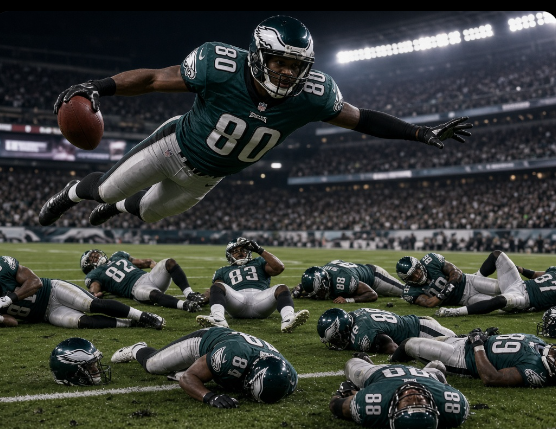
Cooper didn’t wait around for an invitation. With Smith and Lemon both out, he has kept making himself an option for Jalen Hurts, and beat reporters have noted his number 80 has been constantly noticeable in camp, and always for something good. Coaches and reporters alike have called him a “highlight machine” during this stretch, and he was singled out alongside Elijah Moore as one of the players who has earned first-team reps. In Philadelphia’s preseason opener, he backed it up on the field, catching six of seven targets for 82 yards and a touchdown.
None of that reads like a fluke. It reads like a player taking advantage of an opportunity that circumstance handed him — which is exactly where the “hard work vs. weak roster” question gets interesting, because both things are true at once.
The case that it’s Cooper, not the circumstances
Cooper’s path to this moment is not a product of the Eagles running out of options. He’s been building toward it for over a year. Undrafted out of a small FCS program, he made Philadelphia’s 53-man roster as a rookie in 2025 purely off camp performance, then stuck on the active roster through a shoulder injury and returned to contribute down the stretch (but cost the Eagles in the final game of the season). Jalen Hurts himself has praised him publicly, which matters in an offense where quarterback trust often determines who actually sees the football regardless of what the depth chart says.
Cooper’s own words frame this as an identity: “Coming from a smaller school, [as an] undrafted free agent, that’s kind of been my life for my whole football career… Really just staying humble, keeping my faith in everything like that and putting the work in, and God will handle the rest.”
That’s not the language of a guy who backed into a role. It’s the language of someone who has had to out-work more talented, more highly drafted teammates at every stop, and is doing it again now against Wicks and a rookie first-rounder.
The route-running detail matters too: reporters have specifically pointed to Cooper’s sharp, decisive cuts as giving Hurts a reliable, quick outlet in the passing game — a trait that’s schematically valuable in offensive coordinator Sean Mannion’s system, which is reportedly built around Hurts spreading the ball around more than in years past. That’s a skill, not a scheduling accident.
The case that the room is just thin
At the same time, it’s hard to ignore how much circumstance is doing the heavy lifting here. This is a Cooper who, entering the summer, was widely projected as Philadelphia’s fifth receiver at best — a special-teams and depth piece behind a room that included DeVonta Smith, two notable free-agent/trade additions, and a first-round rookie. Analysts pegged Cooper’s realistic ceiling as the No. 5 receiver job given how crowded the position was on paper.
What changed wasn’t Cooper suddenly becoming a different player — it’s that the depth chart above him fell apart. Smith got hurt. Lemon, the actual plan at WR2, has been identified as a fruit more than a football player. Cooper’s rise has coincided almost exactly with a run of injuries at the position, not with him beating healthy competition head-to-head in extended reps.
That raises a fair question about roster construction. Howie Roseman moved on from a true WR1 in Brown, leaning on a rookie from a bad draft class and a group of complementary veterans, who were discarded by their teams, rather than adding a proven, health-tested WR2. When that plan hit turbulence in the first two weeks of camp, the fallback wasn’t another established name — it was an undrafted second-year player who was a projected roster-bubble piece a few months ago. If the room had been built deeper or with more proven WR2 insurance, Cooper likely never sniffs this opportunity, regardless of how well he’s playing.
Where that leaves the debate
The honest answer is that this isn’t really an either/or. Cooper’s camp performance is real, and it’s been produced under real reps against real NFL competition. That’s not nothing! And it’s not automatically erased by the fact that Smith and Lemon weren’t on the field to take those reps themselves. But it’s also true that the opportunity itself exists because of decisions and health situations upstream of Cooper, not because he beat out a fully healthy Lemon or a bunch of competent wide receivers.
The more useful test comes once camp normalizes. When Smith returns and Lemon eventually gets healthy (don’t count on it), and Cooper is still commanding snaps and targets over Wicks with the room at full strength, that’s the strongest evidence this is talent, not vacancy. If his role shrinks back toward WR4/WR5 the moment the healthier, higher-pedigree names are back on the field, that tells you the injuries — not a permanent talent gap that favors Cooper — were doing most of the work. Camp stat lines and beat-writer buzz are notoriously unreliable predictors once the games start counting; Cooper’s next real test is whether Philadelphia’s coaching staff keeps him ahead of Wicks in September when everyone is actually available.
Right now, both stories are happening simultaneously: an undrafted grinder is validating the belief he’s had in himself since college, and a receiver room that lost its true WR1 and hasn’t gotten its top WR2 replacement on the field is more thin than the Eagles probably hoped it would be in August. Cooper’s rise doesn’t have to be a referendum on Roseman’s offseason to be legitimate, but it’s fair to say it wouldn’t be happening, at least not yet, without Roseman’s offseason creating the opening for it.
My personal view
Cooper starts Week One as WR2 and gets his opportunity for revenge against the Commanders. Wicks lacks the explosion or upside that Cooper has demonstrated in camp, and Lemon refuses to leave the fruit stand or the used car lot and actually play football!
Elijah Moore should be WR3 over Wicks, but that’s another article!