


















Bleed Green Sports declared the reset had begun, but the Philadelphia Eagles spent four quarters surviving injuries, replacement linemen and an offense that kept abandoning the defense in an attempt to avoid the reset becoming official team policy. They needed only eight more seconds of competence to escape London with an improbable victory, and Nick Sirianni could not find them.
Jake Elliott’s 48-yard field goal gave Philadelphia a 17-16 lead with eight seconds remaining. Jacksonville had no timeouts. A touchback would have placed the Jaguars at their own 35 and forced Trevor Lawrence to complete a meaningful sideline throw before Cam Little could attempt anything realistic.
Sirianni ordered a returnable kickoff instead. Ameer Abdullah caught the ball at the 8, ran 53 yards in seven seconds and gave Little one final snap from the Philadelphia 39. Little drilled the 57-yard field goal as time expired, sending the Jaguars to 4-1 and the Eagles home at 2-3 after a third consecutive loss.
The decision was indefensible because the warning had arrived on the first play of the game. Josh Cameron returned the opening kickoff 90 yards for an apparent touchdown before offsetting penalties erased it. Jeremiah Trotter Jr., one of Philadelphia’s best coverage players, was ejected during the confrontation that followed. Will Shipley, another coverage contributor, later left with a foot injury. Sirianni watched Jacksonville threaten to break the game open on the first kickoff, lost important pieces from the coverage unit and still placed the season in that unit’s hands on the final kickoff.
He accepted responsibility afterward. That admission was accurate and incomplete.
Philadelphia had already mishandled the possession that produced Elliott’s field goal. Dallas Goedert’s 17-yard reception created first-and-10 at the Jacksonville 34 with 25 seconds left, and the Jaguars used their second timeout. They had one remaining. Jalen Hurts threw incomplete on first down, then completed a seven-yard pass to Makai Lemon near the right sideline. Lemon allowed himself to be pushed out of bounds with 17 seconds left. A third-down run lost three yards, Jacksonville used its final timeout and Elliott kicked with eight seconds remaining.
If Lemon stays in bounds, Jacksonville almost certainly spends its final timeout. Philadelphia can run again, use its own timeout with three or four seconds left and let Elliott attempt the last meaningful play of the game. Sirianni defended the plan because he wanted to make the kick shorter. The Eagles ultimately kicked from 48 yards anyway, and the failure to control the clock created the kickoff decision that finished them.
Lemon deserves blame for losing awareness of the boundary. Hurts deserves blame for choosing a target moving toward the sideline when an uncovered option was available near the left hash. Sean Mannion and Sirianni deserve blame for calling and approving a concept that invited a rookie receiver toward the one place the football could not go.
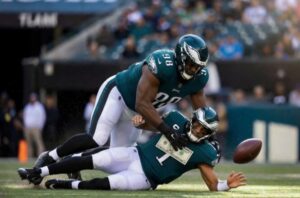
The catastrophe will dominate the conversation because it happened last. It should not erase the previous 59 minutes and 52 seconds. Philadelphia gained 232 yards while Jacksonville gained 408. The Eagles rushed for 22 yards on 18 carries, produced 13 first downs, went 0-for-2 on fourth down and held the ball for only 24:58. The offense scored three points after halftime and generated four three-and-outs across seven second-half possessions. (ESPN box score, Pro Football Reference box score)
Vic Fangio’s defense produced two goal-line stands, two Jalen Carter strip-sacks and Quinyon Mitchell’s first regular-season interception. Jacksonville reached the red zone three times and scored no touchdowns on those trips. The offense turned Mitchell’s takeaway into another punt and asked the defense to survive 35 minutes of football.
The Eagles lost because Sirianni botched the ending. They were in position to lose because Hurts and the offense remained incapable of producing a complete game.
Team Grade: D
The final score creates the illusion of a competitive team. The underlying numbers describe a defense dragging an offense across London while the head coach searched for one more way to sabotage the result.
Jacksonville held a 176-yard advantage, ran 68 plays to Philadelphia’s 59 and averaged 6.0 yards per play against the Eagles’ 3.9. Lawrence threw for 331 yards. Hurts produced 220, with 62 arriving when Darius Cooper turned one completion into a touchdown. The Eagles’ longest rush gained six yards, and their backs combined for 20 yards on 16 carries.
Philadelphia reached halftime with a 14-7 lead because the defense dominated the most important areas of the field. Carter repeatedly destroyed Jacksonville’s protection. Zack Baun ended the first half by dropping Bhayshul Tuten for a six-yard loss on fourth-and-goal. Mitchell intercepted Lawrence in the third quarter. Another goal-line stand protected the lead during the fourth.
The offense answered that work with three points in the second half. It gained five first downs after halftime and kept sending an exhausted defense back onto the field. The final drive deserves credit for creating Elliott’s attempt, although one competent possession cannot erase the pattern that made the comeback necessary.
The defense earned an A-level grade. The offense and late-game management earned failures. Special teams supplied productive returns and excellent punting before committing the decisive collapse. D is the compromise created by units playing entirely different sports.
Offensive Player Grades
Jalen Hurts: D
Hurts completed 21 of 40 passes for 220 yards, one touchdown and no interceptions. His 52.5 percent completion rate, 5.5 yards per attempt and 77.1 passer rating describe an inefficient afternoon that one 62-yard touchdown made respectable. He also rushed twice for two yards, removing the mobility that once forced defenses to account for every gap.
The touchdown to Cooper mattered. Hurts recognized single coverage, gave his receiver a chance and watched Cooper separate from the defense after the catch. He also delivered important third-down throws to Dontayvion Wicks during the first touchdown drive and found Goedert for 17 yards on the final possession.
Those plays belong in the evaluation. So do the other 19 incompletions.
The largest miss came late in the third quarter after Mitchell’s interception. Jacksonville sent an all-out pressure and lost Wicks down the left sideline. Hurts got the throw away off his back foot and overshot a receiver running alone toward the end zone. A completion would have put Philadelphia ahead 21-10 late in the third quarter, a margin that probably ends the game given how Fangio’s defense was playing. Pressure explains the difficult platform. A franchise quarterback still has to convert the throw that can decide the afternoon.
Hurts also accepted a delay-of-game penalty before that opportunity, failed to convert either fourth-down attempt and could not create anything with his legs. Philadelphia has now scored 10 second-half points during its three-game losing streak. A quarterback with Hurts’ salary, experience and authority cannot separate himself from that collapse.
The season numbers make the larger case. Hurts is completing 57.8 percent of his passes for 6.1 yards per attempt through five games. PFF currently gives him a 61.9 overall grade and a 59.9 passing grade, both 26th among 36 qualified quarterbacks. Public success-rate databases use different qualifiers, but one current model places him 30th at 37.7 percent and another places him 23rd of 27 at 38.7 percent. The exact ranking changes with the methodology. Every credible version places his efficiency near the bottom of the league. (PFF player grade, Pro Football Reference season log)
The final drive should have produced a victory. Sirianni and the coverage unit wasted it. Hurts still needed 40 attempts to generate 17 offensive points, and the defense carried the game long enough for him to make the missed Wicks throw irrelevant. He did not.
Will Shipley: C+
Shipley scored Philadelphia’s first touchdown by changing direction behind heavy personnel and following Willie Lampkin into the end zone. He also contributed as a receiver and on special teams before a foot injury ended his afternoon during the second quarter.
Five carries produced six yards, including the failed fourth-and-1 from the Jacksonville 37. The virtual measurement found him three inches short. Shipley was operating behind a reconstructed line against a defense determined to erase the run, and his injury makes a complete grade unfair. The touchdown and effort lift a limited performance slightly above average.
Dameon Pierce: D
Pierce inherited the backfield after spending most of the season outside Philadelphia’s active plan. He ran hard and finished with 14 yards on 11 carries, an average of 1.3. His five targets produced two receptions for minus-2 yards.
The blocking offered little help, and Mannion kept calling runs that Jacksonville had already solved. Pierce also failed to manufacture anything beyond what was blocked. The Eagles needed emergency competence and received emergency-level production.
Darius Cooper: A-
Cooper caught two passes for 71 yards and scored Philadelphia’s only explosive touchdown. He beat Montaric Brown at the line, tracked Hurts’ throw, cut across the field and finished a 62-yard play that gave the Eagles a 14-7 lead.
Three targets were an absurdly small reward for the only receiver who changed the geometry of the game. Cooper later committed an illegal block that erased field position on a Covey return, keeping the grade below an A. Mannion’s failure to revisit the matchup belongs to the coordinator.
Dontayvion Wicks: B-
Wicks caught five of eight targets for 63 yards. He converted two difficult third downs during the first touchdown drive, secured a 19-yard sideline catch in the third quarter and continued serving as Hurts’ most reliable target outside the numbers.
The deep miss will divide the blame. Wicks was uncovered and had room to finish the game’s biggest offensive play. Hurts’ throw carried too far, while Wicks appeared to lose speed as he located the ball. Better timing from either player creates a touchdown. The rest of Wicks’ afternoon supplied enough value to remain above average.
Makai Lemon: D+
Lemon caught five passes for 43 yards and produced an 18-yard conversion after Mitchell’s interception. He worked through contact, found useful space underneath and looked capable of handling a growing role.
His final reception changed the game. With Jacksonville holding one timeout and Philadelphia already inside Elliott’s range, Lemon had to surrender himself in bounds. He instead drifted toward the sideline and allowed the clock to stop at 17 seconds. The coaches and quarterback share responsibility for placing him there. Situational awareness still belongs to the player carrying the football.
Dallas Goedert: B
Goedert returned from his knee injury and caught six passes for 38 yards on nine targets. His 17-yard reception on the final drive moved Philadelphia to the Jacksonville 34 and should have created the conditions for a walk-off field goal.
The average of 6.3 yards per catch reflects a passing game trapped near the line of scrimmage. Goedert gave Hurts a dependable answer and blocked through a difficult assignment. His return stabilized a position that had offered very little during the previous two weeks.
Zach Ertz: F
Ertz received two targets and caught neither. His return to the organization produced no offensive value, and the Eagles never found a useful role for him behind Goedert.
The assignment was limited, but a veteran elevated for a depleted offense has to provide something. Ertz finished with zero catches while Philadelphia searched for one additional first down throughout the second half.
Offensive Line: C+
Jordan Mailata and Tyler Steen were the only remaining Week 1 starters. Willie Lampkin made his first career start at left guard, practice-squad promotion Jake Majors started at center and rookie Markel Bell replaced the retired Lane Johnson at right tackle. Steen also missed part of the game with a shoulder injury.
That group allowed one sack on 41 dropbacks and survived Jacksonville’s pressure better than expected. Bell produced encouraging pass-protection snaps, and Lampkin delivered the key block on Shipley’s touchdown. The line also committed mistakes, including poor shotgun snaps from Majors, and created almost no movement in the running game. Twenty-two rushing yards prevent an inflated grade. The circumstances make the performance respectable.
Defensive Player Grades
Jalen Carter: A+
Carter played the best game of any Eagle this season. He recorded five tackles, two sacks, three tackles for loss, a pass defended and two forced fumbles. Both fumbles were recovered by Jacksonville, keeping an extraordinary performance from producing the turnovers it deserved.
He wrecked the first half from multiple alignments, chased Lawrence out of structure and helped hold Jacksonville’s running backs near three yards per carry. Carter supplied the dominant interior performance Philadelphia has been waiting for. The offense and head coach wasted it.
Zack Baun: A
Baun returned from the concussion protocol and immediately became the defense’s stabilizer. He led Philadelphia with 11 tackles, added a tackle for loss and repeatedly forced Lawrence to speed up his decisions.
His finest snap came with one second left in the first half. Jacksonville pitched to Tuten on fourth-and-goal from the 1, and Baun read the play immediately before dropping the runner at the 7. That stop preserved a seven-point halftime lead and completed a goal-line stand that should have defined the game.
Quinyon Mitchell: A-
Mitchell broke up a potential touchdown late in the second quarter and intercepted Lawrence during the third. The interception was his first in a regular-season game, and it gave Philadelphia possession while protecting a four-point lead.
He briefly left after making the diving catch, then returned. Jacksonville avoided testing him consistently because the matchup offered easier answers elsewhere. Mitchell played winning football and watched the offense punt away his takeaway.
Riq Woolen: B
Woolen competed throughout the afternoon and had strong coverage on Parker Washington’s 27-yard touchdown. Washington made an exceptional one-handed catch while falling into the end zone on fourth-and-5. Good coverage can still lose to a better play.
Lawrence threw for 331 yards, so no member of the secondary receives immunity. Woolen challenged his assignments and forced tight-window throws. His performance belonged among the defense’s stronger efforts.
Cooper DeJean: B-
DeJean recorded 10 tackles and two tackles for loss, providing important support against the run. He attacked the football and remained one of Fangio’s most dependable open-field defenders.
Josh Cameron escaped him on a 32-yard catch-and-run during the third quarter, and Jacksonville found completions in his area. The missed opportunity lowers the grade. His work near the line of scrimmage remained valuable.
Andrew Mukuba: D+
Mukuba attacked the opening play-action pass too aggressively and lost his leverage on Washington’s 51-yard touchdown. Washington caught a short crossing route, ran away from Mukuba’s angle and crossed the entire secondary without being touched again.
The failure was shared by several defenders, although Mukuba supplied the first error. He recovered enough to avoid another explosive mistake. One touchdown accounted for most of the damage attached to his afternoon.
Special Teams Grade: F
Britain Covey returned three kickoffs for 92 yards and four punts for 42. Braden Mann averaged 50.5 yards across six punts, placed two inside the 20 and repeatedly forced Jacksonville to travel a long field. Elliott made both extra points and converted the 48-yard field goal that should have won the game.
The final kickoff swallowed every positive contribution. Abdullah gained 53 yards in seven seconds against a unit that needed one ordinary tackle. Jonathan Jones eventually stopped him at the Philadelphia 39, exactly where Little’s extraordinary range became decisive.
Sirianni created the risk. Michael Clay’s coverage unit turned it into a loss. The opening return touchdown that disappeared through offsetting penalties had already exposed the danger. Repeating the invitation with eight seconds left converts a full afternoon of useful special-teams work into a failure.
Sean Mannion: D-
Mannion faced an ugly personnel problem. Barkley, DeVonta Smith, Hollywood Brown, Johnson, Landon Dickerson and Drew Kendall were unavailable. Shipley left during the first half, and Steen missed snaps after halftime. Any evaluation that ignores those losses becomes dishonest.
The coordinator still directed an offense that gained 232 yards and scored three second-half points. Philadelphia ran for 22 yards, continued wasting early downs on a ground game producing 1.2 yards per carry and failed to create consistent pressure answers. Cooper caught a 62-yard touchdown, then saw one more target. The offense produced four three-and-outs after halftime while Fangio’s defense kept manufacturing another chance.
Mannion deserves credit for the final drive and for several aggressive third-down concepts during the first half. The grade reflects the entire game. His offense keeps losing its answers after halftime, and three consecutive losses have created 10 total second-half points.
Vic Fangio: A-
Fangio held Jacksonville to 19 points despite his defense spending 35:02 on the field. Two of those points-producing possessions were field goals, including the walk-off kick created entirely by the return. His unit produced two goal-line stands, forced an interception and created two additional fumbles that Jacksonville recovered.
Lawrence threw for 331 yards and Washington scored twice from outside the red zone. The explosive plays prevent a perfect grade. Fangio still constructed a winning plan with Jonathan Greenard inactive and Jalyx Hunt injured before halftime. The defense gave Sirianni and Hurts more than enough support.
Nick Sirianni: F
Sirianni made two late decisions, and either one working properly sends Philadelphia home with a victory.
The first failure began at the Jacksonville 34 with 25 seconds left. The Jaguars had one timeout. Philadelphia could have forced Jacksonville to spend it, run again and use its own timeout to position Elliott for the last snap. Sirianni pursued extra yardage through the air, watched an incompletion stop the clock and then watched Lemon go out of bounds. He defended that approach Monday because he wanted to improve the field-goal percentage.
The explanation collapses under the result. Elliott made a 48-yard field goal, the same type of attempt Philadelphia was already positioned to create without preserving time for Jacksonville. A coach managing the entire game must weigh field position against possession and clock. Sirianni protected the kick while exposing the outcome.
The second failure finished the job. A touchback would have given Jacksonville the ball at its own 35 with eight seconds and no timeouts. Lawrence would have needed a completion near the boundary, enough yardage to reach Little’s range and a receiver capable of getting out before time expired. Sirianni chose the returnable kick because he wanted the play to consume time.
That logic required trusting a depleted coverage unit that had already allowed a 90-yard touchdown erased by penalty. It also gave Abdullah the opportunity to create field position without requiring Lawrence to complete anything. The return consumed seven seconds and moved 53 yards. It accomplished the clock objective while destroying the field-position objective.
Sirianni told the locker room that he lost the game. He was right. Accepting blame is the beginning of accountability, while repeatedly surviving the same category of mistake turns the admission into routine maintenance.
Player of the Game: Jalen Carter
Carter overwhelmed Jacksonville’s offensive line and changed possessions without receiving the statistical reward of recovered fumbles. Two strip-sacks, three tackles for loss and constant disruption gave Philadelphia control of a game its offense could not sustain.
The Eagles needed their most talented defender to dominate. He did. His performance deserved a victory and received another lesson in organizational waste.
Scapegoat of the Game: Nick Sirianni
Sirianni controls the situational plan, approves the final offensive sequence and decides the kickoff strategy. Every road led back to the head coach before Abdullah ever touched the football.
Hurts played poorly, Lemon lost awareness and the coverage unit failed. Sirianni placed all three in positions where their weaknesses could decide the game. His job is to reduce those risks. He multiplied them.
Top Five Eagles
- Jalen Carter: A+. Carter controlled the line of scrimmage and produced the most dominant defensive performance of Philadelphia’s season.
- Zack Baun: A. Baun returned with immediate command, led the team in tackles and delivered the first-half goal-line stop.
- Quinyon Mitchell: A-. Mitchell erased a touchdown, secured his first regular-season interception and returned after getting hurt on the play.
- Darius Cooper: A-. Cooper created Philadelphia’s only explosive score and punished the single coverage Mannion stopped targeting.
- Braden Mann: A-. Mann averaged 50.5 yards, controlled field position and performed his assignment cleanly throughout the afternoon.
Honorable Mention: Dallas Goedert. Goedert gave Hurts a stable underneath target and created the field position that should have allowed Philadelphia to end the game on Elliott’s kick.
Bottom Five Eagles
- Nick Sirianni: F. Sirianni mishandled the final offensive sequence and selected the one kickoff strategy capable of creating an immediate loss.
- Jalen Hurts: D. Hurts missed 19 throws, failed to punish the busted coverage on Wicks and directed another offense that disappeared after halftime.
- Sean Mannion: D-. Mannion produced no second-half counterpunch and kept returning to a running game Jacksonville had eliminated.
- Makai Lemon: D+. Lemon made useful catches before one boundary mistake preserved the seconds Jacksonville used to win.
- Kick coverage: F. The group allowed two catastrophic returns, received a penalty reprieve on the first and received no rescue on the last.
Final Word
Sirianni will absorb the loudest criticism because the final error was his call. He deserves it. An NFL head coach cannot watch a kickoff return threaten a touchdown on the opening snap, lose important coverage players and then create the same test with eight seconds protecting a one-point lead.
The organization cannot allow that mistake to become camouflage for Hurts. He completed barely half his throws, produced 5.5 yards per attempt and missed the touchdown that could have made every clock-management debate irrelevant. Philadelphia pays him to punish the defense when one receiver is abandoned. Wicks ran alone and the ball landed beyond him.
The defense produced the performance this roster has been waiting for. Carter dominated, Baun controlled the middle, Mitchell finally secured his interception and Fangio’s group defended two goal-line possessions without surrendering a point. That unit provided enough football to beat a 4-1 team while missing important players.
Sirianni, Mannion and Hurts gave it away in different stages. Mannion failed to build a second-half offense. Hurts failed to complete the decisive throw. Sirianni failed to control the final 25 seconds and then selected the wrong kickoff. Their mistakes connected cleanly enough to turn Elliott’s apparent game-winner into a setup for someone else’s celebration.
Philadelphia flew to London hoping to avoid the reset becoming official. The defense showed up in London without bringing their baggage, while the offense and head coach carried their baggage through customs and displayed during the game.