




Updated: September 4th 2026. The season recap covers 2025; personnel sections look ahead to 2026. Includes Predictions, Projections and Compete Standings
Leadership and Coordinators
- Owner: Steve Bisciotti Baltimore’s majority owner since 2004 remains the organization’s strategic backstop. After a rare losing season, Bisciotti approved the first head-coaching change in nearly two decades while retaining the front-office structure.
- Decision Maker: Eric DeCosta Executive Vice President & General Manager DeCosta has final authority over personnel, contracts and the draft. His 2026 mandate is to restore a championship roster around Lamar Jackson while helping a new coaching staff refresh schemes without dismantling the club’s core.
- Head Coach: Jesse Minter Minter succeeds John Harbaugh and brings a modern, multiple defensive background. His immediate task is to restore weekly consistency and preserve the physical identity that has long defined Baltimore.
- Offensive Coordinator: Declan Doyle Doyle inherits an offense still built around Jackson’s stress on defenses and Derrick Henry’s downhill force. The priority is marrying efficiency with answers against pressure and late-game situations.
- Defensive Coordinator: Doug Mallory Mallory is charged with coordinating Minter’s flexible pressure-and-coverage system. A deeper edge group gives him more ways to affect quarterbacks without exposing the secondary.
- Special Teams Coordinator: Anthony Levine The former Ravens special-teams leader takes over a unit with unusually high organizational importance. Rookie punter Ryan Eckley creates a consequential transition at a specialist spot.
2025 Season Recap
Baltimore’s 8–9 finish and first missed postseason since 2021 represented a striking underachievement for a roster that entered the year with Super Bowl expectations. The season began with a 41–40 collapse in Buffalo after the Ravens led by 15 in the fourth quarter, an early warning that talent would not consistently translate into closed-out games. Injuries compounded the problem. Lamar Jackson’s hamstring issue interrupted the offense’s rhythm, and Baltimore stumbled to 1–5 before mounting a five-game winning streak that briefly returned it to first place.
The offense remained dangerous enough to score 424 points, second in the division, because Jackson’s improvisational threat, Derrick Henry’s punishing run style and Zay Flowers’ separation could still tilt matchups. Henry remained the offense’s stabilizer, while Flowers gave the passing game a reliable creator at multiple levels. Yet the unit too often operated in extremes. Protection and execution deteriorated against better fronts, turnovers arrived at damaging moments, and the passing game lacked dependable counterpunches when opponents crowded the middle or forced Baltimore into obvious dropback situations.
Defensively, the Ravens allowed 398 points. The unit produced stretches of authoritative football, but it was not consistently the controlling group Baltimore expected. Kyle Hamilton remained the movable centerpiece, Roquan Smith organized the middle, and Nnamdi Madubuike supplied interior disruption when healthy. Still, breakdowns in coverage and uneven edge pressure made the defense vulnerable to explosive plays. The early loss at Kansas City, played amid mounting injuries, illustrated how quickly the structure could unravel when the front failed to dictate terms.
The season’s defining feature was its oscillation. Baltimore recovered from the 1–5 start to reach 6–5, then lost decisively to Cincinnati on Thanksgiving. A late push created a winner-take-all Week 18 game at Pittsburgh, but the Steelers prevailed and claimed the division. Baltimore’s 3–3 AFC North record kept the club alive, but it did not provide the edge needed to overcome the early deficit. Missing the playoffs with a positive point differential underscored the central failure: the Ravens were competitive in aggregate but unreliable in decisive moments.
The positive point differential explains why the season did not feel like a conventional teardown. Baltimore remained capable of dominant stretches, yet its worst football arrived at leverage points: fourth-quarter defense, protection breakdowns and possessions immediately following momentum swings. Special teams, traditionally a source of hidden-yardage advantage, was not consistently decisive enough to cover those flaws. The Ravens were better than their record in some predictive measures but entirely responsible for the record they earned.
The aftermath produced a major organizational reset. Harbaugh’s long tenure ended, Minter arrived, and all three coordinator positions changed. DeCosta’s response was aggressive but recognizably Ravens-like: invest in the offensive line, add pass-rush depth and draft for size, toughness and special-teams value. The 2025 season therefore matters less as evidence of a depleted core than as a warning about execution. Jackson, Henry, Hamilton and Smith still define a contender-level nucleus. The 2026 question is whether new voices can turn that talent back into situationally sound football before another prime year of the quarterback’s career is lost.
2025 Division Standing
- 1. Pittsburgh Steelers — 10–7 (5–1 division) — Lost WC PF: 397 · PA: 387
- 2. Baltimore Ravens — 8–9 (3–3 division) — Missed Playoffs. PF: 424 · PA: 398
- 3. Cincinnati Bengals — 6–11 (3–3 division) — Missed Playoffs PF: 414 · PA: 492
- 4. Cleveland Browns — 5–12 (2–4 division) — Missed Playoffs PF: 279 · PA: 379
Baltimore finished second. Its split division record kept the Week 18 title path open, but losing the finale to Pittsburgh left the Ravens two games back and outside the postseason.
Notable 2026 Player Additions
- EDGE Trey Hendrickson (free agency, Cincinnati Bengals) Baltimore imported an accomplished division rival to provide the proven edge finisher the defense lacked. His age and workload warrant monitoring, but his rush craft should create cleaner opportunities for the interior front.
- G John Simpson (free agency, New York Jets) Simpson returns to Baltimore as a familiar, powerful interior blocker. He raises the floor of a line being reshaped for the Jackson–Henry run game.
- S Jaylinn Hawkins (free agency, New England Patriots) Hawkins adds veteran range and special-teams utility, allowing the staff to vary Hamilton’s alignment without thinning the back end.
- TE Durham Smythe (free agency, Chicago Bears) Smythe supplies blocking experience and formation flexibility. His value will be clearest in heavy personnel and protection packages rather than raw receiving volume.
- DL Calais Campbell (free agency) Campbell’s return adds length, run defense and veteran leadership. At 39, he is a role player rather than an every-down answer, but his situational impact can still be meaningful.
- C Ethan Pocic (free agency, Cleveland Browns) Pocic was added during camp to stabilize an unsettled center picture. His starting experience gives Baltimore insurance while the younger linemen develop.
Notable 2026 Player Losses
- C Tyler Linderbaum (Las Vegas Raiders) Losing an elite movement center removes a defining feature of Baltimore’s run game and helps explain the additions of Pocic, Danny Pinter and interior draft depth.
- TE Isaiah Likely (New York Giants) Likely’s receiving explosiveness gave Baltimore a second seam-stretching tight end. His exit places more burden on Mark Andrews and makes the two drafted tight ends immediately relevant.
- FB Patrick Ricard (New York Giants) Ricard’s blocking, formation flexibility and understanding of Baltimore’s run game leave a demanding role to replace.
2026 Draft Class
- Round 1, Pick 14 — G Vega Ioane, Penn State A powerful, athletic guard with the temperament for Baltimore’s run game, Ioane has moved smoothly into the starting right-guard role and should improve pocket firmness.
- Round 2, Pick 45 — EDGE Zion Young, Missouri Young brings length, explosiveness and a high-effort profile. He can begin in a pass-rush rotation while developing counters and run-game discipline.
- Round 3, Pick 80 — WR Ja’Kobi Lane, USC The 6-foot-4 target adds catch-radius and red-zone size to a smaller receiver room. Winning against NFL press coverage will determine how quickly he becomes a full-time option.
- Round 4, Pick 115 — WR Elijah Sarratt, Indiana Sarratt is a competitive possession target with useful route feel and contested-catch toughness. He can compete for chain-moving snaps immediately.
- Round 4, Pick 133 — TE Matt Hibner, SMU Hibner’s receiving growth and special-teams background fit Baltimore’s preference for versatile tight ends. He projects first as a complementary piece.
- Round 5, Pick 162 — CB Chandler Rivers, Duke Rivers’ 4.40 speed and short-area quickness suit nickel coverage. Size limitations make tackling and matchup deployment important.
- Round 5, Pick 173 — TE Josh Cuevas, Alabama Cuevas offers receiving experience and developmental upside after a productive final college season. A prior foot injury is part of his evaluation.
- Round 5, Pick 174 — RB Adam Randall, Clemson The converted receiver is a 220-pound multipurpose runner with receiving and return experience. His versatility could earn a game-day role behind Henry.
- Round 6, Pick 211 — P Ryan Eckley, Michigan State The 2025 Big Ten Punter of the Year averaged 48.5 yards and brings legitimate field-position ability. He enters with a clear chance to win the job.
- Round 7, Pick 250 — DT Rayshaun Benny, Michigan Benny is an experienced interior defender whose leverage and toughness fit early-down rotation work.
- Round 7, Pick 253 — G Evan Beerntsen, Northwestern Beerntsen offers extensive right-guard experience across two programs. His immediate route is through developmental depth and special-teams protection units.
2026 Spotlight Watch
- Hot Seat — Eric DeCosta DeCosta retained control after an 8–9 season and selected the staff and personnel for Baltimore’s reset. The roster now must return to the playoffs and look dependable in decisive moments.
- Breakout Watch — Teddye Buchanan Buchanan passed his physical and came off the PUP list after losing his rookie season to injury. His range and opportunity could make him a three-down complement to Smith if he stays healthy and processes play action consistently.
- Bust Watch — Trey Hendrickson Hendrickson remains an accomplished edge finisher, but he was limited to seven games in 2025 and required core-muscle surgery. Baltimore needs him available for a full season rather than managing another interrupted year.
- Team Superstar — Lamar Jackson Jackson remains the player around whom every opponent’s plan bends. His combination of rushing gravity, arm talent and creation outside structure defines Baltimore’s ceiling.
Predictions
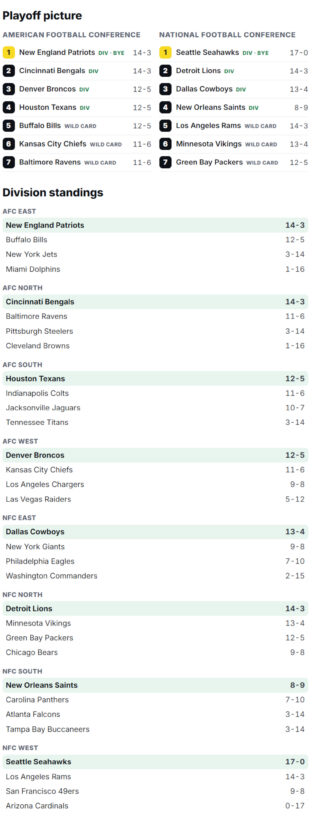
We have Baltimore returning to the playoffs in 2026 by going 11-6, good enough for the 7th seed in a top-heavy AFC. They are projected to be the 2nd place team in the AFC North, 3 games behind the Bengals.
Below is the complete 2026 regular season projections.