



Leadership and Coordinators
- Owner: Arthur M. Blank — Owner and Chairman Blank ordered a complete football leadership reset after Atlanta missed the playoffs for an eighth consecutive season. He placed franchise quarterback Matt Ryan above the general manager and head coach to create a single line of accountability.
- Decision Maker: Matt Ryan — President of Football Ryan holds final decision authority over the football operation, with general manager Ian Cunningham reporting to him. The franchise icon is responsible for aligning roster construction, coaching and quarterback development.
- Head Coach: Kevin Stefanski Stefanski arrives with a reputation for organized offense and adaptable game planning. His first Atlanta team must resolve an unusual quarterback situation while preserving an offense built around Bijan Robinson.
- Offensive Coordinator: Tommy Rees Rees reunites with Stefanski and will help install a play-action and movement-based system. His job is to create efficient answers for whichever quarterback starts without reducing Robinson’s central role.
- Defensive Coordinator: Jeff Ulbrich Ulbrich returns after the defense showed meaningful front-seven progress but allowed 401 points. Better early-down control and fewer coverage breakdowns are required.
- Special Teams Coordinator: Craig Aukerman Aukerman takes over a unit with new specialists Nick Folk and Jake Bailey. Reliability in the kicking game matters for a team that played a large number of one-score contests.
2025 Season Recap
Atlanta’s 2025 season produced two contradictory conclusions. The Falcons were eliminated from playoff contention at 4–9 and appeared headed toward another dispiriting finish. They then won their final four games, reached 8–9 and finished in a three-way tie for first place in the NFC South. Carolina claimed the division through the tiebreaker, leaving Atlanta outside the postseason for an eighth consecutive year. The late rally showed that the roster still had competitive strength, but it came too late to save head coach Raheem Morris or general manager Terry Fontenot.
The season turned on quarterback instability. Michael Penix Jr. entered the year as the starter and flashed the arm talent that made him Atlanta’s long-term plan. He also struggled with consistency before a season-ending knee injury forced Kirk Cousins back into the lineup. Cousins went 5–2 over his final seven starts and guided the four-game closing streak, but the broader arrangement never provided the clarity Atlanta needed. The Falcons spent too much of the year reacting to quarterback health and form instead of building continuity.
Bijan Robinson remained the offense’s undeniable center. He carried 287 times for 1,478 yards, averaging 5.2 yards per attempt, and consistently created more than the blocking initially offered. Robinson’s patience, contact balance and receiving ability allowed Atlanta to survive inefficient stretches elsewhere. He was equally dangerous on designed runs, checkdowns and routes from the slot. Defenses knew he was the primary problem and still struggled to keep him from controlling games.
Drake London gave Atlanta a physical boundary target when healthy, and Kyle Pitts remained a matchup piece in the middle. Injuries and inconsistency throughout the receiver room, however, made the passing game too dependent on London’s availability. The offense scored 353 points—well behind the league’s better units—and had difficulty sustaining rhythm when negative plays took Robinson out of the plan.
The defense offered more encouraging building blocks. Young edge players Jalon Walker and James Pearce Jr. added speed to a pass rush that had lacked it for years, while Jessie Bates III remained the secondary’s organizer and most dependable playmaker. Kaden Elliss supplied versatile pressure and tackling from linebacker. Atlanta could create disruptive stretches, but it did not maintain coverage discipline or run defense consistently enough. The 401 points allowed explain why the team could not turn Robinson’s elite season into a winning record.
The Falcons’ uneven division performance mirrored the larger season. They finished 3–3 against NFC South opponents and closed with a 19–17 win over New Orleans, a result that completed the four-game streak but could not alter the tiebreaker. Earlier losses had already surrendered control. With Carolina and Tampa Bay also finishing 8–9, one additional clean performance anywhere on the schedule would have ended Atlanta’s postseason drought.
Blank responded within hours of the finale, dismissing Morris and Fontenot. The decision reflected more than the 2025 record. Atlanta had repeatedly entered seasons expecting to contend in a forgiving division and repeatedly fallen short. Hiring Ryan as president of football changed the power structure, while Stefanski and Cunningham brought new voices beneath him.
The 2026 offseason continued that reset. Cousins was released, but Penix’s recovery created the need for another credible starting option, leading to Tua Tagovailoa’s arrival. Atlanta also changed the receiver room, added veteran tackle help and replaced departing linebacker and backfield production. The roster still contains a strong offensive identity because Robinson can anchor almost any system. The question is whether the new leadership can supply the quarterback stability and defensive consistency that the previous regime never sustained.
2025 NFC South Standing
- 1. Carolina Panthers — 8–9 (3–3 division) — Lost WC PF: 311 · PA: 380
- 2. TB Buccaneers — 8–9 (3–3 division) — Missed Playoffs PF: 380 · PA: 411
- 3. Atlanta Falcons — 8–9 (3–3 division) — Missed Playoffs PF: 353 · PA: 401
- 4. NO Saints — 6–11 (3–3 division) — Missed Playoffs PF: 306 · PA: 383
Atlanta matched Carolina and Tampa Bay in overall and division record but lost the multi-team tiebreaker. The four-game finish created optimism, yet the negative 48-point differential showed why leadership viewed structural change as necessary.
Notable 2026 Player Additions
- QB Tua Tagovailoa Tagovailoa gives Stefanski an experienced, accurate starter while Penix works back from knee surgery. His anticipation can make the play-action and quick-game portions of the offense efficient.
- OT Jawaan Taylor Taylor brings extensive starting experience and strengthens the right side of a line responsible for keeping the quarterback clean and maximizing Robinson’s runs.
- WR Jahan Dotson Dotson adds vertical speed and route quickness to a receiver room that needed alternatives to London. Atlanta must help him turn flashes into steadier weekly production.
- RB Brian Robinson Jr. Robinson supplies a physical complement to Bijan Robinson after Tyler Allgeier’s departure. His downhill style can handle short-yardage and closing work.
- S Sydney Brown (trade, Eagles) Brown is an explosive, aggressive safety who can play in the box or cover ground from depth. Pairing him with Bates gives Ulbrich greater disguise flexibility.
- EDGE Samson Ebukam Ebukam adds veteran speed and effort to a young pass-rush rotation. He can help manage the workload of Walker, Pearce and the other developing edge defenders.
- QB Cooper Rush Rush is penciled in as the 3rd string QB for the Falcons, but will end up being the starter week one due to injuries to both Tua Tagovailoa and Michael Penix Jr.
Notable 2026 Player Losses
- QB Kirk Cousins Cousins stabilized the team after Penix’s injury and went 5–2 in his final seven starts. His release cleared the way for a different quarterback plan but removed a proven veteran who understood the locker room.
- RB Tyler Allgeier Allgeier provided tough, dependable work behind Robinson and finished his Atlanta career with 2,876 rushing yards. Brian Robinson now assumes the complementary power role.
- LB Kaden Elliss Elliss started every game over three seasons and produced 380 tackles with 12.5 sacks. His communication, pressure ability and snap volume leave a substantial hole.
- WR Darnell Mooney Mooney’s speed stretched coverage even when targets were inconsistent. Dotson and rookie Zachariah Branch must restore that spacing.
- WR KhaDarel Hodge Hodge contributed as a reserve receiver and special-teams player. His departure is part of a broader reset behind London.
- K Zane Gonzalez Gonzalez made 19 of 22 field goals in 2025, including two game-winners. Folk takes over a position where steadiness was already established.
2026 Draft Class
- Round 2, Pick 48 — CB Avieon Terrell, Clemson A competitive, instinctive corner who joins his brother A.J. Terrell in Atlanta. His quickness and willingness to tackle fit inside or outside.
- Round 3, Pick 79 — WR Zachariah Branch, Georgia One of the class’s most explosive space players. Branch can contribute through motion, manufactured touches and returns while developing as a complete receiver.
- Round 4, Pick 134 — LB Kendal Daniels, Oklahoma A long, versatile defender with experience near the line and in space. He offers Ulbrich a developmental pressure and coverage piece.
- Round 6, Pick 208 — DT Anterio Thompson, Washington A quick interior defender competing for rotational work through leverage and first-step disruption.
- Round 6, Pick 215 — LB Harold Perkins Jr., LSU An exceptional athlete whose college career was interrupted by injury. His speed creates pass-rush and pursuit possibilities if Atlanta can define a stable role.
- Round 7, Pick 231 — OT Ethan Onianwa, Ohio State A massive, experienced tackle prospect with guard flexibility and a developmental path behind Atlanta’s veteran line.
2026 Spotlight Watch
- Hot Seat — Michael Penix Jr. Penix remains an important part of Atlanta’s future, but another knee rehabilitation and Tagovailoa’s arrival change his timeline. He must regain full health, sharpen his processing and show the new leadership that he can still become the long-term starter.
- Breakout Watch — Zachariah Branch Branch’s speed is immediately usable even before his route tree is complete. Stefanski can deploy him on returns, motion, screens and crossers, giving the rookie several ways to become the offense’s needed explosive complement.
- Bust Watch — Jahan Dotson Dotson’s quickness and separation flashes have not yet produced consistent NFL volume. In a rebuilt receiver room, he must win a defined role and deliver outside isolated big plays; otherwise Atlanta may still be overly dependent on London.
- Team Superstar — Bijan Robinson Robinson is already one of football’s most complete backs. His vision, balance, receiving skill and explosive finish make him the foundation of Stefanski’s first offense and the player every opponent must build its plan around.
Prediction
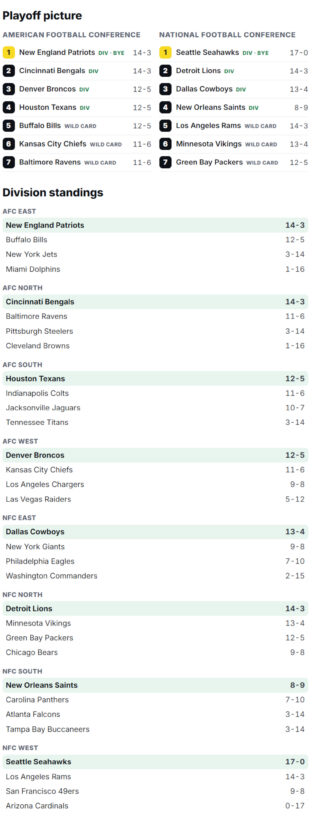
We have the Atlanta Falcons completely crashing out to finish at 3-14 for the season, giving Matt Ryan the opportunity to select a franchise QB that can provide stability to the organization for the first time since he was traded to the Indianapolis Colts.
Below is the complete 2026 regular season projections.
Sources
- NFL: Final 2025 division standings
- Atlanta Falcons: 2025 team statistics
- Atlanta Falcons: Leadership change after the 2025 season
- Atlanta Falcons: Matt Ryan named president of football
- Atlanta Falcons: 2026 coaching staff
- Atlanta Falcons: 2026 free agency tracker
- Atlanta Falcons: 2026 draft tracker
- Atlanta Falcons: 2026 transactions