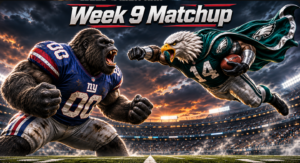

















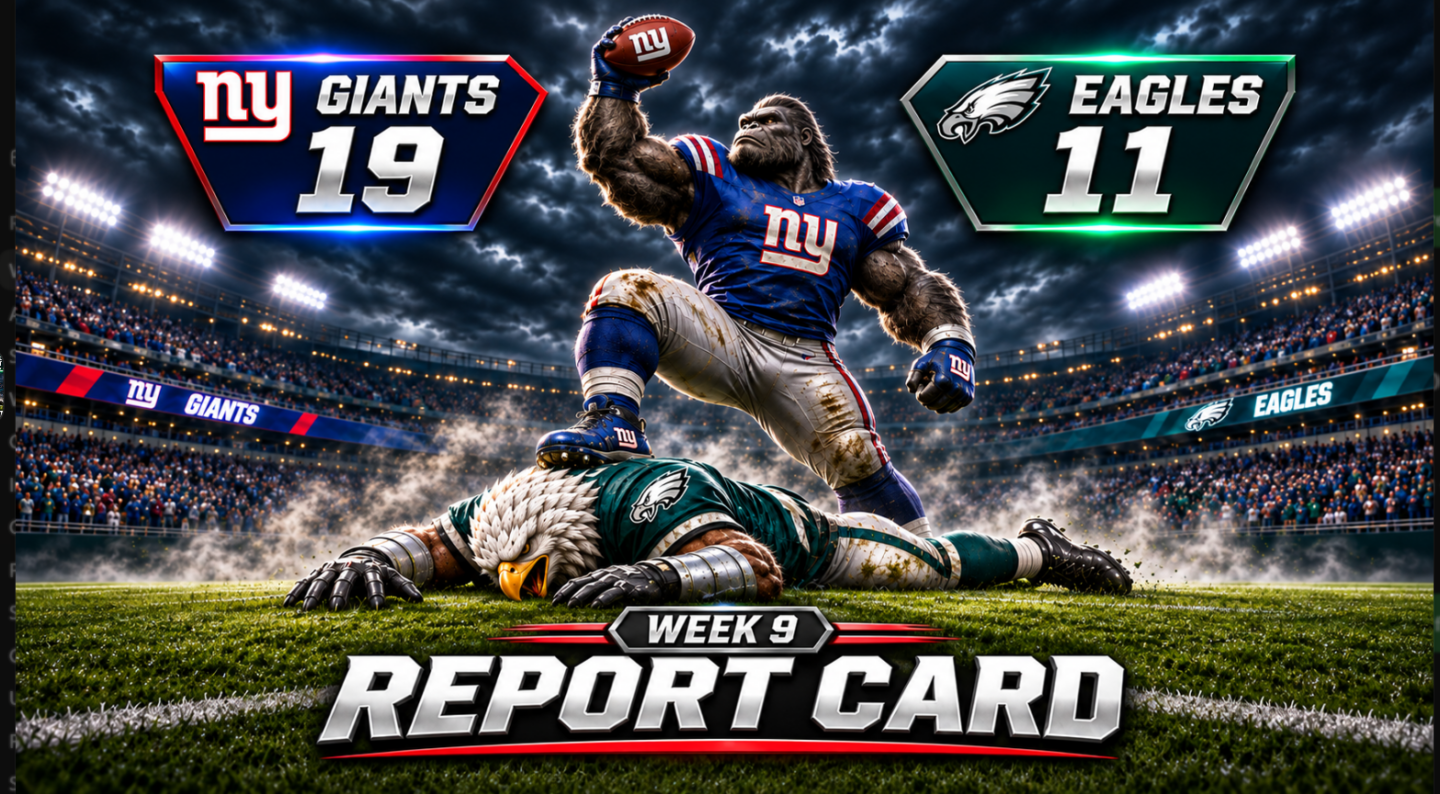
The Philadelphia Eagles changed quarterbacks, welcomed the division-leading New York Giants to Lincoln Financial Field and finally received an encouraging performance from their defensive front. New York still walked away with a 19-11 victory, ending its 13-game road losing streak against Philadelphia and sending the Eagles into their bye week at 2-7.
The Eagles have now lost seven consecutive games, their longest losing streak since 2012. The Giants improved to 5-2-1, strengthened their NFC East lead and celebrated their first victory in Philadelphia since October 27, 2013.
Joe Milton III made his first NFL start after replacing Tanner McKee, bringing the athleticism and extraordinary arm strength that inspired our Can Joe Milton III Save the Day? article. Milton provided occasional excitement with his legs, finished with 64 rushing yards and successfully converted a two-point attempt following Saquon Barkley’s first-quarter touchdown.
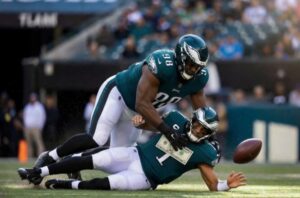
The performance also demonstrated how difficult it has become for any quarterback to function within Sean Mannion’s offense. Milton completed 18 of 34 passes for 169 yards, absorbed seven sacks and lost a fumble. The Eagles finished with 220 total yards, converted five of 18 third downs and possessed the football for only 25 minutes and 15 seconds.
Philadelphia actually led 8-6 at halftime. The defense had already recorded five sacks, the Giants had struggled to move the football after their opening possessions, and an extraordinary 86-yard punt by Braden Mann sent New York into the locker room pinned near its own goal line.
The second half brought the same offensive disappearance that has become Philadelphia’s trademark. Jameis Winston replaced an injured J.J. McCarthy and directed New York’s only touchdown drive, giving the Giants a 13-8 lead. Two fourth-quarter field goals extended the margin before Jake Elliott finally supplied Philadelphia’s only second-half points with 1:56 remaining.
The Washington report card described an offense that disappeared after the first quarter. The Giants game produced another version of that collapse, with Philadelphia scoring three points over the final 45 minutes while its defense repeatedly provided opportunities to remain competitive.
Team Grade: F
Seven consecutive losses deserve an F, particularly when the latest defeat comes against a division rival that generated only 243 yards of total offense. New York struggled to run the football, allowed six sacks and needed four field goals from Dominic Zvada to reach 19 points.
Philadelphia received enough defensive production to win an ordinary football game. The Eagles held the Giants to 80 rushing yards, limited Devin Singletary to 31 yards on 21 carries and generated pressure throughout the afternoon. The defense had its weaknesses, particularly when Winston entered, although it spent much of the game protecting a lead that the offense could never extend.
The offensive performance was considerably more damaging. Philadelphia managed only 28 rushing yards from Barkley and Elijah Mitchell combined, while Milton accounted for the overwhelming majority of the team’s rushing production. The line struggled against pressure, receivers had limited opportunities to attack downfield and the coaching staff repeatedly placed the offense in unfavorable situations.
The Eagles also wasted opportunities created by their opponents. Darius Cooper drew a 30-yard pass interference penalty that helped produce the first-quarter touchdown, while Rocco Underwood recovered a muffed Giants punt in New York territory during the second quarter. The second opportunity ended when Milton was strip-sacked, eliminating another chance to extend Philadelphia’s lead.
A team that once expected to compete for another championship now struggles to score against defenses playing without important starters. The Giants won despite producing one offensive touchdown, and the Eagles enter the bye having failed to reach 20 points in six of their nine games.
Offensive Player Grades
Joe Milton III: D+
Milton completed 18 of 34 passes for 169 yards without a touchdown or interception, finishing with a 66.9 passer rating. He rushed nine times for 64 yards, including a 24-yard scramble, and provided the Eagles with their only successful two-point conversion.
His debut began poorly. Milton committed a false-start penalty on Philadelphia’s first offensive snap, then missed Cooper on a third-down throw that appeared to involve miscommunication between the quarterback and receiver. The opening possession ended without generating meaningful offense.
Milton showed his athleticism during the second drive, escaping for a substantial gain on third down and helping move Philadelphia into Giants territory. His mobility eventually contributed to the scoring opportunity created by Cooper’s pass interference penalty, and his successful two-point conversion included a celebratory backflip that briefly energized the crowd.
The passing performance exposed familiar developmental concerns. Milton missed open receivers, struggled with ball placement and occasionally held the football while waiting for routes to develop. His inability to recognize and adjust to New York’s pressure contributed to several negative plays, including the second-quarter strip-sack.
That turnover was especially costly. Philadelphia had recovered a muffed punt at the Giants’ 47, creating an opportunity to build on its 8-6 lead. On third-and-5, Arvell Reese came unblocked from the left edge and reached Milton in just 2.29 seconds, according to Next Gen Stats. Micah McFadden recovered the fumble at midfield.
Milton’s best late-game contribution came with his legs. Trailing by 11 in the fourth quarter, he scrambled 24 yards on third-and-8, helping move Philadelphia into scoring position before Elliott connected from 45 yards.
His first start also ended painfully. With six seconds remaining and the Eagles facing fourth-and-2 from their own 43, Darius Alexander recorded New York’s seventh sack and eliminated Philadelphia’s final opportunity.
Milton demonstrated enough athletic ability to warrant further evaluation after the bye. His first start also showed how much work remains in his understanding of protection, timing and operating against NFL pressure.
Saquon Barkley: D
Barkley carried 13 times for 22 yards, averaging 1.7 yards per attempt. His three-yard touchdown provided Philadelphia’s only trip into the end zone, and he received limited assistance from an offensive line that repeatedly failed to establish useful running lanes.
The touchdown came from a heavy formation with Willie Lampkin aligned at fullback. Tyler Steen helped create the necessary opening, allowing Barkley to reach the end zone and give the Eagles their first lead.
The remainder of Barkley’s afternoon was frustrating. He managed only five yards on his longest carry, repeatedly encountered defenders near the line of scrimmage and never established the rushing threat Philadelphia needed to support its inexperienced quarterback.
His most damaging opportunity came late in the second quarter. Philadelphia faced fourth-and-1 at the New York 40 and elected to run Barkley from the shotgun. The Giants penetrated the middle and stopped him for a one-yard loss, giving possession back to New York.
Barkley continues playing through hamstring and back problems, and his lack of explosiveness has become increasingly apparent. The blocking deserves substantial blame for his production, although the Eagles received almost nothing from their highest-profile offensive weapon outside the touchdown.
Elijah Mitchell: C
Mitchell carried three times for six yards and caught three passes for 20 yards. His receiving production included a seven-yard catch during Philadelphia’s late fourth-quarter possession, although the running game offered him few opportunities to make an impact.
Mitchell has demonstrated enough experience to deserve a larger role when Barkley is limited physically. Mannion continued using him primarily as a complementary player, leaving the offense without a convincing alternative when the starting running back struggled.
Makai Lemon: B-
Lemon led Philadelphia with six receptions for 61 yards on nine targets, continuing his emergence as the team’s most productive healthy wide receiver. He found openings against New York’s zone coverage and provided Milton with several manageable completions.
His 17-yard reception helped establish a rhythm during Philadelphia’s scoring possession, while a 15-yard catch in the second quarter demonstrated his ability to uncover at intermediate depths. Lemon also showed toughness after the catch, fighting through contact to preserve additional yardage.
The rookie had a second-quarter drop and failed to secure a difficult late opportunity that could have given Philadelphia another chance. Those mistakes prevent a higher grade, although Lemon continues developing into one of the few consistently encouraging players on this offense.
Dallas Goedert: B-
Goedert caught five passes for 50 yards, providing Milton with another reliable target while DeVonta Smith and Dontayvion Wicks remained unavailable. His 12-yard reception against pressure helped move the chains, while a 19-yard completion later demonstrated his ability to find space between defenders.
Goedert also helped Philadelphia sustain its final possession by making a fourth-down catch and gaining additional yardage. His blocking responsibilities remained difficult against New York’s front, although he continued providing dependable receiving production in an offense that rarely generated explosive opportunities.
Darius Cooper: C
Cooper caught two passes for 25 yards, including a 20-yard reception during the second quarter. His most important contribution came without recording a catch, when he drew a 30-yard defensive pass interference penalty against Deonte Banks that placed Philadelphia at the Giants’ three-yard line.
The penalty created the opportunity for Barkley’s touchdown and represented one of the few occasions when Philadelphia successfully challenged New York vertically. Cooper’s involvement otherwise remained limited, with several incomplete targets and an apparent early miscommunication with Milton.
His illegal-shift penalty during Mann’s botched fourth-quarter punt added another mistake to an afternoon when Philadelphia needed considerably cleaner execution.
Hollywood Brown: C-
Brown caught one pass for 16 yards, with the reception arriving late in the fourth quarter. His speed should provide Philadelphia with opportunities to stretch defensive coverage, although the passing offense rarely creates the circumstances necessary to capitalize on it.
Brown has become another receiver whose production depends heavily on the quarterback receiving adequate protection. His limited involvement reflects the offense’s inability to generate consistent opportunities beyond short and intermediate routes.
Offensive Line: F
Seven sacks and 28 combined rushing yards from the running backs provide a straightforward evaluation of Philadelphia’s offensive line. The Giants repeatedly penetrated the pocket, overwhelmed interior protection and left Milton attempting to improvise under pressure.
Reese was the primary problem. The rookie linebacker finished with 12 tackles, three sacks, three tackles for loss and a forced fumble, producing one of the most impressive defensive performances by an NFL rookie this season.
His first sack demonstrated a complete breakdown in protection recognition. Reese arrived untouched and forced the turnover that eliminated Philadelphia’s best second-quarter opportunity. Later in the game, he beat Landon Dickerson directly for another sack as the Eagles attempted to mount a comeback.
Dickerson struggled throughout the afternoon, including the failed fourth-and-1 when the Giants penetrated the middle of Philadelphia’s offensive line. Drew Kendall committed a holding penalty that erased a nine-yard Milton keeper early in the third quarter, while Markel Bell continued having difficulties with protection responsibilities.
Jordan Mailata was the most dependable member of the group, although the left tackle could do little to compensate for the failures around him. New York’s defensive front repeatedly won individual matchups and attacked the protection calls with considerable success.
Philadelphia has changed quarterbacks, adjusted personnel and attempted multiple offensive approaches during its losing streak. The line continues to undermine each effort, and the loss of offensive line coach Jeff Stoutland is becoming an increasingly important part of the discussion surrounding the organization’s collapse.
Defensive Player Grades
Zack Baun: A-
Baun produced two sacks, seven combined tackles and a tackle for loss before leaving with a back injury during the third quarter. His first-half performance was among the strongest individual defensive efforts Philadelphia has received this season.
He stopped Singletary for a loss on New York’s opening possession, then sacked McCarthy on third-and-10 to force a 53-yard field goal attempt. His second sack came during the second quarter, when he brought McCarthy down for an eight-yard loss and left the Giants facing third-and-22.
Baun also delivered the hit on McCarthy’s third-quarter run that resulted in the quarterback temporarily leaving with a hip injury. Baun injured his back during the same play and did not return, leaving Philadelphia without one of its most effective defenders for the remainder of the afternoon.
The injury interrupted an excellent performance. Baun controlled his assignments, contributed meaningful pressure and provided the physical presence Philadelphia needed against an opponent that had entered the game with an advantage in offensive consistency.
Jalen Carter: B+
Carter recorded a sack and forced a fumble while producing one of his strongest interior performances in several weeks. His ability to disrupt the pocket helped prevent McCarthy from establishing a comfortable passing rhythm, particularly during the second quarter.
The forced fumble created an opportunity for another defensive takeaway, although a Giants offensive lineman recovered the loose football. Carter continued generating pressure and helped Philadelphia control the middle against a New York running game that struggled throughout the afternoon.
His performance represented meaningful improvement from the Dallas game, when he failed to provide the interior disruption expected from one of Philadelphia’s most talented defenders.
Jordan Davis: B
Davis recorded a sack and contributed to the defensive front’s best performance against the run in several weeks. He penetrated the backfield for an early tackle for loss and repeatedly occupied blockers while Philadelphia held Singletary to fewer than 1.5 yards per carry.
His sack late in the first half helped force another Giants punt and preserved Philadelphia’s narrow lead. The interior defense consistently prevented New York from generating the rushing production that Dallas and Washington had established during previous games.
Davis also committed a roughing-the-passer penalty during the second quarter, extending a New York possession after an incompletion. The mistake prevents a higher grade because unnecessary penalties remain particularly damaging when the offense struggles to score.
Jonathan Greenard: B
Greenard recorded his first sack as a Philadelphia Eagle, bringing down McCarthy for a 10-yard loss on third down during New York’s second possession. He also generated additional quarterback pressure and contributed to an improved performance from Philadelphia’s edge rotation.
His sack forced another long field goal attempt and helped prevent the Giants from building a substantial first-quarter lead. Greenard’s improved involvement provides some encouragement after an underwhelming start to his tenure in Philadelphia.
Nolan Smith: B
Smith recorded a sack of Winston during the third quarter and continued demonstrating the burst that Philadelphia has missed whenever injuries have disrupted its edge rotation. His pressure helped force New York into another difficult down-and-distance situation.
Smith now has five sacks on the season and remains one of the more productive members of the defense. His ability to finish plays provides Philadelphia with an important pass-rushing threat as the organization evaluates its defensive personnel beyond 2026.
Jeremiah Trotter Jr.: B
Trotter finished with 10 combined tackles and continued handling significant responsibilities while Jihaad Campbell remained unavailable. His third-quarter tackle for loss helped disrupt New York’s rushing attack, while his late-game run defense contributed to another Giants possession ending in a field goal.
The second-year linebacker has received increased playing time during Philadelphia’s recent injuries and has generally responded with disciplined tackling. His performance against New York provided another encouraging example of his development.
Quinyon Mitchell: B+
Mitchell handled much of the responsibility for defending Malik Nabers and delivered one of his more effective performances of the season. Nabers finished with five catches for 43 yards, and Mitchell repeatedly limited opportunities for New York’s most dangerous receiver to generate explosive plays.
His fourth-quarter pass breakup against Nabers helped prevent another significant completion. Mitchell also closed quickly on shorter routes and generally maintained favorable positioning against one of the league’s most talented young receivers.
He missed a tackle during the third quarter, although the mistake carried limited consequences compared with the coverage problems elsewhere in Philadelphia’s secondary. Mitchell continues demonstrating the individual ability expected from a cornerstone defensive back.
Cooper DeJean: C
DeJean finished with four tackles and contributed a third-quarter tackle for loss when he attacked the backfield and stopped Singletary. His ability to close quickly against the run remains an important strength, particularly when Philadelphia needs additional support from its defensive backs.
The coverage performance was less convincing. Darnell Mooney gained 27 yards on a crossing route with DeJean in coverage during Winston’s touchdown drive, creating one of the most important gains of the second half.
DeJean also returned three punts for 21 yards. His overall contribution was respectable, although the coverage loss helped New York complete the drive that permanently changed the score.
Riq Woolen: D+
Woolen continued experiencing coverage difficulties after struggling against Dallas and Washington. He appeared to carry significant responsibility for an early 27-yard completion to Isaiah Likely, allowing New York to convert a third down and move into Philadelphia territory.
The Giants also attacked him during Winston’s touchdown drive. Malachi Fields caught a 16-yard pass on third-and-15 when Woolen struggled to maintain favorable positioning, extending a possession that eventually produced seven points.
Woolen recorded a pass breakup and made several tackles, providing occasional evidence of his physical ability. His coverage inconsistency remains a serious concern for a defense that cannot afford explosive plays when the offense is producing so little.
Andrew Mukuba: D+
Mukuba finished with five tackles but experienced another difficult afternoon in coverage. His responsibilities appeared to contribute to multiple defensive miscommunications, including the first-quarter completion to Mooney on third-and-12.
The most damaging breakdown came during New York’s third-quarter touchdown drive. Likely found himself uncovered near the goal line, allowing Winston to complete an easy five-yard touchdown pass that gave the Giants a 13-8 lead.
The play appeared to involve confusion among multiple defenders, making it difficult to assign responsibility to one player without knowing the intended coverage. Mukuba’s involvement in another communication breakdown is concerning because Philadelphia needs greater reliability from its safeties.
Marcus Epps: C+
Epps finished with six combined tackles and provided a physical presence near the line of scrimmage. He briefly appeared to force a fumble from Likely during the first quarter, although replay overturned the ruling after determining that the receiver was down.
His run support was generally dependable, and he avoided some of the explosive coverage mistakes that have damaged previous performances. Epps still needs greater consistency, although Sunday’s effort represented a more controlled contribution than several of his earlier appearances.
Special Teams Grade: C-
Braden Mann delivered one of the most extraordinary individual plays of Philadelphia’s season when he launched an 86-yard punt from his own eight-yard line late in the first half. The ball traveled over Charlie Jones and rolled out of bounds at the Giants’ six, producing the longest NFL punt since 2001 and the second-longest in Eagles history behind Randall Cunningham’s 91-yarder in 1989.
Mann followed that remarkable achievement with a 60-yard punt early in the third quarter. His ability to flip field position repeatedly gave Philadelphia’s defense opportunities to protect a narrow lead while the offense struggled.
Unfortunately, his afternoon also included a 17-yard punt during the second quarter and a disastrous fourth-quarter sequence. Attempting to punt with the Eagles trailing 16-8, Mann mishandled the ball, recovered it and ultimately produced a punt that traveled negative two yards.
The Giants took possession near Philadelphia’s 35 and converted the favorable field position into a 49-yard field goal. Mann had spent much of the afternoon keeping New York away from the end zone, then handed the Giants an opportunity to extend their lead.
Rocco Underwood deserves credit for recovering Jones’ muffed punt during the second quarter. His awareness created a valuable possession inside Giants territory, although Philadelphia’s offense immediately squandered the opportunity.
Jake Elliott converted his only field goal attempt from 45 yards, while Jaydon Blue returned six kickoffs for 124 yards. DeJean added 21 yards on three punt returns, providing modest contributions without changing the game’s outcome.
Special teams generated one historic highlight, one important takeaway and one disastrous mistake. The final grade reflects a unit whose best and worst moments arrived in the same afternoon.
Sean Mannion: F
Mannion entered Sunday with an opportunity to demonstrate that Philadelphia’s offensive limitations were primarily connected to the quarterback position. Milton offered the ability to escape pressure, attack downfield and threaten defenses with designed quarterback runs, providing a different collection of tools from the ones available to McKee.
The results were damning. Philadelphia produced 220 yards, converted five of 18 third downs and finished with one touchdown despite receiving favorable field position from penalties and special teams.
The offense showed occasional creativity during the opening scoring possession. Milton’s mobility helped create movement, while the use of a heavy formation with Lampkin at fullback provided a successful short-yardage rushing concept.
Mannion struggled to build on that success. New York adjusted its defensive approach, attacked protection responsibilities and repeatedly forced Milton into situations requiring him to process pressure before receivers could complete their routes.
The failed fourth-and-1 late in the second quarter represented another questionable decision. Philadelphia aligned in the shotgun and ran Barkley into the middle of a defense that had spent most of the afternoon controlling the line of scrimmage. New York stopped the play behind the line and recovered possession.
The concerns documented in The Mannion Honeymoon Is Over! have now followed Philadelphia through three different starting quarterbacks. The passing concepts remain inconsistent, the protection adjustments continue failing and the coordinator has struggled to sustain offensive production beyond his initial approach.
Mannion has had nine games to demonstrate that he can construct an effective NFL offense. The Eagles now enter their bye with the league’s least productive offensive unit and a coaching staff that has repeatedly failed to solve problems identified months before the season began.
Vic Fangio: B-
Fangio’s defense produced six sacks and held New York to 243 total yards, including only 80 on the ground. The unit generated consistent pressure against McCarthy, controlled the interior and repeatedly forced the Giants to settle for field goals.
Those improvements deserve recognition after the Dallas report card documented one of the worst defensive performances of Fangio’s tenure. Philadelphia displayed better gap discipline, improved its tackling and finally generated meaningful production from its defensive front.
The most damaging failure arrived after McCarthy suffered his hip injury. Winston entered and eventually directed a 14-play, 76-yard touchdown drive that consumed nearly eight minutes and exposed several weaknesses in Philadelphia’s coverage communication.
Winston converted a fourth-and-1 with a quarterback sneak, escaped for another first down and completed a 27-yard pass to Mooney. He later found Fields for 14 yards before connecting with an uncovered Likely for the touchdown.
The defense surrendered only one touchdown and forced four field goals, providing enough production to keep Philadelphia competitive. Fangio receives a B- because his unit showed meaningful improvement while still allowing a backup quarterback to lead the game’s decisive scoring possession.
Nick Sirianni: F
Sirianni’s team has now lost seven consecutive games, including three straight to NFC East opponents. The latest defeat came at home against a Giants team that struggled offensively for much of the afternoon and still managed to control the second half.
The head coach deserves responsibility for the repeated failures in offensive preparation, game management and the inability to make effective adjustments. Philadelphia changed starting quarterbacks after McKee failed to generate sufficient production, yet the same offensive limitations appeared immediately with Milton.
The fourth-and-1 decision in the second quarter deserves particular scrutiny. Sirianni elected to keep the offense on the field, then trusted a struggling offensive line to create a running lane from the shotgun. The decision resulted in another failed possession and eliminated an opportunity to extend Philadelphia’s lead.
Sirianni also continues defending an offensive coordinator whose system has failed to generate consistency. The Eagles have cycled through quarterbacks, adjusted personnel and endured repeated injuries, although the organizational responsibility for the offense ultimately belongs to the head coach.
The upcoming bye provides additional preparation time and an opportunity to evaluate the coaching staff. Continuing with the same offensive approach would suggest the organization has accepted the possibility of further failures during the second half of the season.
An F reflects nine games of deteriorating performance and a coaching operation that has repeatedly failed to provide effective solutions.
Player Of The Game: Zack Baun
Baun was Philadelphia’s most disruptive defender before suffering his back injury. His two sacks helped prevent New York from establishing an early offensive rhythm, and his physical presence contributed to a defensive front that repeatedly controlled the line of scrimmage.
The injury prevented Baun from completing what could have become an exceptional individual performance. His seven tackles, pressure and leadership still made him the clearest choice on a day when Philadelphia’s strongest contributions came from the defense.
Scapegoat Of The Game: Sean Mannion
Mannion had a new quarterback with exceptional physical ability and an opponent that generated only 243 yards of offense. Philadelphia still scored 11 points, produced one touchdown and failed to move the football consistently.
The offense has now demonstrated similar limitations under Hurts, McKee and Milton. Protection failures, limited running production and ineffective adjustments continue undermining the talent available, while Mannion has failed to establish an approach capable of producing reliable scoring opportunities.
Sunday’s performance strengthens the argument that Philadelphia needs a significant change in offensive leadership during the bye week. Mannion has received more than enough opportunities to demonstrate that his system can function at the professional level.
Top Five Eagles
Zack Baun: A-
Baun recorded two sacks and seven tackles before his injury interrupted an outstanding afternoon. His pressure and run defense provided Philadelphia with the physical presence required to control New York’s offense during the first half.
Quinyon Mitchell: B+
Mitchell limited Nabers’ opportunities and delivered an important fourth-quarter pass breakup. His coverage remained dependable while Philadelphia experienced communication problems elsewhere in the secondary.
Jalen Carter: B+
Carter generated interior pressure, recorded a sack and forced a fumble that New York recovered. His improved performance helped establish the defensive front as Philadelphia’s strongest unit.
Jeremiah Trotter Jr.: B
Trotter finished with 10 combined tackles and handled increased responsibilities with Campbell unavailable. His development continues providing encouraging evidence about Philadelphia’s younger defensive personnel.
Makai Lemon: B-
Lemon led Philadelphia in receiving and continued demonstrating the route-running ability and toughness that have made him Milton’s most dependable target. His development remains valuable regardless of the team’s disappointing record.
Honorable Mention: Jonathan Greenard and Jordan Davis. Greenard recorded his first sack as an Eagle, while Davis contributed a sack and important interior run defense during one of Philadelphia’s strongest defensive performances of the season.
Bottom Five Eagles
Sean Mannion: F
Mannion failed to create a consistent passing attack with his third starting quarterback of the season. His inability to address protection problems and establish sustainable offensive production has become one of Philadelphia’s most serious organizational concerns.
Offensive Line: F
The offensive line surrendered seven sacks and repeatedly failed to establish rushing lanes. Reese dominated the matchup, while the interior struggled with protection recognition and short-yardage execution.
Nick Sirianni: F
Sirianni’s team failed to capitalize on an improved defensive performance and entered the bye with seven consecutive losses. His continued confidence in Mannion and questionable offensive decisions have become increasingly difficult to defend.
Andrew Mukuba: D+
Mukuba was involved in multiple coverage communication problems, including the breakdown that left Likely uncovered for New York’s only touchdown. Philadelphia needs more dependable play from its safety group when the defensive front generates consistent pressure.
Riq Woolen: D+
Woolen allowed important completions during New York’s scoring possessions and continued struggling with coverage responsibilities. His physical ability remains appealing, although opponents have repeatedly identified him as a favorable target.
Final Word
Philadelphia enters the bye week at 2-7 after another loss in which the coaching staff received enough defensive production to win. The Giants generated only 243 yards, struggled to establish their running game and relied on field goals for most of their scoring. The Eagles still failed to take advantage of a winnable game at Lincoln Financial Field.
Milton’s first start supplied valuable information about his physical abilities and developmental limitations. His mobility provided opportunities that McKee could rarely create, while his difficulties against pressure demonstrated the importance of protection recognition and consistent decision-making.
Philadelphia needs to continue evaluating Milton during the remaining eight games, particularly after he has additional time to learn the offense. Our earlier Who Is Joe Milton III? profile examined his long developmental history, and the Giants game provided the first meaningful NFL starting performance against which that history can be evaluated.
The larger quarterback situation remains connected to the organizational analysis presented in Why the Eagles Will Release Jalen Hurts. Our expectation of a potential quarterback transition in 2027 was established before the season began, while Hurts’ serious medical condition remains a separate matter requiring appropriate care and recovery.
Philadelphia’s position in the standings also increases the importance of the 2027 NFL Draft quarterback class. The Eagles’ seven consecutive losses have substantially improved their potential draft position, creating opportunities to evaluate prospects who could influence the franchise’s long-term direction.
The prediction for Sunday’s game was Eagles 27, Giants 20, with Philadelphia covering as a 3.5-point underdog and the total going over 39.5 points. New York won by eight, covered the spread and kept the combined score at 30. BGS falls to 5-4 against the spread, 4-5 on the moneyline and 3-6 picking totals through nine Eagles games.
The Eagles have a bye in Week 10 before returning to Lincoln Financial Field against the Pittsburgh Steelers on November 22. The additional preparation time provides Sirianni and his coaching staff with an opportunity to reconsider their offensive approach and determine which players deserve increased responsibilities.
The organization also faces the November 10 trade deadline, creating another opportunity for Howie Roseman to determine whether the remaining season should emphasize immediate improvement or longer-term roster planning.
Philadelphia began 2026 with championship expectations and now approaches the second half of the season with serious questions at quarterback, offensive coordinator and head coach. The losses have become sufficiently repetitive that evaluating the organization requires looking beyond individual opponents and identifying which structural problems need to be addressed before another season begins.
Seven consecutive losses have made those decisions unavoidable. The bye week provides Philadelphia with time to confront them, and the second half of the season will reveal whether the organization has any meaningful answers.