



Updated: September 1st, 2026. The season recap covers 2025; personnel sections look ahead to 2026. Added Predictions, Projections and Standings. Diggs was released 9-1-26
Leadership and Coordinators
- Owner: The Paul G. Allen Estate, represented by Jody Allen, with an approved sale pending final closing NFL owners unanimously approved the franchise’s sale to the Khosla family, which will become the controlling ownership group once the transaction closes.
- Decision Maker: John Schneider President of Football Operations/General Manager Schneider has final roster authority and now faces the difficult task of sustaining a champion while managing extensions, departures and a low draft slot.
- Head Coach: Mike Macdonald Macdonald’s second season produced a 14–3 record and a Super Bowl title. His disguised, connected defense has become the team’s defining competitive advantage.
- Offensive Coordinator: Brian Fleury Promoted into the coordinator role, Fleury must preserve the balance and efficiency of the championship offense while adding his own answers around Sam Darnold and Jaxon Smith-Njigba.
- Defensive Coordinator: Aden Durde Durde coordinates the front mechanics inside Macdonald’s broader system, with pressure distribution and run fits central to keeping the league’s best scoring defense intact.
- Special Teams Coordinator: Jay Harbaugh Harbaugh oversees a unit that produced three return touchdowns in 2025; Rashid Shaheed’s explosiveness and Jason Myers’ reliability give Seattle genuine hidden-yardage weapons.
2025 Season Recap
Seattle’s 2025 season became one of the greatest in franchise history. The Seahawks went 14–3, won the NFC West and the conference’s No. 1 seed, then defeated San Francisco, Los Angeles and New England to capture Super Bowl LX. The 29–13 championship win was a fitting conclusion: Seattle’s defense kept the Patriots scoreless for three quarters and turned a close game into a controlled coronation.
The transformation began with defense. Macdonald’s unit allowed only 292 points, the fewest in the NFC West by a wide margin, while forcing quarterbacks to diagnose late rotations and pressure from changing launch points. Leonard Williams supplied interior disruption, Devon Witherspoon blurred the line between slot corner and pressure defender, and safety Nick Emmanwori added range and physicality. Seattle could win without constant blitzing because its front generated pressure and its coverage rules remained connected.
The offense complemented that structure rather than undermining it. Sam Darnold gave Seattle poised, aggressive quarterback play, and Jaxon Smith-Njigba developed into the passing game’s centerpiece. His route precision and work from multiple alignments allowed the Seahawks to create reliable completions without sacrificing explosive potential. The run game and play-action package kept defenses honest, while Rashid Shaheed affected both offensive spacing and field position.
Just as important, the postseason never required Seattle to become a different team. Its defense traveled from week to week, the offense protected the ball, and special teams created field-position pressure. That repeatability is why the championship looks sustainable rather than accidental.
The achievement also represented a rapid organizational validation. Two years after replacing Pete Carroll with Macdonald and one year after changing quarterbacks, Seattle did not merely return to relevance; it established the NFL’s best record and won through a repeatable formula. The Seahawks finished with a plus-191 point differential, strongest in the league, so their postseason run was not the product of narrow-game luck. They paired explosive skill talent with a defense that consistently lowered opponents’ efficiency, then carried that advantage through three postseason games.
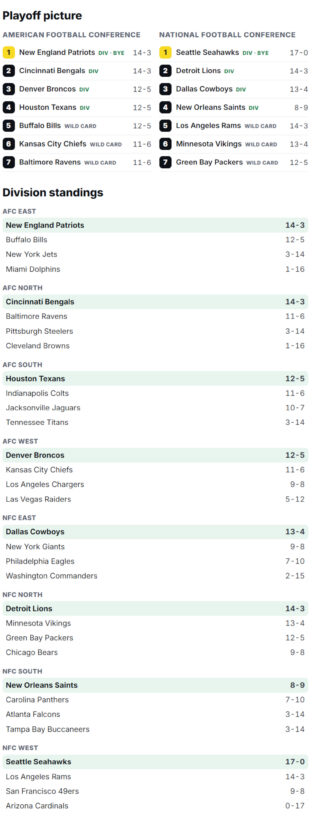
Seattle’s path through the NFC West gave the championship additional weight. The division produced the conference’s three best records: Seattle at 14–3, with Los Angeles and San Francisco both 12–5. The Seahawks survived an extraordinary overtime win against the Rams and then beat the 49ers 13–3 in Week 18 to secure the division and first seed. Their 4–2 division mark was shared by all three contenders, so superiority outside the division supplied the separator.
After the bye, Seattle dismantled San Francisco 41–6 in the Divisional Round. The NFC Championship against the Rams was far more demanding. Los Angeles gained 479 yards, but Seattle made enough high-leverage plays to win 31–27. That contrast showed the team’s range: the Seahawks could smother an opponent or survive a shootout without abandoning their identity.
The 2026 challenge is no longer proving the rebuild worked; it is managing the consequences of success. Schneider retained the core coaching structure and continued building depth around the championship nucleus. A champion rarely returns unchanged, but Seattle’s foundational advantages—Macdonald’s defense, a star receiver, strong specialists and a roster built for speed—remain. Anything short of another deep playoff run will feel disappointing, which is the clearest measure of how completely the franchise’s standard changed in 2025.
2025 Division Standing
- 1. Seattle Seahawks — 14–3 (4–2 division) — Won SB PF: 483 · PA: 292
- 2. Los Angeles Rams — 12–5 (4–2 division) — Lost CC PF: 518 · PA: 346
- 3. San Francisco 49ers — 12–5 (4–2 division) — Lost DR PF: 437 · PA: 371
- 4. Arizona Cardinals — 3–14 (0–6 division) — Missed Playoffs PF: 355 · PA: 488
Seattle finished first and earned the NFC’s top seed. All three contenders went 4–2 in the division, making the Seahawks’ superior non-division record decisive.
Notable 2026 Player Additions
- CB Trevon Diggs (free agency) The former All-Pro adds elite ball production and veteran outside coverage. His health and consistency will determine the size of his role.
- EDGE Dante Fowler Jr. (free agency, Dallas Cowboys) Fowler adds proven situational rush skill to an already deep pressure plan.
- WR Irvin Charles (trade, New York Jets) Charles is a core special-teamer who strengthens coverage depth.
- TE Nick Vannett (free agency) Vannett returns as a familiar in-line option after camp injuries changed the room.
Notable 2026 Player Losses
- RB Kenneth Walker III (Kansas City Chiefs) Walker’s acceleration and explosive runs leave a substantial workload for the reshaped backfield.
- CB Riq Woolen (Philadelphia Eagles) Seattle loses rare length and recovery speed from the boundary, although its corner depth and Diggs signing mitigate the departure.
- EDGE Boye Mafe (Cincinnati Bengals) Mafe’s speed and ascending pressure production leave a meaningful role in the edge rotation.
2026 Draft Class
- Round 1, Pick 32 — RB Jadarian Price, Notre Dame Price averaged 6.0 yards per carry in 2025 and adds home-run speed plus return value. First-round status gives him an immediate path to lead work.
- Round 2, Pick 64 — S Bud Clark, TCU Clark’s instincts and 15 career interceptions fit a disguise-heavy secondary. He fractured an ankle on his first defensive snap of the preseason and was placed on injured reserve, ending his rookie season before it began.
- Round 3, Pick 99 — CB Julian Neal, Arkansas Neal adds length and developmental man-coverage ability to a crowded room.
- Round 5, Pick 148 — G Beau Stephens, Iowa Stephens brings Big Ten toughness and interior competition for a line that must remain sturdy around Darnold.
- Round 6, Pick 199 — WR Emmanuel Henderson Jr., Alabama Henderson is a developmental speed target with special-teams potential.
- Round 7, Pick 236 — CB Andre Fuller, Toledo Fuller’s quickest route to the roster is through coverage units and reserve outside work.
- Round 7, Pick 242 — NT Deven Eastern, Minnesota Eastern is a 315-pound run defender with extensive starting experience and rotational value.
- Round 7, Pick 255 — CB Michael Dansby, Arizona Dansby is an athletic depth bet who must distinguish himself on special teams.
2026 Spotlight Watch
- Hot Seat — Brian Fleury Fleury inherits a championship offense in his first season as coordinator. Any major decline in balance, third-down answers or Darnold’s efficiency will place his sequencing and adjustments under immediate scrutiny.
- Breakout Watch — Nick Emmanwori His size, range and role in Macdonald’s positionless secondary create a realistic path from promising young defender to national star.
- Bust Watch — Julian Neal An extended quad injury cost Neal valuable camp reps and left him behind in Seattle’s crowded cornerback rotation. If he cannot catch up quickly and earn a dependable weekly role, his rookie season could become more developmental redshirt than immediate contribution. UPDATE: 9-1-26 -> Had Treyvon Diggs on Bust Watch but he was released by the Seahawks.
- Team Superstar — Jaxon Smith-Njigba Smith-Njigba is Seattle’s offensive centerpiece and premier coverage dictator, capable of winning from the slot or outside.
Prediction
The Seattle Seahawks, the reigning Super Bowl Champions, didn’t get worse in 2026, but are projected to dominate the NFL. They would be projected to lose in Week 18 vs the Rams, except the Rams benched their starters since they couldn’t win the division. Seattle has the first undefeated regular season since 2007 and will be the NFC’s 1-seed in 2026. Will they have better luck than the New England Patriots undefeated season?
Below is the complete 2026 regular season projections.