
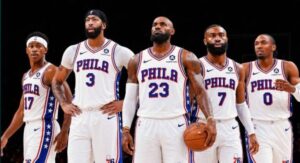



















The Philadelphia Eagles gave Tanner McKee his first meaningful start and discovered that changing the quarterback could not repair an entire offense in one afternoon. Carolina left Lincoln Financial Field with a 25-14 victory, while Philadelphia fell to 2-4 and extended its losing streak to four games.
Our Panthers matchup preview argued that McKee could postpone the reset. He supplied a few reasons to keep evaluating him. The rest of the roster supplied overwhelming evidence that the reset has already moved beyond one position.
McKee completed 26 of 45 passes for 215 yards, one touchdown and no interceptions. The line produces a 57.8 percent completion rate, 4.8 yards per attempt and a 77.5 passer rating. He protected the football and delivered two legitimate scoring drives, although the offense remained trapped inside the same small geometry that has defined the season.
Philadelphia gained 222 net yards, rushed for 35 and produced 17 first downs. The Eagles punted eight times, averaged 3.6 yards per play and finished without an offensive gain longer than 19 yards. Carolina controlled possession for 34:48 and ran 74 plays against a defense that spent another afternoon waiting for help. (NFL gamebook)
The game remained available deep into the fourth quarter. McKee’s touchdown to DeVonta Smith reduced Carolina’s lead to 19-14, and Vic Fangio’s defense immediately forced a three-and-out. Philadelphia took possession at its own 48 with 9:32 remaining and a chance to take the lead.
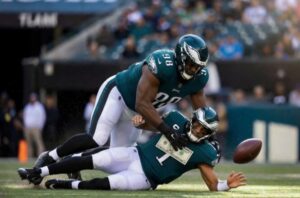
Jake Majors then snapped the ball past McKee for a 12-yard loss. The offense never recovered, Braden Mann’s punt was blocked and Carolina received possession at the Philadelphia 48. Four plays later, Bryce Young found Tommy Tremble uncovered for the touchdown that ended any realistic comeback.
That sequence contained the entire Eagles season. The defense created an opportunity, the offense damaged it and special teams finished the destruction. Carolina needed only 33 offensive yards after the block because Philadelphia supplied everything else.
The Panthers accumulated 399 yards and 25 first downs. Young threw for 281 yards and two touchdowns without an interception, while Chuba Hubbard carried 28 times for 120 yards and a score. The Eagles held Hubbard to 24 first-half rushing yards, then lost control of the line of scrimmage as fatigue and injuries accumulated.
Philadelphia also committed 11 penalties for 84 yards. Carolina was flagged more often and surrendered 149 penalty yards, yet the Eagles repeatedly selected the most damaging possible moment for their mistakes. Jordan Davis extended one touchdown drive with roughing the passer, Moro Ojomo handed Carolina a new set of downs near the goal line and Cooper DeJean added two costly personal failures during the decisive stretch.
Last week’s Jaguars report card described a defense carrying a failing offense. This version was less dramatic and more discouraging. Every phase contributed to a home loss against an opponent Philadelphia had identified as vulnerable.
Team Grade: D
The Eagles replaced the quarterback and produced the same basic result. They scored on two drives, created almost no explosive offense and watched another opponent dictate the length and shape of the game.
Carolina ran 13 more plays, gained 177 more yards and held the ball nearly 10 minutes longer. The Panthers entered with one of the league’s least effective defenses, then limited Philadelphia to a pair of touchdowns and allowed the Eagles inside the red zone only twice.
The defense deserves credit for keeping the margin manageable through three quarters. It forced repeated incompletions, created two sacks and gave the offense the ball near midfield while the deficit remained five. The fourth-quarter collapse prevents that unit from carrying the overall grade much higher.
Special teams offered no rescue. Philadelphia generated zero punt-return yards, averaged 15.7 yards on six kickoff returns, allowed 57 yards on four punt returns and surrendered the blocked kick that created Carolina’s final touchdown.
A D reflects a team that remained technically alive longer than its performance deserved. The score showed an 11-point loss. The snap-by-snap evidence showed an opponent controlling the field, possession and available answers.
Offensive Player Grades
Tanner McKee: C
McKee’s afternoon began with an 11-yard sack on his first snap. Carolina sent Bobby Okereke through the protection, and the new starter immediately learned that the Panthers planned to test every communication point around Philadelphia’s reconstructed line.
He recovered well enough to make several NFL throws. McKee found Dallas Goedert between the hashes off play action, escaped pressure to convert a third down to Dontayvion Wicks and led a 78-yard touchdown drive before halftime. His best pass came in the fourth quarter, when he placed the ball over Will Lee’s outside shoulder and allowed Smith to adjust for a 19-yard score.
The interception column remained clean. That matters for a quarterback starting behind a damaged line with an ineffective running game. McKee avoided the reckless mistake that would have allowed Carolina to end the afternoon early.
The remaining production was ordinary. Nineteen passes fell incomplete, three sacks cost 28 yards and Philadelphia generated 187 net passing yards across 48 called dropbacks. McKee held the ball too long against several pressure looks and rarely forced the secondary to defend beyond the sticks.
The case for Tanner McKee as QB1 centered on anticipation, structure and his potential fit inside Sean Mannion’s system. Those traits appeared in flashes. A C is the correct grade because he gave Philadelphia competent quarterback play without supplying the elevation required to overcome everything around him.
Dameon Pierce: C+
Pierce accounted for every Eagles rushing yard, finishing with 35 on 12 carries. He broke contact on a two-yard touchdown before halftime and added four receptions for 15 yards as the only healthy back trusted with a substantial role.
His 2.9-yard rushing average offered little efficiency, and his longest run gained nine. The offensive line rarely created clean access to the second level. Pierce ran with enough force to keep the grade slightly above average under difficult circumstances.
DeVonta Smith: B+
Smith returned from injury and immediately became the offense’s most important receiver. He caught seven passes for 75 yards, created a third-down conversion on a delayed in-breaker and finished the fourth-quarter touchdown with outstanding body control near the boundary.
Fourteen targets reveal how heavily McKee depended on him. Several opportunities arrived late or outside a comfortable catch radius, including the fourth-and-17 attempt that ended Philadelphia’s final meaningful possession. Smith gave the passing game its only consistent matchup advantage.
Dallas Goedert: B
Goedert caught six of eight targets for 61 yards and repeatedly settled into the middle of Carolina’s coverage. His 18-yard reception in the third quarter came after McKee stepped away from pressure and provided one of the few examples of the offense creating after the initial structure broke.
He also recorded his 426th reception as an Eagle, tying Brian Westbrook for fourth place in franchise history. Goedert blocked through a difficult assignment and gave the new starter a dependable answer throughout the afternoon.
Dontayvion Wicks: C
Wicks caught two passes for 24 yards and converted two important third downs. His 17-yard reception helped begin the fourth-quarter touchdown drive before an injury ended his afternoon.
Four targets were too few for a receiver capable of threatening the sideline. The limited workload and early exit prevent a stronger judgment in either direction.
Makai Lemon: D+
Lemon caught three of six targets for 19 yards. Carolina crowded his underneath routes, and he never created the separation or yards after the catch required to punish that attention.
His longest reception gained 13, while the other two combined for six. The rookie remained involved and avoided the situational mistake that hurt him in London, although involvement without impact could not help the offense escape its cramped design.
Darius Cooper: D
Cooper received two targets and caught one for nine yards. He also returned two kickoffs for 38, giving him more opportunity as a returner than as the receiver who had scored three touchdowns across the previous two games.
That usage makes little sense after his recent production. Cooper shares responsibility for failing to win his limited routes, while Mannion deserves the larger share for allowing a useful matchup piece to disappear.
Offensive Line: D
Jordan Mailata, Willie Lampkin, Jake Majors, Tyler Steen and Markel Bell allowed three sacks and 11 quarterback hits. The run game averaged 2.7 yards per carry, and Carolina recorded five tackles for loss without needing to sell out on every down.
Majors committed the defining offensive mistake when his fourth-quarter snap created a 12-yard loss immediately after the defense returned the ball near midfield. Philadelphia also struggled to identify pressure through the interior, leaving McKee exposed to free or delayed rushers during several stalled possessions.
The group deserves context because Lane Johnson has retired, Cam Jurgens was traded and Landon Dickerson and Drew Kendall remained unavailable. Context explains the instability. It cannot turn 35 rushing yards and constant backfield stress into an acceptable performance.
Defensive Player Grades
Quinyon Mitchell: B+
Mitchell recorded five tackles and three passes defensed, the highest total on the team. He challenged throws outside, closed quickly when Young tried to work the boundary and stayed with John Metchie II on Carolina’s failed two-point conversion.
Tremble powered through him on the first Panthers touchdown, placing a negative play on an otherwise strong afternoon. Mitchell competed for four quarters while injuries and extended possessions weakened the structure around him.
Nolan Smith: B
Smith produced an eight-yard sack, a tackle for loss and three combined tackles before leaving in the second quarter with a concussion. His pressure helped shut down Carolina’s early possessions, and his speed forced Young to account for the edge before every dropback.
The injury removed one of Fangio’s few healthy outside rushers and changed the rotation. A limited snap count caps the grade, while the quality of those snaps keeps Smith among Philadelphia’s best performers.
Riq Woolen: B-
Woolen broke up a deep throw intended for Darren Waller and forced Jalen Coker to fumble after a completion. The ball went out of bounds, denying Philadelphia the takeaway that could have shifted the game.
Carolina found more productive matchups away from him for much of the afternoon. Woolen allowed some underneath access and finished with two tackles, although his coverage remained one of the steadier parts of the secondary.
Zack Baun: C+
Baun finished with six combined tackles, one quarterback hit and a pass defended. His blitz pressure forced Young to throw the ball away several times, and his fourth-quarter deflection helped create the three-and-out that gave Philadelphia its final legitimate chance.
Coker’s 43-yard slant in the third quarter escaped Baun and flipped a drive that had begun near Carolina’s goal line. That failure started the 92-yard touchdown possession that gave the Panthers control of the fourth quarter.
Jalen Carter: C+
Carter recorded three combined tackles and batted down a third-down pass during another strong opening stretch for the defense. Carolina struggled to run inside during the first half, and Carter’s presence helped force Young toward the edges.
His influence faded as the game lengthened. The Panthers eventually established Hubbard, controlled the ball and finished without allowing Carter a sack or quarterback hit. Philadelphia needed another dominant performance from its best defender and received a respectable one.
Jordan Davis: D
Davis contributed four assisted tackles, shared a sack with Jeremiah Trotter Jr. and deflected a pass. Those plays should have supported a useful grade for an interior defender who helped control the first half.
Two penalties changed the evaluation. His roughing-the-passer foul moved Carolina to the Philadelphia 12 before Tremble’s first touchdown, and his offside penalty erased a fourth-down stop at the goal line before Hubbard scored. Davis later left with an ankle injury, completing a costly afternoon.
Cooper DeJean: D-
DeJean collected six tackles, one tackle for loss and a pass defended. The production hides a collection of mistakes that repeatedly extended Carolina possessions.
His illegal-contact penalty erased a third-down stop before the Panthers’ first touchdown. Hubbard ran through his tackle on fourth-and-1 during the 92-yard drive, and an unnecessary-roughness flag added 15 yards after a late Carolina conversion. DeJean was also the closest defender when Tremble escaped uncovered for the final touchdown.
Andrew Mukuba: D
Mukuba finished with eight combined tackles because Carolina kept reaching the second level. Volume at safety often describes how frequently the defense lost in front of him.
He missed Hubbard on an 11-yard run to begin the second half and later allowed David Moore to turn a short completion into 27 yards. Mukuba prevented several plays from becoming even larger, although his angles helped create the damage he was forced to clean up.
Special Teams Grade: F
Britain Covey mishandled two bouncing kickoffs, and Philadelphia’s six returns generated only 94 yards. A holding penalty erased Covey’s best return of the afternoon, while another illegal block pushed the offense back to its own 13 after Carolina’s final touchdown.
Mann punted eight times for a 42.5-yard average and placed two inside the 20. His 65-yard punt from deep in Philadelphia territory was excellent. His 16-yard punt in the second quarter gave Carolina a short field, and the fourth-quarter block became the decisive special-teams failure.
Carolina also returned four punts for 57 yards. The Eagles produced none because Covey fair-caught three and watched another kick get downed. Field position leaned toward the Panthers throughout the afternoon, leaving a struggling offense to begin its drives from an average starting point near its own 21.
The blocked punt arrived after the offense had already created fourth-and-18. Special teams still had one assignment: send Carolina backward and preserve a five-point game. The unit failed at the exact moment Philadelphia required competence.
Sean Mannion: F
Mannion entered the afternoon with a first-time starter, one healthy primary running back and another reconstructed offensive line. Those limitations belong in the evaluation, and they made a difficult job even harder.
The coordinator also faced a Carolina defense that had entered near the bottom of the league in points, yards, rushing yards and red-zone efficiency. Philadelphia produced 14 points, two red-zone trips and no gain beyond 19 yards. The weakness identified in the Eagles-Panthers forecast never became the foundation of a coherent plan.
Mannion called 45 passes and 13 runs for a quarterback making his first meaningful start. Injuries reduced the backfield options, while abandoning balance allowed Carolina to keep disguising pressure and attacking protection. The Eagles went three-and-out four times and ran only 61 offensive plays.
The two touchdown drives showed what could work. Play action created access to Goedert, Smith won inside and outside, and McKee delivered on schedule. Mannion never connected those ideas into sustained offense across the other nine possessions.
Concerns first raised when the Mannion honeymoon ended during the preseason have survived every change in personnel. The offense remains small, predictable and incapable of producing a complete game. An F reflects the matchup wasted as much as the points left on the field.
Vic Fangio: C-
Fangio’s defense held Carolina to 10 first-half points and repeatedly forced Young into difficult third-down throws. Smith created early pressure, Mitchell challenged the perimeter and the interior front limited Hubbard before halftime.
The second half changed the grade. Carolina ran for 102 yards after the break, completed a 92-yard touchdown drive and finished with 399 total yards. Coker’s slant, Hubbard’s fourth-down run and Tremble’s uncovered score each exposed a different layer of the defense.
Fangio dealt with Smith’s concussion, Davis’ ankle injury and DeJean’s late exit. He still received enough talent to prevent Carolina from converting every long possession into a touchdown. The defense gave the offense one final opportunity after Smith’s score, then failed to protect the short field created by the blocked punt.
A C- recognizes the early resistance and the circumstances. It also accounts for a defense that forced no takeaways and eventually allowed Carolina to dictate the final 20 minutes.
Nick Sirianni: D
Sirianni spent the postgame press conference emphasizing collective responsibility. The description fits a loss involving offensive stagnation, defensive erosion, special-teams failure and 11 penalties.
Collective failure still reaches the head coach. Philadelphia opened with consecutive three-and-outs, fell behind by double digits, committed repeated drive-extending penalties and produced another decisive special-teams error. The team never appeared prepared to exploit the opponent’s clearest weakness.
The fourth consecutive loss is the longest skid of Sirianni’s tenure. The Eagles have moved from 2-0 to 2-4 while changing offensive linemen, losing stars, trading veterans and placing Jalen Hurts on Injured Reserve. Instability provides context and increases the importance of organized coaching.
Sirianni did not commit the bad snap, miss the tackles or allow the blocked punt. His team committed every one of those errors during the nine minutes that decided the game. A head coach responsible for standards and situational readiness owns the accumulation.
Player of the Game: DeVonta Smith
Smith returned from a multiweek absence and immediately restored credibility to the receiving corps. His route on the first touchdown drive created a critical third-down conversion, and his adjustment on McKee’s fourth-quarter throw gave Philadelphia a chance to steal the game.
The Eagles needed a lead receiver to win contested situations and create trust for a new starter. Smith fulfilled that role while drawing twice as many targets as any teammate outside Goedert.
Scapegoat of the Game: Sean Mannion
Mannion received the quarterback whose traits were supposed to fit his structure. He also received Smith and Goedert together against a defense that had spent September allowing opponents to move the football.
The result was 222 yards, eight punts and another afternoon without an explosive offensive identity. Personnel losses limited the options. They did not require 45 pass attempts, four three-and-outs or a game plan that abandoned Cooper after his recent scoring surge.
Top Five Eagles
DeVonta Smith: B+
Smith reclaimed the lead-receiver role and produced Philadelphia’s best offensive moment with his fourth-quarter touchdown. His return gave McKee the one matchup he could trust throughout the game.
Quinyon Mitchell: B+
Mitchell broke up three passes, defended the failed conversion and remained steady while Carolina attacked other matchups. His coverage held up while the front and underneath zones weakened late.
Dallas Goedert: B
Goedert controlled the middle of the field and reached a meaningful franchise milestone during a productive return to the offense. He supplied consistent spacing inside a passing game with very little room elsewhere.
Nolan Smith: B
Smith created Philadelphia’s best early pressure before a concussion removed him from the game. The pass rush lost its most dangerous outside threat when he departed.
Riq Woolen: B-
Woolen challenged the deep ball and forced the only Panthers fumble, even though the bounce denied Philadelphia possession. Carolina largely found easier answers away from his coverage.
Honorable Mention: Dameon Pierce. Pierce handled the entire rushing workload, scored through contact and continued contributing as a receiver despite limited blocking. His efficiency remained modest, although his physical effort never disappeared.
Bottom Five Eagles
Sean Mannion: F
Mannion failed to build a functional plan around his new quarterback and an opponent offering clear defensive weaknesses. Two productive drives could not rescue nine possessions that ended without points.
Special Teams: F
The return game lost field position, penalties erased progress and the blocked punt created Carolina’s final touchdown. Every special-teams advantage belonged to the Panthers when the game tightened.
Jake Majors: F
Majors’ bad snap destroyed the possession Philadelphia needed to convert into a potential go-ahead drive. The mistake arrived immediately after the defense had created ideal field position.
Cooper DeJean: D-
DeJean’s penalties and missed tackle extended scoring possessions before the final coverage breakdown placed him nearest Tremble. His positive production could not offset the leverage of those errors.
Nick Sirianni: D
Sirianni’s team committed errors in every phase and extended the longest losing streak of his tenure. The lack of discipline and situational stability belongs on the head coach’s record.
Final Word
Tanner McKee earned a C. He showed enough pocket command, toughness and placement to justify another evaluation, and he also showed how difficult life becomes when his first read disappears and the protection cannot sort pressure.
One average start settles nothing. Philadelphia asked a quarterback making his first meaningful start to throw 45 times behind a replacement line with no established running game. He delivered 14 points, avoided a turnover and left the field with the same unanswered questions surrounding the offense.
The Eagles-Jaguars matchup preview said the reset had begun. Two games later, that argument looks stronger. The Panthers did not require a spectacular afternoon from Young because Philadelphia kept damaging its own chances through penalties, field position and execution.
The Week 6 power rankings already reflected the collapse in confidence around this team. A fourth consecutive defeat will push the Eagles lower and force the organization to confront how little of the current offense survives contact with a real game.
McKee deserves another start while Hurts prioritizes his health. The quarterback evaluation can continue against Dallas, and everyone should keep wishing Hurts a complete recovery. Football remains secondary to his long-term well-being.
The reset was supposed to pause if McKee injected new life into the season. He provided a pulse for two drives. Philadelphia spent the rest of the afternoon proving that one pulse cannot revive an entire organization.