


















The Philadelphia Eagles have reached the point where a quarterback discarded by the Dallas Cowboys has become their latest hope for saving the 2026 season. Joe Milton III, signed from Dallas’ practice squad less than three weeks ago, is reportedly replacing Tanner McKee as Philadelphia’s starting quarterback against the New York Giants on Sunday.
The decision comes with the Eagles sitting at 2-6, riding a six-game losing streak and occupying the basement of an NFC East division they entered the season expecting to compete for. Philadelphia has already turned to its developmental quarterback, watched its offensive problems continue and exhausted much of the goodwill generated by years of successful football.
Milton now inherits an offense that has struggled with multiple quarterbacks, a coaching staff facing increasingly difficult questions and a fan base searching for something resembling competence. His first NFL start arrives under circumstances that would challenge even an established veteran.
There is also something intriguing about the opportunity. Philadelphia has spent much of the season operating an offense that rarely threatens defenses vertically, struggles to create separation through its concepts and repeatedly collapses when protection breaks down. Milton possesses the arm strength and athleticism to introduce possibilities that have been largely absent from the Eagles’ offense.
Whether those abilities can translate into meaningful production will determine how much longer Philadelphia’s latest quarterback experiment lasts.
From 2-0 to 2-6: How Philadelphia Reached This Point
The Eagles opened the season with consecutive victories over Washington and Tennessee, winning both games by a combined six points. The results temporarily concealed an offense that was already struggling to establish a consistent identity under first-year coordinator Sean Mannion.
Philadelphia defeated the Commanders 24-22 in Week 1 and survived Tennessee 24-20 the following Sunday. Neither performance offered compelling evidence that Mannion had solved the structural problems that had followed the offense through training camp and the preseason.
Those concerns became impossible to ignore when Chicago dismantled Philadelphia 27-7 in Week 3. Losses to the Rams and Jaguars followed, turning a promising 2-0 start into a three-game losing streak before Jalen Hurts was sidelined by a serious medical condition involving blood clots.
The team’s problems expanded during October. Carolina defeated Philadelphia 25-14 in Tanner McKee’s first start, Dallas embarrassed the Eagles 38-21 on Monday Night Football, and Washington completed the collapse with a 27-10 victory in Week 8.
Through eight games, Philadelphia has scored only 137 points, an average of 17.1 per game. The team that began the season discussing another championship now enters November searching for its first victory since September 20.
Our Week 8 NFL Power Rankings reflected the increasingly difficult reality surrounding Philadelphia. The Eagles have spent weeks moving in the wrong direction, and the performances on the field provide little evidence of an imminent recovery.
Even the organization’s standards have changed. A team constructed to compete for the Super Bowl is now preparing a third different quarterback to operate an offense that has failed to function consistently since the beginning of the season.
Sean Mannion’s Offense Has Failed Every Quarterback
Sean Mannion arrived in Philadelphia with the responsibility of modernizing an offense that had become increasingly predictable. His system promised greater emphasis on motion, under-center formations, play action, timing and conventional passing concepts designed to attack the entire field.
The early warning signs appeared during training camp and preseason, when Bleed Green Sports published The Mannion Honeymoon Is Over!. The concern centered on the decision to place a championship-caliber roster in the hands of a first-time offensive coordinator whose system had yet to demonstrate it could function against NFL defenses.
Eight games have provided an increasingly damaging evaluation. The Eagles have struggled to establish a dependable rushing attack, protect their quarterbacks and consistently create favorable passing situations. Injuries and changes along the offensive line have compounded the problems, placing additional responsibility on quarterbacks already struggling with their own limitations.
Mannion’s passing concepts have too frequently produced short gains followed by obvious passing situations. Defensive coordinators have responded by attacking Philadelphia’s protection, forcing quarterbacks to make hurried decisions and eliminating the time required for longer routes to develop.
The results have affected every phase of the operation. Philadelphia has struggled to sustain drives, convert manageable third downs and finish possessions with touchdowns, increasing the burden on a defense that has experienced its own difficulties.
Milton’s arrival creates another opportunity to evaluate Mannion’s ability to adapt. The coordinator will be working with a quarterback whose athletic strengths differ considerably from those of McKee, allowing Philadelphia to explore concepts that were difficult to execute with a stationary passer.
The coaching staff’s response will be important because the organization has reached a stage where continued offensive failures carry consequences extending well beyond the quarterback position.
Tanner McKee Had His Opportunity
When Jalen Hurts was placed on Injured Reserve, Tanner McKee appeared to have the opportunity he had spent three seasons preparing to receive. Bleed Green Sports examined his development in Tanner McKee Is QB1 before exploring his first assignment in Tanner to the Rescue vs Panthers.
McKee entered the starting lineup with legitimate reasons for optimism. His previous appearances had demonstrated accuracy, composure and an ability to operate within a structured passing offense. Those characteristics appeared compatible with the system Mannion had spent months implementing.
The Carolina game quickly exposed the limitations of that projection. McKee completed 26 of 45 passes for 215 yards, one touchdown and no interceptions in a 25-14 defeat, producing only 4.8 yards per attempt while struggling to generate explosive passing plays.
We examined those difficulties in Monday Night Should Be Tanner McKee’s Last Chance, arguing that the Dallas game needed to produce evidence of improvement. McKee completed 23 of 35 passes for 211 yards against the Cowboys, throwing one touchdown and one interception as Philadelphia suffered a 17-point defeat.
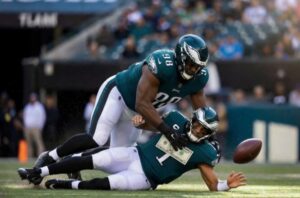
The final opportunity came against Washington in Week 8. McKee completed 23 of 34 attempts for 212 yards, threw an interception, lost a fumble and absorbed five sacks as the Commanders generated pressure on 46.5 percent of Philadelphia’s dropbacks.
Across three starts, McKee completed 72 of 114 passes for 638 yards, two touchdowns and two interceptions. His 5.6 yards per attempt and 10 sacks reflected an offense that rarely generated explosive plays and repeatedly struggled against pressure.
Those statistics also demonstrate the difficulty of separating quarterback performance from the environment surrounding him. McKee frequently operated behind compromised protection, received limited support from the running game and was asked to survive obvious passing situations created by earlier failures.
His individual limitations still became increasingly apparent. McKee offered little ability to escape pressure, threaten defenses with designed quarterback runs or manufacture plays after the original concept broke down.
On November 2, Nick Sirianni publicly supported McKee as Philadelphia’s starter for the Giants game. Two days later, reports indicated that Milton would receive the assignment, completing a remarkably abrupt change in the organization’s plans.
The Eagles have now decided that McKee’s three-game audition provided enough information to explore another possibility.
Joe Milton Changes the Possibilities for Philadelphia’s Offense
Milton brings an entirely different collection of physical tools to Philadelphia’s quarterback position. The 6-foot-5, 246-pound passer possesses exceptional arm strength, enough mobility to extend plays and the size to challenge defenders who attempt to bring him down in the open field.
His throwing ability offers immediate opportunities for the Eagles to attack defenses that have grown comfortable defending short and intermediate passing concepts. Milton can drive the football toward the sidelines, attack vertical routes and deliver passes across the field without requiring the same mechanical effort as many quarterbacks.
The potential impact extends beyond spectacular deep throws. Defenses must account for the possibility of Milton escaping the pocket, extending a play and forcing defensive backs to maintain coverage for additional seconds.
That mobility changes how opponents can approach Philadelphia’s protection problems. A free rusher who would almost certainly end a play against McKee may find himself chasing Milton toward the sideline, creating opportunities for receivers to uncover while the play continues.
Milton also provides a legitimate threat in the quarterback running game. Designed keepers, read-option concepts and occasional quarterback draws could force defenders to account for an additional ball carrier, creating opportunities for the running backs and altering how defenses align against Philadelphia.
The physical abilities are established. Milton’s 2024 regular-season appearance against Buffalo produced 241 passing yards, a touchdown and an additional rushing score, while his 2026 preseason with Dallas included 378 passing yards, three touchdowns and no interceptions.
The more difficult evaluation concerns how those abilities function against an NFL defense preparing specifically for him. Milton’s college career featured accuracy inconsistencies, delayed decisions and difficulties processing complex coverage, the same weaknesses professional defensive coordinators attempt to expose.
Philadelphia’s offense needs a quarterback capable of making decisions within the structure of the play. Milton will have opportunities to create outside that structure, although his long-term value will depend on how effectively he operates before improvisation becomes necessary.
Mannion Must Build an Offense That Takes Advantage of Milton
The Giants game provides Mannion with an opportunity to make meaningful changes to Philadelphia’s offensive approach. Milton’s physical abilities support a more varied collection of plays, although the coaching staff must remain disciplined about how those opportunities are introduced.
Under-center formations and play action could create favorable throwing angles while reducing the number of defenders Milton must evaluate immediately after the snap. Moving pockets and designed rollouts would also allow him to use his athleticism without requiring the offensive line to maintain a stationary pocket for extended periods.
Philadelphia should establish clear answers against pressure through quick routes, running back outlets and appropriately designed protection adjustments. Those options are particularly important for Milton, whose developmental concerns have consistently included hesitation when the defense removes his initial receiving option.
The vertical passing game should become a meaningful part of the plan. DeVonta Smith, when healthy, provides the route-running ability to win at multiple depths, while Dontayvion Wicks, Makai Lemon and Darius Cooper offer different forms of receiving talent that can challenge defenses when properly deployed.
The status of Philadelphia’s injured receivers will influence how aggressively Mannion can approach the game. That makes it especially important to create opportunities through formation, alignment and route combinations instead of depending entirely on individual matchups.
Mannion must also avoid placing Milton in the same situations that overwhelmed McKee. Excessive passing volume, repeated third-and-long opportunities and protection failures would increase the burden on a quarterback preparing for his first professional start.
There should be room for controlled aggression. Milton’s arm strength allows Philadelphia to attack intermediate and deep routes when the defensive alignment provides favorable conditions, while his mobility creates additional options when the original play develops poorly.
The objective should be an offense that allows Milton to make confident decisions, generates manageable down-and-distance situations and forces the Giants to defend more possibilities than Philadelphia’s previous opponents.
Joe Milton vs. the Giants Defense: A Difficult First Assignment
Milton’s first NFL start comes against a New York Giants team that has established itself as one of the more competitive surprises of the 2026 season. New York enters Week 9 at 4-2-1, leading the NFC East under first-year head coach John Harbaugh.
The Giants’ defense has provided an important foundation for that success. Through Week 8, New York ranks eighth in the NFL in total defense, allowing approximately 313 yards per game while recording 21 sacks and six interceptions.
Defensive coordinator Dennard Wilson presents another challenge for Philadelphia. Wilson previously coached the Eagles’ defensive backs and coordinated their defensive passing game during the 2022 Super Bowl season, giving this matchup an interesting connection to Philadelphia’s recent history.
Wilson now operates a Giants defense with several players capable of creating difficult situations for inexperienced quarterbacks. Abdul Carter provides an athletic pass-rushing threat, Arvell Reese and Tremaine Edmunds contribute to the linebacker group, and safety Jevon Holland has already recorded three interceptions.
New York has enough talent to challenge Milton in multiple ways. Wilson can use pressure to accelerate his decisions, disguise coverage before the snap and force him to recognize defenders moving into passing lanes after the ball is snapped.
Those tactics would directly challenge the areas of Milton’s development that generated concern during the 2024 draft process. His ability to diagnose pressure and maintain proper throwing mechanics when the first read disappears will be particularly important.
The Giants must also account for his ability to escape pressure and create explosive plays. Philadelphia can use Milton’s mobility to influence the pass rush, while his arm strength gives the Eagles opportunities to punish aggressive coverage when receivers gain favorable leverage.
The most revealing plays may occur on ordinary second- and third-down situations. Milton’s ability to take available completions, recognize favorable matchups and protect the football will reveal considerably more about his readiness than one extraordinary throw.
Philadelphia will need him to demonstrate command against a defense capable of exploiting inexperienced quarterbacks. That makes the Giants a meaningful early evaluation of the potential Milton brings to the organization.
The Opportunity Arrives at an Unusual Moment
Milton will make his first NFL start with Philadelphia entering a critical stretch of its season. A victory over New York would end a six-game losing streak, provide the team with some momentum entering its Week 10 bye and create an opportunity for the coaching staff to evaluate whether a different offensive approach can produce sustainable improvement.
The standings create considerable urgency. Philadelphia trails the division-leading Giants, and another defeat would leave the Eagles at 2-7 with eight games remaining and an increasingly narrow path toward postseason contention.
That pressure creates an unusual situation for a quarterback who has spent much of his professional career working behind established starters. Milton is receiving an opportunity to play meaningful football at a time when his team is desperate for production and the organization is beginning to confront major questions about its future.
He also arrives without the expectations that normally accompany a highly drafted quarterback. Milton entered the NFL as a sixth-round selection, spent most of his rookie season behind Drake Maye and was unable to secure a permanent role with Dallas.
Philadelphia acquired him for a comparatively modest commitment, creating an opportunity to evaluate a talented player without the financial and organizational obligations normally associated with a franchise quarterback.
A successful performance would provide the Eagles with another option at the most important position on the field. It could also earn Milton additional starts and a more substantial opportunity to demonstrate whether his development has progressed beyond the concerns that followed him out of college.
How Does Milton Fit Philadelphia’s Plans for 2027?
The timing of Milton’s opportunity becomes especially interesting when viewed alongside Philadelphia’s approaching quarterback decisions.
Bleed Green Sports has argued for months that Jeffrey Lurie and Howie Roseman completed their evaluation of Jalen Hurts before the 2026 season began. Our November 2 analysis, Why the Eagles Will Release Jalen Hurts, explains the organizational and financial factors behind our expectation that Philadelphia will move in another direction after the season.
That remains our editorial projection, with no official announcement from the Eagles establishing that such a decision has been made. Hurts’ medical recovery deserves separate consideration, and the quarterback’s long-term health must remain the priority while the organization determines its football plans.
The approaching 2027 NFL Draft creates additional possibilities. Our November 3 update of the 2027 quarterback class examines the prospects who could become candidates for Philadelphia, emphasizing processing, anticipation, pocket awareness and the ability to operate a complete NFL passing game.
Milton offers the Eagles another piece of information as they approach those decisions. At 26 years old, he has already spent three seasons in the NFL and possesses physical abilities that remain appealing despite the questions surrounding his development.
A productive series of starts could establish him as a legitimate candidate for a more substantial role in 2027. Philadelphia could enter the offseason with increased confidence in its quarterback depth and greater flexibility when determining how aggressively to pursue a player in the draft.
The evaluation must remain demanding. The organization needs to determine whether Milton can consistently make the decisions required of an NFL starter, especially when defensive coordinators begin tailoring their coverage and pressure packages to his weaknesses.
That process begins Sunday, with the possibility that the results could influence Philadelphia’s quarterback planning well beyond the remainder of 2026.
What Would a Successful First Start Look Like?
Milton’s evaluation should begin with his ability to operate the offense efficiently. Philadelphia needs sustained possessions, manageable third downs and enough explosive plays to prevent New York’s defense from concentrating its resources near the line of scrimmage.
The quarterback’s decision-making will be particularly revealing. Recognizing pressure before the snap, adjusting protection responsibilities and finding receivers when the initial concept is covered would demonstrate meaningful development in areas that previously limited his professional opportunities.
Accuracy matters just as much as arm strength. Milton must consistently deliver catchable footballs on short and intermediate routes, allowing his receivers to gain yards after the catch and reducing the number of possessions wasted by preventable incompletions.
There should also be opportunities for him to create plays with his legs. Philadelphia has enough experience operating with a mobile quarterback to understand how that threat can influence defensive assignments, although Mannion must incorporate those concepts into a cohesive offensive plan.
Most importantly, Milton needs to demonstrate that he can respond when the game becomes difficult. NFL defenses will adjust to his early success, and New York’s coaching staff will search for ways to exploit his weaknesses throughout the afternoon.
A productive first half would be encouraging. His ability to sustain that performance after halftime, when defensive adjustments become more sophisticated, could provide the strongest evidence of his potential.
Final Word: Joe Milton Has a Chance to Change His Career
The Eagles’ season has reached a point where every quarterback decision carries consequences for the present and the future. Milton enters that environment with limited professional experience, extraordinary physical ability and an opportunity that appeared distant when Dallas placed him on its practice squad in September.
There is something fitting about Philadelphia turning to a quarterback whose career has repeatedly been interrupted by opportunities that disappeared almost as quickly as they arrived. He has already demonstrated the determination required to survive those setbacks, and his performance Sunday will determine whether he can begin converting that experience into professional success.
The Giants will provide a challenging introduction to life as an NFL starter. Lincoln Financial Field will provide an equally demanding audience, with Eagles fans waiting to see whether their offense can finally produce the type of football they expected when the season began.
Milton has an opportunity to give Philadelphia a reason to believe that the remainder of 2026 can still produce something meaningful. He also has a chance to transform his own career by demonstrating that the quarterback selected 193rd overall in 2024 has developed into a player capable of handling NFL responsibilities.
The Eagles have searched for answers throughout a miserable six-game losing streak, and Sunday introduces another possibility. Joe Milton has finally been handed the football, the starting assignment and the opportunity to make his case.
Now he has to deliver.