















Tanner McKee has spent most of his football life waiting for somebody to see more than the obvious. He waited through cancer, a mission in Brazil, losing seasons at Stanford, 187 selections in the 2023 NFL Draft, two years on the bottom of Philadelphia’s quarterback depth chart, a failed summer trade market and a 2026 demotion behind a 38-year-old Andy Dalton.
Now the waiting is over. Jalen Hurts is out, Philadelphia is 2-3, and the quarterback nobody wanted badly enough to trade for is QB1 for a team trying to prevent a championship-caliber defense from carrying another broken season to nowhere.
This is the moment Tanner McKee has been preparing for since the Eagles used the 188th pick on him. It may also be the moment Sean Mannion finally discovers the quarterback best suited to run the offense he has spent months trying to install.
The Long Road to Philadelphia
McKee’s path never resembled the normal development track of an NFL quarterback. He was a highly regarded recruit at Centennial High School in Corona, California, and an Elite 11 finalist with offers from many of college football’s biggest programs. Alabama wanted him. Texas wanted him. The sport appeared ready to place him on the familiar expressway from blue-chip recruit to national television to the NFL.
Life intervened before football could become that simple. McKee was diagnosed with melanoma at 16 after his mother noticed a suspicious mole on his face. Doctors removed the mole and two lymph nodes from his neck. He recovered, returned to football and later stepped away from the game for nearly two years to serve a mission for the Church of Jesus Christ of Latter-day Saints in Curitiba, Brazil. He learned Portuguese, lived far from home and returned older than the typical freshman quarterback.
Stanford became the next stop. McKee played in only one game during the pandemic-shortened 2020 season, then took over an offense that rarely gave him favorable conditions. Across 23 college games, including 21 starts, he completed 63.2 percent of his passes for 5,336 yards, 28 touchdowns and 15 interceptions. Stanford went 3-9 in each of his two seasons as the primary starter. The record buried much of what evaluators liked about him: a 6-foot-6 frame, a compact release for such a tall passer, enough arm strength to attack tight windows and the patience to keep functioning inside a collapsing offense.
The flaws were visible too. McKee lacked the mobility that had begun to define the modern position. His footwork could become deliberate, pressure disrupted his timing and he offered little of the off-script creation that turns broken plays into highlights. He entered the draft as a traditional pocket passer in a league increasingly fascinated by quarterbacks who could manufacture offense with their legs.
Philadelphia saw enough value to take him in the sixth round. The Eagles had Jalen Hurts coming off an MVP-caliber season and a Super Bowl appearance, so McKee arrived without a path to immediate playing time. He was a developmental pick for an organization that has always believed in taking extra swings at quarterback.
That decision looks much larger today than it did on April 29, 2023, because Philadelphia’s developmental quarterback has become the emergency plan for an entire season.
The Rookie Who Kept Making People Look Twice
McKee began changing the conversation during his first preseason. He threw for 453 yards across three games in 2023, displaying poise and command that looked unusual for a sixth-round rookie working with reserve linemen and receivers. His numbers were imperfect, including a 54.2 percent completion rate, yet the film repeatedly showed a passer willing to stand in the pocket, work through concepts and deliver throws before windows closed.
The regular season offered no opportunity. McKee stayed behind Hurts and Marcus Mariota as a rookie, then entered 2024 behind Hurts and Kenny Pickett. Every summer seemed to produce another veteran placed between McKee and the field. Every summer also ended with people inside and outside the building wondering whether the young quarterback had played better than the veteran ahead of him.
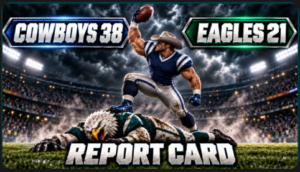
His first meaningful NFL action finally came against Dallas in December 2024. Pickett left with an injury, and McKee entered a division-clinching game with four career pass attempts waiting to happen. He completed three of them for 54 yards and two touchdowns. No player in the NFL Draft era had ever thrown multiple touchdown passes in his debut while attempting five or fewer passes.
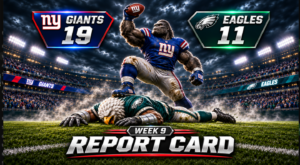
One week later, with Philadelphia resting starters against the Giants, McKee completed 27 of 41 throws for 269 yards, two touchdowns and zero interceptions in his first start. He remained calm, identified answers before the snap and distributed the ball to a collection of reserves. His 2024 line finished at 30 completions on 45 attempts, 323 yards, four touchdowns, zero interceptions and a 117.2 passer rating.
That was the first real rise of Tanner McKee. A player drafted as a long-term project had suddenly looked like one of the league’s more intriguing young backups. Trade speculation followed because that is what happens when a quarterback plays well in Philadelphia and lacks a clear route to the starting job.
Washington Changed the Temperature
The hype cooled at the end of the 2025 season. Philadelphia rested most of its starters against Washington in Week 18 while retaining a chance to improve its playoff seeding. McKee started with an offense built largely from second-string and third-string players and completed 21 of 40 passes for 241 yards, one touchdown and one interception in a 24-17 loss.
The performance was mediocre. McKee missed throws, held the ball too long at times and struggled when Washington forced him off his spot. He completed only one of 14 passes under pressure for 12 yards. Those numbers cannot be erased by pointing to the personnel around him.
The context still matters. Philadelphia committed nine penalties for 123 yards, surrendered three sacks and asked a stationary quarterback to survive pressure behind a reserve-heavy unit. McKee also delivered an accurate, on-time touchdown to Grant Calcaterra and produced enough offense to keep the Eagles within one score. It was a poor audition rather than a final verdict.
That distinction became essential during the following offseason. The league appeared to remember Washington more vividly than Dallas or New York.
The Summer Nobody Wanted Tanner McKee
The Eagles acquired Andy Dalton from Carolina in March 2026 for a 2027 seventh-round pick. Dalton brought 169 career starts, a respected veteran presence and immediate credibility as a backup. His arrival also placed McKee’s future under a microscope.
Trade speculation followed him through the entire summer. Every quarterback injury elsewhere became a possible destination. Every Dalton rep with the second-team offense became evidence that Philadelphia was preparing to move McKee. Every McKee preseason throw felt like an audition for 31 other teams.
The competition never became convincing. Dalton started the first two preseason games and regularly received the first opportunity with the second unit. McKee completed 34 of 54 preseason passes for 263 yards, two touchdowns and one interception. Dalton finished 18 of 35 for 168 yards, one touchdown and no interceptions. Neither passer seized the job, and the rotation prevented either from establishing much rhythm.
Philadelphia kept Hurts, Dalton, McKee and fifth-round rookie Cole Payton on the initial 53-man roster. Carrying four quarterbacks was awkward roster management and an unmistakable sign that the Eagles had spent August waiting for a trade offer.
The offer never arrived. The harsh reading is the one McKee had to live with: nobody wanted him, at least at the price Howie Roseman was willing to accept. The flashes from 2024 had failed to create a meaningful market after the uneven Washington start and a forgettable preseason.
Then came the demotion. Dalton dressed as Hurts’ backup for the first three games while McKee was inactive as the emergency third quarterback. The young passer who had once seemed destined to become a valuable trade chip had fallen behind an aging veteran on his own team. McKee responded in the only way available to a third-string quarterback. He kept preparing.
From QB3 to QB1 in Less Than Three Weeks
Dalton’s lone regular-season pass as an Eagle came when Hurts briefly left the Week 3 loss in Chicago for a head-injury evaluation. Dalton threw an interception in the end zone. By the following week, McKee had moved ahead of him. Philadelphia released Dalton on October 9, ending one of the strangest backup competitions the Eagles have staged in years.
Six days later, football became secondary. The Eagles announced that Hurts would miss the Carolina game after doctors discovered a superficial blood clot in his calf. The condition followed treatment for a calf injury suffered against the Rams, and the uncertainty around his return extends beyond one Sunday. Philadelphia has confirmed his Week 6 absence. A longer absence, potentially the remainder of the season, remains possible while doctors determine the safest course.
Everyone at Bleed Green Sports wishes Jalen Hurts a complete recovery. Football is a game, and his health matters far more than the standings, the offense or any debate about his future in Philadelphia. There will be time later to revisit the argument that 2026 could be Hurts’ final season with the Eagles. Right now, the priority should be Hurts the person and his long-term health.
The football consequences still have to be confronted. The Eagles are 2-3 after three consecutive losses. The latest NFL power rankings reflect a team sliding away from the league’s contenders, and the loss to Jacksonville in London showed how quickly an elite defensive performance can be wasted by offensive dysfunction and poor late-game management.
McKee has gone from emergency QB3 to starter in less than three weeks. The player the Eagles could not trade is now the player they need to save their season.
Why McKee May Fit Sean Mannion’s Offense
Sean Mannion came to Philadelphia promising a modernized attack built around outside zone, under-center formations, motion, play action and throws created through sequencing. The early results have been inconsistent. Concerns began in the preseason, when the Mannion honeymoon ended before the games counted, and five regular-season games have yet to establish a dependable offensive identity.
McKee offers Mannion a different type of operator. His game lives inside structure. He wins by seeing the field, setting his feet and delivering the ball on time. His height gives him a clean view over the middle, his release is quicker than his long frame suggests, and his willingness to take the available completion can help an offense that has spent too many drives hunting for a dramatic answer.
Those traits map naturally onto Mannion’s preferred system. Under-center play action can give McKee defined reads and create space behind linebackers. Motion can help him identify coverage before the snap. Layered route combinations can use his anticipation and touch. Outside zone can move the defensive front horizontally, creating the throwing lanes a pocket passer needs on bootlegs, half-rolls and reset throws.
The supporting cast also contains players who can make that approach work. DeVonta Smith can win quickly at every level. Dontayvion Wicks can attack intermediate windows. Tight ends can become friendly targets between the numbers. Darius Cooper’s rise has given Philadelphia another decisive route runner who can present McKee with a clear, quick outlet. Cooper and McKee also share the experience of being treated as replaceable before circumstance finally opened a door.
Mannion must protect the conditions that allow McKee to function. Washington supplied the warning in January. When pressure arrives immediately and the offense falls behind the chains, McKee lacks Hurts’ ability to escape and create a first down with his legs. The run game has to become credible. Protection calls have to become cleaner. Mannion must provide answers against the blitz and resist asking his quarterback to live on third-and-long.
That discipline could help the entire operation. McKee’s physical limitations force the play caller to build a coherent plan around timing, protection and connected concepts. Every pass needs a purpose. Every motion needs to reveal or influence the defense. Every run fake needs to set up something that appears later. Mannion now has a quarterback whose success depends on the system being implemented as designed, which may be exactly what this offense needs.
The Defense Has Already Bought Him Time
Philadelphia still has enough defensive talent to keep games manageable while McKee settles into the job. The young core has repeatedly created opportunities the offense failed to cash in, and the continued development described in Jalyx Hunt’s journey toward becoming the Eagles’ next defensive star gives Vic Fangio another versatile weapon, in the next few weeks, who can affect the quarterback without simplifying the coverage behind him.
That matters for McKee. He should not have to win shootouts every week. If the defense can control field position and keep opponents near 20 points, Philadelphia can lean on its running game, use play action and ask McKee to make a handful of high-leverage throws. His best NFL performances have come under similar conditions, when the offense stayed on schedule and he could distribute rather than improvise.
The Eagles need competence before they need heroics. They need first downs that allow the defense to breathe, red-zone possessions that end with touchdowns and a quarterback who operates the call without turning every snap into a referendum on the entire offense.
McKee has already shown he can do those things in short stretches. The next stage of his journey is proving he can sustain them when the opponent has prepared for him, the starters are playing and the season depends on the result.
Tanner Time Finally Means Something
The easy version of this story turns McKee into the next great Eagles backup before he starts a meaningful game. His career deserves a more honest reading. He has thrown only 88 regular-season passes. His finest work came against Dallas and New York at the end of 2024. His most recent start exposed serious problems against pressure. The 2026 preseason gave the Eagles enough doubt to place Dalton ahead of him.
Every concern is legitimate, and so is the opportunity. McKee survived cancer as a teenager, left football for a mission, returned to play for a collapsing college program, waited until the sixth round to hear his name, impressed in three straight preseasons, delivered four touchdowns without an interception when his first NFL chance arrived, absorbed a bad start, endured a summer as trade bait and spent September wearing the emergency quarterback designation. Now he walks into the huddle as QB1.
The Eagles need the version of Tanner McKee that made Philadelphia draft him: calm, accurate, decisive and comfortable letting the offense create the answer. If Mannion commits to under-center play action, motion, intermediate throws and a real running game, McKee may give the coordinator his cleanest opportunity yet to show what this system was supposed to become.
The quarterback nobody wanted has inherited the season nobody in Philadelphia is ready to surrender. Tanner McKee has spent his career waiting for the door to open. It is open now, and the entire Eagles season is standing on the other side.