















The Philadelphia Eagles scored 10 points in the first quarter Sunday night and disappeared. Washington answered with the final 27 points, shut out Philadelphia across the last three quarters and sent the Eagles into last place in the NFC East with a 27-10 defeat at Northwest Stadium.
Philadelphia has lost six consecutive games after opening the season 2-0. The skid is the franchise’s longest since 2012, when the Eagles lost eight straight during Andy Reid’s final season, and it has already moved beyond anything Nick Sirianni previously experienced as a head coach.
Our Eagles-Commanders II preview gave Washington the advantage because its rushing structure attacked the weakness Dallas exposed and its defense could force Tanner McKee into another pass-heavy game. The prediction was Commanders 27, Eagles 20. Washington supplied the exact winning score and removed the extra 10 points Philadelphia was expected to find.
The Eagles opened with an 8:50 field-goal drive, then Andrew Mukuba forced a Chig Okonkwo fumble that Zack Baun recovered at the Washington 26. McKee found Saquon Barkley for 24 yards on the next snap, and Barkley finished the short field with a direct-snap touchdown. Philadelphia led 10-0 with 4:27 remaining in the first quarter.
That was the offense for the night. Washington adjusted its pressure plan, sacked McKee repeatedly and limited the Eagles to 268 yards. Sixty-nine of those yards came during the final possession after the outcome had been decided. Philadelphia generated 199 yards while the game still mattered and never entered the end zone after the turnover created its only touchdown. (Eagles-Commanders game recap and box score)
Last week’s Dallas report card described an offense that finally functioned while the defense collapsed. Washington reversed the order. Vic Fangio’s defense kept Philadelphia within one possession deep into the fourth quarter, and the offense wasted every chance it received.
Team Grade: F
An F belongs to a team that turned a 10-point lead into a 17-point loss against a one-win division opponent. Washington entered with the league’s 31st-ranked scoring defense, spent the first quarter committing penalties and handed Philadelphia a possession inside the 30. The Eagles still found a way to go scoreless for 49 minutes.
The offense failed to create an answer after Washington crowded the line, changed the pressure picture and closed the short passing lanes. The offensive line lost one-on-one blocks, McKee held the ball when the first read disappeared and Sean Mannion kept calling a game built around a quarterback who had stopped processing it.
The defense produced enough stops to keep the score at 16-10 entering the fourth quarter. That unit eventually cracked under the weight of explosive passes and an offense that provided no rest, no field position and no points. Special teams erased a made field goal with an alignment penalty before Jake Elliott hit the upright on the retry.
Philadelphia lost every quarter after the first and every meaningful adjustment after Washington settled into the game. The result moved the Eagles below the Commanders and turned next week’s meeting with the Giants into another opportunity to measure how far the season has fallen.
Offensive Player Grades
Tanner McKee: D-
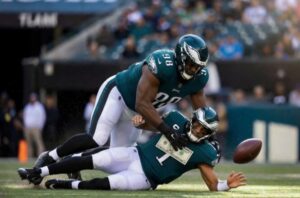
McKee completed 23 of 34 passes for 212 yards, no touchdowns and one interception. He absorbed five sacks, lost a fumble on one of them and finished with a 72.2 passer rating. The completion percentage hides an offense that rarely threatened Washington beyond the first read or the line to gain.
His opening work was competent. He hit Makai Lemon for 20 yards, found Darius Cooper on second-and-5 and delivered the throw to Barkley that created the touchdown. Washington then changed the picture, and McKee never solved it. He took a seven-yard sack on second-and-5 during the first drive of the second quarter, lost the ball on a third-and-4 strip-sack in the third and turned a late fourth-and-25 desperation throw into the interception that set up Washington’s final touchdown.
Monday Night Should Be Tanner McKee’s Last Chance called for quicker decisions, useful pocket movement and a benching if the offense remained broken. McKee survived Dallas by clearing the first-half scoring threshold. Against Washington, seven of the first 10 points came from a 26-yard field created by the defense, and Philadelphia never scored again.
Joe Milton should have replaced him after the strip-sack. The Eagles needed a different arm, a different movement profile and a reason for Washington to reconsider the same pressure plan. Cole Payton remained the emergency quarterback, so the available change was Milton. Sirianni and Mannion watched McKee finish the game instead.
Saquon Barkley: C+
Barkley carried 13 times for 30 yards and scored on the direct snap. His best offensive contribution came through the air when he gained 24 yards on the play after Baun’s recovery. Washington held every one of his runs to five yards or fewer.
The hamstring and back injuries provide context for the missing explosion. The Eagles still chose to build the early offense around him, and the run game produced no leverage once Washington tightened the front. Barkley handled the available work without creating the play Philadelphia needed after the first quarter.
Elijah Mitchell: C
Mitchell rushed 11 times for 34 yards and caught four passes for three yards. He converted a third-and-2 during the second quarter and gained six yards before the nullified field goal attempt, although most of his touches ended in crowded space.
The receiving total explains the problem. Mannion used Mitchell as an outlet without giving him room to turn those throws into offense. Mitchell ran hard enough to keep his grade near the middle, and the structure around him produced almost nothing.
Makai Lemon: B
Lemon caught six of nine targets for 57 yards and produced the wide receivers’ only 20-yard reception during competitive game action. He remained McKee’s most reliable target, finding space on intermediate routes and converting a third down during the third quarter.
The rookie also contributed to the final possession after Washington had removed the stakes. His grade reflects another solid performance inside an offense that rarely gave its receivers opportunities to change the game.
Eli Stowers: C+
Stowers caught all three targets for 53 yards in his first meaningful receiving role. His 7-yard reception helped the opening second-half drive move toward midfield, while the other two catches came during the final seconds with Washington protecting a three-score lead.
The production deserves recognition without pretending the timing carried equal value. Stowers showed dependable hands and enough route skill to earn more work against the Giants.
Dallas Goedert: C+
Goedert caught four passes for 30 yards and converted a third-and-7 with a 16-yard reception. Washington kept him underneath on the other catches, and the offense never created a red-zone target for its most established healthy receiver.
His only rushing attempt gained two yards. Goedert executed the limited role Mannion gave him, while the game plan failed to turn that role into points.
Darius Cooper: D
Cooper caught two of six targets for 19 yards. He moved the opening drive with an 11-yard reception, then disappeared while Washington forced McKee to find answers outside the first read.
The final interception was thrown in his direction on fourth-and-25. Cooper had little chance to rescue that play, although four other targets also ended without a completion. A receiver who scored four early touchdowns has become a minor part of a damaged passing game.
Hollywood Brown: C
Brown caught both of his targets for 17 yards. One came during the final drive, leaving a single 8-yard reception while the game remained competitive.
Philadelphia signed Brown to add speed and a veteran answer against pressure. Two targets do not provide either function, and the distribution belongs as much to Mannion as it does to the receiver.
Offensive Line: F
Washington’s rush took over after the first quarter. Sheldon Tuttle, Charles Omenihu, Dorance Armstrong, K’Lavon Chaisson and Odafe Oweh each reached McKee, and Armstrong forced the fumble that ended Philadelphia’s best third-quarter possession.
Markel Bell committed a false start before the fourth-quarter field-goal sequence. Jordan Mailata then lined up illegally, wiping away Elliott’s make and turning a manageable attempt into a miss. The line failed in protection, failed to create a consistent running lane and committed the penalty that removed Philadelphia’s final realistic chance to make the game close.
Defensive Player Grades
Andrew Mukuba: B+
Mukuba forced Okonkwo’s first-quarter fumble and led Philadelphia with seven solo tackles and two assists. He also broke up a red-zone throw intended for Okonkwo, helping the defense hold Washington to a field goal after the Eagles’ fumble.
Rachaad White reached his level on the late 33-yard run, and Mukuba prevented the touchdown before Washington finished the drive from the 1. The safety created the only takeaway and remained involved across every level, making him the best Eagles player on the night.
Zack Baun: B
Baun recovered Mukuba’s forced fumble and finished with seven combined tackles. His stop of Austin Ekeler for no gain helped force a goal-line field goal, and he consistently closed the interior lanes Washington tried to create.
The final touchdown drive reached him after the interception gave Washington a short field. Baun did enough to keep the defense organized before the offense made the workload impossible to overcome.
Jalen Carter: B
Carter recorded a 12-yard sack, five combined tackles and a late run stop that helped force Washington’s fourth field goal. The pass rush finally received disruption from the middle after producing nothing against Dallas.
His encroachment penalty during the two-minute sequence gave Washington a shorter second down, although the defense recovered and forced a punt. Carter responded to his failing grade from last week with a credible performance that needed help from the offense.
Nolan Smith: B
Smith returned from the concussion protocol and produced a fourth-quarter sack that held Washington to three points. He also pressured Daniels on the incompletion before halftime that prevented the Commanders from extending the final drive.
The edge group looked more functional with Smith available. His return improved the rush without solving the explosive completions behind it.
Jeremiah Trotter Jr.: B-
Trotter finished with 10 combined tackles and helped hold Washington to a field goal after the 53-yard completion to Treylon Burks. His fourth-quarter stop of White for no gain kept another drive from reaching the red zone.
Washington still averaged more than five yards per rush, with the largest gains arriving once the game had stretched the defense. Trotter handled the volume and generally finished the plays that reached him.
Quinyon Mitchell: D+
Mitchell allowed Burks to get behind him for the 53-yard completion that moved Washington from its own 40 to the Philadelphia 7. The defense prevented the touchdown, which kept the game within six, though the coverage loss created the entire scoring opportunity.
Mitchell added three solo tackles and avoided another damaging completion. One explosive mistake carried enormous weight in a game where the Eagles offense could not answer any points.
Riq Woolen: C-
Burks beat Woolen for a 21-yard gain during Washington’s touchdown drive, and a later holding penalty was declined because Okonkwo gained more on the completion. Washington continued testing his side after Dallas had established the matchup.
Woolen prevented Antonio Williams from adding yards after an early catch and finished with three solo tackles. The improvement from Monday was modest, and the opponent still found completions whenever the pass rush arrived late.
Special Teams Grade: C
Elliott opened the scoring from 40 yards and later hit from 36 before Mailata’s illegal formation erased the kick. His second attempt struck the left upright from 41, turning a possible 16-13 game into a possession that produced nothing.
Braden Mann averaged 44.2 yards across five punts and placed three inside the 20. A 27-yard Luke McCaffrey return before halftime gave Washington midfield position for the field goal that created the 13-10 lead.
Jaydon Blue averaged 24 yards across six kickoff returns and broke a 34-yarder that gave the offense useful field position late. Cooper DeJean added a 12-yard punt return. The return units were functional, and the missed opportunity on the field-goal sequence defines the grade.
Sean Mannion: F
Mannion’s opening script moved the ball methodically, although it ended with a field goal after consuming nearly nine minutes. The second score required Mukuba and Baun to hand the offense a short field. Once Washington adjusted, Mannion never produced another answer.
The concerns first documented in The Mannion Honeymoon Is Over have become the offense’s identity. The concepts disconnect when the first plan fails, pressure removes the intermediate passing game and the quarterback receives no reliable counter after the defense changes the picture.
Mannion also participated in the decision to leave McKee on the field. Milton was active as QB2 and offered a different physical skill set after the strip-sack made the need obvious. Keeping the same quarterback preserved the same problems and produced the same empty scoreboard.
Vic Fangio: D-
Washington gained 339 yards, including 135 on the ground, and averaged 5.9 yards per play. The defense allowed six scoring possessions and surrendered explosive gains to Burks, Williams and White.
That total requires context from the game state. Fangio’s unit created a turnover, produced two sacks and forced four field goals. Washington had 19 points with fewer than four minutes remaining, and the last touchdown followed McKee’s interception and a 33-yard run from a short field.
The defense improved considerably from Dallas. It did enough to make an ordinary offensive performance competitive and received nothing after the first quarter. A D- recognizes the stops while holding Fangio responsible for the explosive plays that kept Washington moving.
Nick Sirianni: F
Sirianni’s team now occupies last place in the division after extending the losing streak described above. The opponent made the necessary adjustments, while Philadelphia responded with penalties, sacks and a turnover.
The quarterback decision belongs to the head coach. McKee remained on the field after the offense lost its structure and after his fumble turned a promising possession into Washington points. Sirianni protected continuity at the expense of creating any chance for a different outcome.
The weekly message about fighting carries less value each time the same failures return. An F reflects the result, the standings and a coaching staff that refused to make the most obvious available change.
Player Of The Game: Andrew Mukuba
Mukuba created Philadelphia’s only touchdown opportunity by forcing the first-quarter fumble. He remained the defense’s most active tackler and helped prevent Washington from converting a later turnover into seven points.
The late rushing gain keeps the performance from an A. His takeaway, range and red-zone coverage still made him the clearest choice on a night with few complete performances.
Scapegoat Of The Game: Tanner McKee
McKee received the third start and another favorable defensive matchup. Washington entered near the bottom of the league against the pass, then held Philadelphia without an offensive point after the short-field touchdown.
The protection failed around him, and Mannion failed to create counters. McKee still held the ball, lost the fumble and never forced the coaches to reconsider the bench through his play. The short leash should be gone now.
Top Five Eagles
Andrew Mukuba: B+
Mukuba created the takeaway that produced Philadelphia’s touchdown and led the defense in activity. His performance kept the Eagles ahead while the offense was already beginning to stall.
Zack Baun: B
Baun secured the fumble, communicated the front and contributed to an important goal-line stand. He remained steady as the defense spent most of the second half protecting a one-score margin.
Jalen Carter: B
Carter responded to the Dallas loss with interior pressure and better run defense. His sack ended a third-quarter drive before Washington could cross midfield.
Nolan Smith: B
Smith’s return gave the edge rotation a needed finisher. His fourth-quarter sack preserved one last chance for the offense to make the game competitive.
Makai Lemon: B
Lemon remained the most dependable healthy receiver and produced the passing game’s best early play. He continues earning targets even while the offense around him loses functionality.
Honorable Mention: Jaydon Blue and Jeremiah Trotter Jr. Blue gave the return game reliable field position, while Trotter handled a heavy tackling workload without becoming the source of Washington’s explosive plays.
Bottom Five Eagles
Sean Mannion: F
Mannion had no counter after Washington changed its pressure plan. The scoring drought continued, and the coordinator never used the backup quarterback available to him.
Nick Sirianni: F
Sirianni accepted another second-half collapse and another week of the same offensive answers. The streak and the division position now define the season he is leading.
Offensive Line: F
The line lost the protection battle and committed the penalty that erased a successful field goal. Washington controlled the pocket without needing exotic answers after halftime.
Tanner McKee: D-
McKee failed to create a touchdown drive that began outside Washington territory. His fumble ended the best chance to reclaim momentum, and the late interception finalized a performance that should cost him the starting job.
Quinyon Mitchell: D+
Mitchell’s coverage loss created Washington’s largest gain and flipped the field immediately after the strip-sack. The defense recovered in the red zone, which prevented the mistake from becoming more damaging.
Final Word
The quarterback evaluation has reached its answer. McKee received three starts, multiple game plans and enough opportunities to show that the offense could operate through him. Philadelphia has lost all three, with each defeat exposing the same late-game ceiling.
Milton should start against the Giants. His arm strength and mobility may create a different set of problems, and the Eagles need information about the second quarterback before the season becomes a series of ceremonial losses. Payton remains the emergency option unless the depth chart changes.
The larger quarterback question remains connected to the organizational case that 2026 could be Jalen Hurts’ final season in Philadelphia. Hurts’ recovery continues to matter more than football, and everyone at Bleed Green Sports wishes him a full recovery. The roster still needs an honest evaluation of every available option behind him.
Philadelphia’s draft position is moving in the opposite direction of its season. The latest 2027 NFL Draft quarterback tiers place Darian Mensah at the top and identify the next group of first-round candidates. Howie Roseman has more reason to study each one after another loss built around inadequate quarterback play.
The preview produced the correct winner, spread result and exact Washington score. The total stayed under, dropping that part of the prediction. BGS improves to 5-3 against the spread and 4-4 on the Moneyline while falling to 3-5 on totals through eight Eagles games.
The Giants visit next, and Philadelphia has one week to decide whether it wants a different quarterback or another version of the same game. Washington already supplied the final judgment on the current version.