











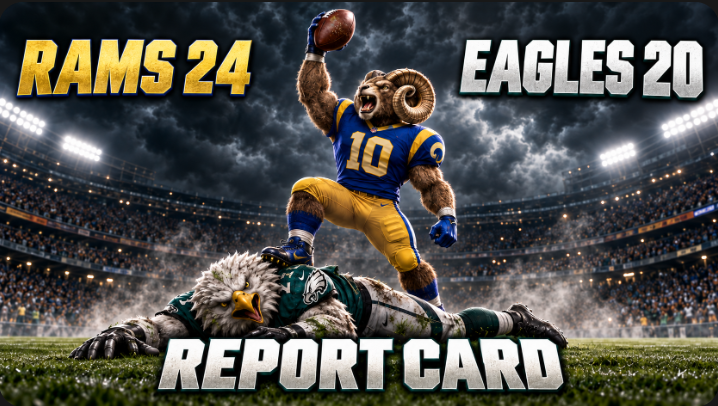
The Philadelphia Eagles found a more painful way to lose Sunday. One week after getting embarrassed by a third-string quarterback in Chicago, Philadelphia wasted a 10-point fourth-quarter lead at home and lost 24-20 to a Los Angeles Rams team that spent most of the afternoon trying to hand the game away.
Philadelphia entered training camp selling a slogan that now deserves to be thrown directly back at its leaders: 100% alignment. 0% entitlement. Jalen Hurts wrote the phrase down as a T-shirt idea after listening to Nick Sirianni’s opening address, then used it to introduce the team’s mentality during his first camp news conference. Sirianni embraced the message and explained that the entire team needed to pull in the same direction.
The slogan also landed as a subtle jab at A.J. Brown after Philadelphia traded him to New England. The message suggested that Brown’s departure had cleared away the drama, aligned the locker room and restored collective purpose. Hurts and Sirianni presented themselves as the leaders of a healthier operation.
Everything that followed exposed the slogan. Hurts threw interceptions throughout camp and the New England joint practices, the offense stumbled through three ugly preseason losses, and the Eagles survived uneven performances against Washington and Tennessee. Chicago then provided the clearest test of alignment: Hurts took a vicious late hit, almost nobody defended him, he screamed at Sirianni on the sideline and the team emerged from halftime looking completely disconnected.
Philadelphia received every opening required to win. The defense created takeaways, special teams changed field position, Los Angeles missed a field goal, and an opponent playing without Aaron Donald donated 100 yards through penalties. The Eagles answered those gifts by disappearing offensively and inviting the Rams to take the game back.
The final six possessions produced no points, no response and no evidence that anyone in charge knew how to stop the collapse. Los Angeles accepted the invitation with two Kyren Williams touchdowns during the final four minutes.
That collapse made our Rams preview look optimistic. Bleed Green Sports predicted a 27-10 Los Angeles victory because Sean Mannion had shown no ability to repair the offense after an opponent adjusted, Nick Sirianni had lost control of critical situations and Hurts had become increasingly uncomfortable inside a passing game that kept shrinking around him. The Eagles stayed close because Vic Fangio’s defense created extra possessions and controlled the game for three quarters. The offense eventually proved every concern correct.
Injuries mattered. DeVonta Smith, Dallas Goedert, Lane Johnson and Zack Baun were inactive, while Saquon Barkley left during the opening possession with a hamstring injury. Jonathan Greenard later exited with an ankle injury. Those absences explain why several young players received major roles. They do not absolve the people responsible for keeping an NFL offense functional.
Philadelphia is 2-2 after consecutive losses that exposed a broken offense built on broken alignment. Sirianni’s judgment, Mannion’s design and Hurts’ limitations feed one another whenever adversity arrives. The Eagles have three men sharing control of the offense and nobody capable of fixing it.
Team Grade: D+
The defense and special teams repeatedly handed the offense short fields through takeaways and a long return. Philadelphia kept receiving possession within striking distance and rarely proved capable of traveling there on its own. The field-position advantage concealed the offense’s inability to sustain anything until the Rams finally stopped donating opportunities.
The four scoring possessions officially covered 17, 29, 17 and 35 yards when accepted penalty yardage is included. They totaled 98 yards, exactly the length of the Rams’ fourth-quarter touchdown drive from their own 2. One Los Angeles possession matched the combined distance of every Eagles scoring drive.
The apparent contradiction between a 17-yard drive and Darius Cooper’s 18-yard touchdown catch comes from a one-yard loss on the preceding play. The final scoring possession traveled 35 yards, with a 25-yard pass-interference penalty doing most of the work before Cooper scored from the 10. Those details make the offensive dependence on manufactured field position even uglier.
The official box score captures the humiliation. Los Angeles held a 415-172 advantage in total yardage, a 26-12 advantage in first downs and a 309-68 advantage in net passing yards. The Rams ran 77 plays while Philadelphia ran 58, even though the Eagles won the turnover battle 2-0. Philadelphia also went 0-for-12 on third down and converted only one of four fourth downs.
An NFL team that wins the turnover battle and carries a two-score advantage into the fourth quarter should finish the job. Philadelphia gave away a game that the defense and special teams had placed in its hands.
The offense earned an F and the coaching decisions belonged in the same sewer. Fangio’s defense and an excellent special-teams performance did enough to raise the overall team grade to a D+. They supplied every reason Philadelphia remained competitive and prevented the collective grade from matching the offense’s failure.
This is where the training-camp motto crumbles under the weight of what the Eagles have actually shown. A team operating with 100 percent alignment does not leave its quarterback virtually undefended after a brutal hit, showcase a public sideline argument between its franchise quarterback and the head coach, banish the offensive coordinator to the coach’s booth to maintain control, and then generate consecutive scoreless second halves. A team practicing zero entitlement does not feature a coach fighting to preserve authority and a quarterback’s PR team weaponizing the media to redirect blame and evade accountability.
If even half of what our eyes and ears are telling us is accurate, the offense is broken because the alignment behind it is broken. Sirianni appears consumed with maintaining control, Hurts appears determined to redirect accountability and Mannion looks trapped between two competing power centers while failing at his actual job. Their dysfunction is no longer hiding behind a training-camp slogan.
Offensive Player Grades
Jalen Hurts: F
Hurts threw two touchdown passes and avoided an interception. Those numbers provide the thinnest possible layer of respectability over a performance that was unacceptable for a veteran quarterback carrying a $255 million contract.
He completed 44.4 percent of his passes, averaged 3.4 yards per attempt and finished with 93 passing yards. His first touchdown required Cooper to take the football away from Quentin Lake on a throw that was floating toward a defender. His second came from 10 yards after DeJean’s interception and a pass-interference penalty created the opportunity.
Hurts did very little outside those short fields. He repeatedly failed to find a solution when Los Angeles pressured him, lost a fourth-and-1 sneak late in the third quarter and could not punish a defense that kept challenging his processing speed. The Rams steadily removed the comfortable answers, and Hurts never created a new one.
At some point, Jalen defenders need to come to grips that GETTING NOTHING FROM HIM IN THE 2ND HALF IS UNACCEPTABLE!— BleedGreenSports (@bleedgrnsports) October 4, 2026
The final drive was especially damning. A franchise quarterback receiving the ball with 1:10 remaining needs to give his team a chance. Hurts held the ball, absorbed a seven-yard sack, fumbled on another sack and turned the final snap into a desperation throw from his own 12. Byron Young wrecked the possession because Philadelphia had no quick answer and Hurts supplied no independent one.
The injuries around him were significant. A quarterback approaching his third contract is paid to elevate compromised personnel, identify pressure, accelerate decisions and keep the offense functional. Hurts made every limitation around him look larger.
Saquon Barkley: Incomplete
Barkley carried twice for eight yards before leaving with a hamstring injury on the opening possession. Philadelphia lost its most dangerous offensive player before the game had developed, forcing Tank Bigsby and Will Shipley into larger roles.
The injury changed the personnel available to Mannion, although it did not require the passing game to collapse. Barkley’s absence removed the most forgiving piece of the offense and exposed how little adaptability remained behind him. A serious coaching staff must have a functional plan that survives one injury, even when the injured player is its best weapon.
Tank Bigsby: C
Bigsby rushed 14 times for 55 yards and produced Philadelphia’s longest run, a 19-yard gain that started the fourth-quarter march to the Rams’ goal line. He ran hard enough to keep the offense on schedule during several possessions and avoided the turnover that destroyed his grade in Chicago.
The 3.9-yard average was ordinary, and he was injured late after becoming the primary runner. Bigsby gave Philadelphia competent emergency production. The coaches and quarterback did almost nothing with it.
Will Shipley: C+
Shipley rushed six times for 23 yards and handled the kickoff work after Barkley went down. Three consecutive fourth-quarter runs moved Philadelphia to the doorstep, creating the decision that should have made the game much more difficult for the Rams.
He did his job within a limited role and helped create Philadelphia’s best chance to put the game away. The coaches wasted the opportunity by taking the ball away from the backs at the goal line and trusting the weakest part of the offense to finish the job.
Darius Cooper: A-
Cooper caught three passes for 33 yards and scored both Philadelphia touchdowns. His first was an outstanding competitive play, as he tracked a dangerous throw, fought Lake for possession and stole a touchdown from a defender who appeared positioned to intercept it.
He later found open space in the middle of the end zone for a 10-yard score with three seconds remaining before halftime. Cooper also made a special-teams tackle and finished as Philadelphia’s leading receiver. Seven targets produced only three receptions, although the quality of those opportunities varied wildly. Read more about Cooper’s rise coming into the season here.
Makai Lemon: C+
Lemon caught three of six targets for 27 yards. His 13-yard reception on fourth-and-2 extended a scoring drive, and his early eight-yard catch showed the underneath reliability Philadelphia needed without Smith.
The rookie could not create a larger impact inside a passing game that produced five first downs through the air. Lemon continues to look capable of helping a functional offense. Philadelphia does not currently have one.
Dontayvion Wicks: D+
Wicks caught three passes for 18 yards on five targets. His most valuable contribution came when his downfield target drew pass interference and moved the Eagles to the Rams’ 10 before halftime.
Philadelphia needed Wicks to threaten a defense missing major pieces, especially with Smith unavailable. The offense never established that threat, and Wicks finished with six yards per catch while the field became smaller on every possession.
Zach Ertz: D
Ertz caught two passes for 13 yards on four targets in his return to Lincoln Financial Field. The Eagles needed a dependable middle-of-the-field option with Goedert injured, yet Ertz never became a meaningful answer against the Rams’ pressure or underneath coverage.
Some of that failure belongs to Hurts and Mannion. The result still left Philadelphia with almost no production from a position that should have helped a depleted receiving group survive.
Offensive Line: F
The line played without Lane Johnson and placed rookie Markel Bell at right tackle. Los Angeles overwhelmed that replacement plan, collapsed the right side in critical situations and turned Byron Young into the controlling figure on Philadelphia’s final possession.
Cam Jurgens also caused Hurts to juggle the exchange from center on the third-and-goal keeper that preceded Sirianni’s disastrous fourth-down decision. The group lost its leverage in short yardage, protected poorly when the outcome depended on it and committed too many procedural mistakes. Injuries forced a difficult lineup onto the field, and the group failed that difficult assignment.
Defensive Player Grades
Andrew Mukuba: A-
Mukuba produced Philadelphia’s first takeaway of the season by intercepting an overthrow on the Rams’ opening possession and returning it 20 yards to the Los Angeles 28. Jonathan Greenard created the pressure, and Mukuba completed the play that gave the offense an immediate scoring opportunity.
That response mattered after his disastrous game in Chicago. Mukuba played faster, capitalized on Stafford’s mistake and helped the defense establish control early.
Cooper DeJean: A-
DeJean intercepted Stafford late in the second quarter after Michael Carter II broke up a pass intended for Puka Nacua. His 25-yard return gave Philadelphia the ball at the Los Angeles 35 and led directly to Cooper’s second touchdown.
DeJean briefly left after missing Williams on a 23-yard run, then returned on the same series. The missed tackle keeps the grade below an A, while the interception and overall coverage work made him one of Philadelphia’s most valuable players.
Jeremiah Trotter Jr.: B+
Trotter started for Baun and recorded 15 tackles, including 10 solo stops. He attacked the run, pressured Stafford on an early third down and looked capable of handling a much larger defensive role.
Williams ran through his tackle attempt on the winning seven-yard touchdown, which will linger because it was the final opportunity to save the game. One missed tackle does not erase the work that came before it. Trotter spent the afternoon cleaning up plays while the offense repeatedly sent the defense back onto the field.
Jalen Carter: B+
Carter generated interior pressure, hit Stafford on the third-down throw that forced Los Angeles to settle for its first-quarter field goal and helped Moro Ojomo stop Williams behind the line in the second quarter. The Rams struggled to run consistently until the final period.
Philadelphia needed the defensive front to create more than one sack across 51 Stafford dropbacks. Carter still played disruptive football and helped Fangio keep the Rams out of the end zone for nearly 42 minutes.
Jonathan Greenard: B+
Greenard’s pressure forced Stafford to overthrow Konata Mumpfield on Mukuba’s interception. That was exactly the kind of finished disruption Philadelphia had failed to create during the first three games.
An ankle injury ended his afternoon during the third quarter. His absence reduced the rotation while Los Angeles mounted its comeback, adding another burden to a defense already playing without Baun.
Nolan Smith: A-
Smith recorded Philadelphia’s only sack and dropped Stafford for an eight-yard loss during the third quarter. That negative play helped force Mevis into a 48-yard attempt that he missed, preserving the two-score lead.
The pass rush needed more production across the full game, yet Smith delivered the unit’s most important individual pressure. His play directly removed points from the Rams.
Jihaad Campbell: B-
Campbell broke up Stafford’s fourth-down pass to Tyler Higbee early in the fourth quarter, giving the offense possession at its own 34 and creating a drive that should have decided the game. That was the kind of high-leverage play the offense spent the afternoon wasting.
Higbee later beat Campbell for 20 yards during the Rams’ comeback march. The rookie made a major stop and later allowed a major completion, producing an uneven performance with real value.
Riq Woolen: D
Woolen was in coverage when Nacua made a 28-yard reception on third down during the opening quarter, and Nacua later separated from him for 32 yards on the first Rams touchdown drive of the fourth quarter. Nacua finished with nine catches for 125 yards after missing two games.
Fangio had limited options after Quinyon Mitchell briefly left and Jonathan Jones was forced into a larger role. Woolen still has to make elite receivers work harder than Nacua did during the decisive possessions.
Jonathan Jones: F
Jones committed an unnecessary-roughness penalty after Williams’ wheel-route reception during the comeback. The completion already gave Los Angeles a first down, and the late hit moved the Rams another 13 yards to the Philadelphia 13.
Veterans are supposed to eliminate free yardage when a defense is protecting a fourth-quarter lead. Jones instead helped transform a long drive into a goal-line situation and placed more pressure on teammates who had carried the game for three quarters.
Special Teams Grade: A
Jake Elliott converted both field goals, including a 56-yarder after a third-down sack pushed Philadelphia backward. He also made both extra points and accounted for eight of the Eagles’ 20 points.
Covey’s 41-yard punt return gave the offense the ball at the Los Angeles 17 and created Philadelphia’s first touchdown. Braden Mann averaged 48.8 yards on six punts and placed two inside the 20. Special teams did enough to win, just like the defense.
Sean Mannion: F
Bleed Green Sports warned in August that the Sean Mannion honeymoon was over. Chicago showed that Mannion could not adjust after halftime. Los Angeles turned that concern into a full indictment.
Mannion’s offense behaves like a script with no second page. The opening ideas can steal a few completions when field position is favorable, then the entire operation freezes as soon as a defense identifies the tendencies. Personnel changes, pressure looks and coverage adjustments arrive, while Philadelphia keeps calling plays as though the opponent has agreed to remain static. Five passing yards after halftime is the statistical signature of that paralysis.
The injuries narrowed the play sheet and made protection more difficult. They also made fast answers more important. Mannion needed to create easy access throws, move the launch point, use protection help and force the Rams to defend the width of the field. Instead, the passing game became slower, tighter and easier to attack with every possession.
That is the most damaging part of the evaluation. Mannion has shown no counterpunch, no feel for sequencing and no ability to manufacture confidence for a struggling quarterback. His offense waits for the players to solve the problem individually, which is a spectacularly useless approach when the quarterback and replacement linemen are among the people creating it.
Jordan Mailata’s offseason endorsement has aged like milk in a car trunk. Mailata called Mannion an “evil genius” and a “wizard”, then said that if the three smartest people in the Eagles facility were locked in a room, Mannion might be there alone. Four games later, the supposed beautiful mind is directing an offense that cannot answer a basic adjustment.
Maybe everyone should stop treating offseason player praise as meaningful analysis. Players support new coaches in May and June because optimism is free, nobody has lost a game and every installation looks brilliant without an opponent attacking its weaknesses. If Mannion is the smartest person in the Eagles building, Philadelphia may be cooked for life.
The hiring process deserves equal ridicule. A qualified offensive coordinator with attractive options would have to accept working beneath Sirianni if Sirianni plays power games and interferes with the play-calling, then accept coaching Hurts after years of coordinator turnover and reported friction over offensive control. A candidate must be insane, desperate or completely clueless to volunteer for both assignments at once. Mannion accepted both, and his results are beginning to identify which category fits.
Vic Fangio: B+
Fangio deserves to leave this loss with the focus directed somewhere else. His plan confused Stafford early, created extra possessions and kept the league’s top-ranked offense out of rhythm while Philadelphia’s offense supplied almost no sustained help.
The late collapse matters. Williams and Nacua controlled the decisive possessions, and a great defense closes one of those opportunities. The extended workload explains part of the decline, yet the missed tackles and soft coverage still belong on the defensive tape.
The larger evaluation remains clear. Fangio constructed a winning defensive performance for most of the afternoon and watched the other side squander it. Any serious accounting of this loss places the overwhelming share of blame on Sirianni, Mannion and Hurts.
Nick Sirianni: F
At 8:57 remaining, immediately after Will Shipley carried the ball to the Los Angeles 2, ESPN Analytics gave Philadelphia a 96.7 percent win probability and the Rams a 3.3 percent chance. Dividing 96.7 by 3.3 produces 29.3, meaning the Eagles were about 29.3 times as likely to win as Los Angeles at that moment. Losing from a position with roughly 29-to-1 odds requires a chain of spectacular incompetence, and Sirianni supplied the first decisive link.
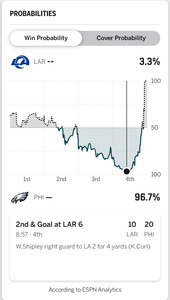
Sirianni made the decision that opened the door for the Rams. Philadelphia held a 10-point lead with 7:31 remaining and faced fourth-and-goal at the 2. A short Elliott field goal would have created a 23-10 lead, changing the Rams’ required path from a touchdown and field goal into two touchdowns. If Los Angeles still scored those touchdowns, Philadelphia would have received the ball trailing 24-23 and needed only a field goal to win. A touchdown by the Eagles would have created a 27-10 lead and turned the game into a three-score problem for Los Angeles. Sirianni chose the one outcome that produced no points, Hurts threw incomplete under immediate pressure and Stafford responded by marching the length of the field.
The choice was even more indefensible after what happened in Chicago. Sirianni punted on fourth-and-a-long-1 while trailing by 13 because he lacked confidence in the same short-yardage offense. Six days later, after Hurts had already been stopped on a fourth-and-1 sneak against the Rams, Sirianni rejected a nearly automatic field goal that would have preserved an Elliott game-winner as Philadelphia’s answer to the exact comeback that followed.
His decisions have no coherent game-management philosophy. He becomes passive when aggression is required and reckless when the scoreboard demands points. Philadelphia has also committed 20 penalties across the last two games, failed to score after halftime in both and looked completely incapable of correcting the same problems.
Sirianni accepted responsibility afterward, saying the failed fourth down was on the head coach. That assessment is correct. Accepting blame does not repair serial incompetence or restore the trust destroyed by repeating it.
Seth Joyner’s Story Deserves Scrutiny
The tension surrounding Sirianni, Mannion and Hurts became stranger after the Chicago loss. On the postgame show, Seth Joyner initially said a source told him Sirianni wanted Mannion in the booth as a way to separate the coordinator from face-to-face communication with Hurts during games. Joyner described Sirianni as a control freak with his hand in the cookie jar and later said the Eagles intentionally deliver plays late so Hurts has less time to change them at the line, which Joyner characterized as a way to prevent the quarterback from going rogue.
After blowback, Joyner reframed the claim as his theory and dropped the source language while continuing to advance essentially the same conclusion. He then argued with Dan Sileo on X over what he had said and became oddly specific that he never claimed his source worked inside the Eagles building. His original presentation clearly implied information connected to the organization, even if the person who spoke directly to Joyner was outside it.
Bleed Green Sports believes both parts can be true. The underlying statement could have originated with someone employed by the Eagles or someone with access to the building, then reached Joyner through an intermediary who had no official connection to the team. That would explain why Joyner sounded sourced while later insisting he never said his direct source was inside NovaCare.
Joyner was emotional after the Bears game, and he may have said more than he intended while processing an ugly loss. That possibility matters because the distinction between sourced information and personal theory is enormous. The public deserves to know which one it heard.
The Source Theory Points Toward Hurts
Bleed Green Sports believes Hurts is the likeliest origin of the message, although that is an inference rather than a verified fact. The claim makes Sirianni the villain, creates dysfunction between Sirianni and Mannion and presents Hurts as the innocent quarterback whose direct access to his coordinator was deliberately removed. That framing benefits Hurts more than anyone else involved.
The context after Chicago made the timing even more convenient. Hurts was the animated participant during the sideline confrontation, the team showed almost no response after he was clobbered near the Bears sideline, and the offense returned from halftime looking emotionally dead. No teammate publicly rushed to defend him afterward. A story portraying Sirianni as the controlling obstacle redirected the conversation away from Hurts’ production, leadership and relationship with the locker room.
The alternative sources make less sense when examined individually. Sirianni would have no reason to plant a story that branded him a control freak sabotaging his own coordinator. Mannion would jeopardize his career by stabbing his head coach in the back to help a quarterback he reportedly does not even communicate with face to face during games.
Jeffrey Lurie and Howie Roseman would call Sirianni into a meeting and order a change if they wanted Mannion on the sideline. Both men have repeatedly demonstrated that they will tell coaches how the organization expects to operate. Other team employees would risk their jobs to advance a narrative that helps one player while damaging the head coach, making them possible sources with an obvious reason to remain cautious.
Hurts has the access, the motive and a bachelor’s degree in public relations. He would benefit from a public campaign that assigns the offense’s dysfunction to Sirianni and turns the quarterback into the person being controlled. Again, that chain of logic is BGS analysis. It is compelling circumstantial reasoning, not proof of authorship.
Joyner’s own commentary strengthens the suspicion because even on his most critical days he rarely places sustained blame on Hurts. He redirects toward Sirianni whenever the quarterback’s responsibility becomes unavoidable. That position closely matches the message that Hurts is being undermined by a controlling coach.
The 2021 McLane Story Provides a Possible Pattern
The possibility deserves attention because Philadelphia has seen another anonymous-source story produce an outcome that benefited Hurts. Jeff McLane’s January 16, 2021 article about Carson Wentz’s turbulent season contained detailed accounts of conversations, corrections and conflict inside the quarterback room involving Wentz, Doug Pederson and Press Taylor. McLane wrote that the story was compiled through team and NFL sources with direct knowledge, so the article itself does not identify Hurts as a source.
The access and incentives remain interesting. Wentz and Taylor had no obvious reason to tell a reporter that they resisted coaching, lacked accountability or mishandled the quarterback room. Nate Sudfeld had little reason to insert himself into a franchise power struggle while trying to preserve his roster spot. Hurts had access to the room and stood to benefit if Pederson, Taylor and Wentz departed.
All three did. Pederson was fired, Taylor moved on, Wentz was traded and Hurts inherited the quarterback job. That sequence cannot prove who spoke to McLane, yet it supplies a precedent that makes the current theory harder to dismiss as impossible.
Hurts’ September GQ interview adds another curious layer. When Hurts decided the conversation had become too focused on the Eagles, he volunteered that he would have spoken to Jeff McLane if that were the discussion he wanted. In the same exchange, he referred to Eliot Shorr-Parks as “Eliot Short whatever his name is,” a dismissive swipe at a reporter many Hurts supporters already dislike.
The contrast looked like a public reward and punishment system. McLane received unsolicited recognition, while Shorr-Parks received a calculated dismissal. That interpretation remains opinion, and the GQ exchange proves no leak. It does show that Hurts understands how a few words can elevate one media figure, diminish another and shape the conversation around him.
The Eagles Need a Complete Offensive Divorce
Philadelphia should stop pretending one replacement can repair this arrangement. Sirianni chose Mannion after an exhaustive search and continues to preside over the offense. Mannion has failed to create answers once defenses change the picture. Hurts has failed to elevate the structure or operate efficiently when his ideal supporting cast is unavailable.
Firing only Mannion would give Hurts an eighth play-caller and restart the same excuse cycle. Removing only Sirianni would preserve a quarterback-coordinator pairing that has already failed its first serious tests. Keeping Hurts while replacing both coaches would ask a new staff to inherit the same authority, adaptability and accountability questions that have followed him through several systems.
The clean answer is a complete divorce after the season. A new staff should receive the freedom to install its own structure, select its own quarterback and build an offense without inherited political debts.
The Optimism Behind Hurts’ Contract Has Expired
On March 28, 2023, weeks before the Eagles signed Hurts to a long-term extension, Jeffrey Lurie described a quarterback he believed was still ascending toward greatness.
“Every quarterback is different,” Lurie said. “Donovan’s different. Carson was a unique situation and suffered a lot of serious injuries right after the contract. And Jalen’s very different from those two. The thing with Jalen that I’m so optimistic about is … seeing him virtually every day, he’s got incredible passion for being phenomenal.
“And you see that in the great ones.”
The 2022 season now stands as Hurts’ peak, a temporary summit the organization mistook for the beginning of a climb. That “passion for being phenomenal” became a mirage that convinced ownership it was purchasing limitless growth. Defenses adjusted, the supporting structure weakened and the supposedly ascending franchise quarterback failed to develop the answers expected from a player carrying that investment.
The extension produced a Lombardi Trophy, which prevents it from qualifying as a complete failure. Hurts helped finish a championship season and deserves his share of the credit. The expected return extended far beyond one trophy, however. Philadelphia paid for sustained contention, offensive stability and a quarterback who would continue improving as the roster around him changed. Instead, the Eagles received coordinator turnover, diminishing production and an offense that increasingly requires perfect circumstances to function.
McLane ended his January 16, 2021 article with another detail from Roseman’s office that feels even more relevant today.
McLane wrote: “In Roseman’s office, there’s also a quote from Bill Russell that sits behind his desk on a banner in between the poster of Wentz, and another of defensive tackle Fletcher Cox, that maybe should have been more prominent in his thinking:”
“Professional athletes are not paid to play, they’re paid to WIN.”
Russell’s career supplied the meaning behind those words. He won 11 NBA championships with the Boston Celtics after winning two national championships in college. Winning was a continuing obligation for Russell, never a lifetime exemption earned by reaching the summit once.
Hurts helped deliver a Lombardi Trophy, and that achievement will always belong to him. The championship cannot become an annuity that pays out credibility, job security and enormous contracts forever. How many disappointing seasons should Philadelphia continue purchasing because Hurts won once?
First, the Wentz poster came down from Roseman’s office. The next question is whether Roseman understands the banner that remained behind. Russell’s message demands repeated winning from highly paid athletes. If one championship grants Hurts permanent immunity from that standard, the quote might as well come down too.
The organization’s current behavior reveals how drastically its expectations have changed. As Bleed Green Sports explained in Jalen Hurts Is Done in Philadelphia and Nothing He Does in 2026 Will Change It, Lurie and Roseman have stopped publicly selling Hurts as the future and appear finished intervening to rescue his deteriorating partnership with Sirianni. Their silence is deafening. They seem content to let the ship run aground while the dysfunction exposes everyone involved and each loss moves Philadelphia higher on the draft board.
That silence should terrify Hurts more than any public criticism. With Lurie, a quarterback can trick him once into offering a contract extension after a rookie deal, but you will never trick him into the 2nd extension.
Hurts’ Contract Does Not Prevent the Change
Bleed Green Sports explained the financial path in Jalen Hurts Is Done in Philadelphia and Nothing He Does in 2026 Will Change It. Under the current accounting, Hurts is scheduled to carry a cap charge of approximately $42.1 million in 2027. A post-June 1 release designation would place approximately $42.7 million on the 2027 cap, only about $567,000 more than keeping him on the roster, while pushing roughly $24.3 million into 2028.
That is expensive but manageable. The Eagles would absorb dead money during the first year of a new coaching cycle, give a rookie quarterback time to develop and emerge from the largest charge as the replacement approaches his second season.
Since 2021, The Eagles have not carried less than $65 million in dead-cap penalties in a season. If anything, Howie and Lurie were always prepared to cut Jalen loose prematurely if they weren’t fully committed to him. As of now, they have $28,713,923 in dead-cap penalties incurred in 2027 and $0 in 2028;
Hurts’ full no-trade clause could complicate a trade because he controls his destination, and teams don’t give up assets to pay a quarterback over $50 million that fails to break 100 yards passing.
A release requires no cooperation or being dependent on finding an outside organization. March 2027 is the exit ramp, and Philadelphia will surely take it.
Howie Roseman Has the Assets to Trade Up
The Eagles should pursue their next quarterback aggressively in the 2027 draft. They currently control their own selections in the first three rounds for each of the next three drafts, giving Roseman the future capital needed to move up. Philadelphia also owns New England’s 2028 first-round pick from the A.J. Brown trade, so the Eagles are scheduled to hold two first-round selections in 2028.
That Patriots pick can become the premium asset in a trade for a top 2027 selection. Roseman used two trades to climb from No. 13 to No. 2 for Carson Wentz in 2016. The organizational philosophy has always valued taking swings at quarterback, and the available capital allows Philadelphia to do it again.
The teams to watch are struggling clubs that already have major investments at quarterback. Los Angeles (AFC) has Justin Herbert, Washington has Jayden Daniels, Tennessee has Cam Ward, New England has Drake Maye, the Giants have Jaxson Dart and Cincinnati has Joe Burrow. Los Angeles (NFC) may also enter the conversation. Their records, quarterback evaluations and draft positions will change, so this is a preliminary watch list rather than a prediction of the eventual trade partner.
The quarterback class and trade market deserve a separate article. That discussion should evaluate the prospects, the likely order and the leverage of each potential seller instead of pretending the target can be identified in October.
Player of the Game: Darius Cooper
Cooper played with the aggression missing from the rest of the offense. He attacked the football in traffic, found space when the design gave him a fair opportunity and contributed on special teams while working inside a depleted receiving group.
The second-year receiver deserved to celebrate a breakout afternoon. His performance showed what decisive football looked like on a day when his coaches and quarterback spent too much time hesitating.
Scapegoat of the Game: Nick Sirianni
Sirianni owns the defining mistake because his fourth-quarter gamble erased Philadelphia’s margin for error and turned Elliott from a potential game-winning weapon into a spectator. You have to wonder whether Sirianni was overcorrecting for his decision to punt on fourth-and-a-long-1 in Chicago. It looked like a coach responding to last week’s criticism instead of managing the game in front of him.
Everything Sirianni had seen pointed toward taking the points: the short-yardage offense was failing, Elliott was reliable and the defense had controlled the afternoon. A field goal would have made it 23-10 and allowed Philadelphia to answer two Rams touchdowns with an Elliott game-winner. Sirianni instead came away with zero points, allowing those touchdowns to produce a 24-20 deficit that required Hurts to reach the end zone.
Top Five Eagles
- Darius Cooper: A-. Cooper supplied conviction, physicality and awareness whenever the ball reached him. He looked prepared for a larger role while veterans around him looked overwhelmed by theirs.
- Jake Elliott: A. Elliott gave Sirianni every reason to trust him and handled every assignment cleanly. His afternoon made the head coach’s refusal to use him in the defining moment look even worse.
- Andrew Mukuba: A-. Mukuba responded to the Chicago disaster with fast, aggressive and productive football. That ability to recover from failure should embarrass an offense that keeps carrying the same problems into every week.
- Cooper DeJean: A-. DeJean remained one of Fangio’s most valuable defenders because he recognized opportunities and attacked them. He played like someone expecting to change the game instead of hoping another unit would eventually help.
- Jeremiah Trotter Jr.: B+. Trotter handled an expanded assignment with the urgency the defense needed. The total performance showed he belongs in the rotation and can survive responsibilities that exceeded the original plan.
Honorable Mention: Nolan Smith. Smith delivered the pass rush’s most valuable moment and played with an edge the offense never matched. His impact deserved a better reward.
Bottom Five Eagles
- Nick Sirianni: F. Sirianni failed the central responsibility of game management and allowed ego to overrule context. The comeback ran directly through his decision.
- Sean Mannion: F. Mannion again entered the second half without a useful response to the opponent’s adjustments. Every series made his original ideas look smaller and his counterpunches look nonexistent.
- Jalen Hurts: F. Hurts played like a quarterback waiting for ideal circumstances to return. His contract, experience and authority demand someone who can create stability when those circumstances disappear.
- Jonathan Jones: F. Jones added reckless aggression to a defense already reaching its breaking point. A veteran turned a difficult situation into an easier one for Los Angeles at the worst possible time.
- Offensive Line: F. The group lost control whenever leverage and communication mattered most. Johnson’s absence explains the strain and leaves the failure intact.
Final Word
This loss clarified the organizational decision ahead. Fangio’s defense and the special teams created a winning position, while Sirianni’s judgment, Mannion’s design and Hurts’ execution corrupted it. Each man failed in a different way, and their failures reinforced one another.
Sirianni and Mannion must be fired when the season ends. Hurts must receive a post-June 1 release designation when the 2027 league year opens, and Roseman must begin the aggressive quarterback search that the roster, contract structure and draft inventory make possible.
The offense is broken because the partnership is broken. Adversity now produces confusion, public blame and fractured communication automatically. Keeping any major piece would preserve the excuse structure that allowed the failure to metastasize.
Maybe Hurts, Sirianni and Mannion have achieved 100 percent alignment after all. Like Adam Smith’s invisible hand guiding a market, each man’s weakness guides the other two toward the same destination. Sirianni’s insecurity, Mannion’s inexperience and Hurts’ limitations complement one another perfectly, creating an automatic system for manufacturing offensive futility.
That is Philadelphia’s dystopian version of alignment: three men pulling in the same direction and dragging the offense straight into the ground. The entitlement is also fully aligned because each has another person to blame.