



For the first two weeks of the season, the Philadelphia Eagles kept finding ways to survive performances that probably should have cost them football games. This time, the Chicago Bears did not let them escape. They embarrassed them.
Philadelphia walked into Soldier Field on Monday night and was humiliated 27-7 by a Bears team starting 38-year-old third-string quarterback Case Keenum. The Eagles turned the football over three times, forced zero turnovers for the third consecutive game, committed 10 penalties and gained only 248 yards while Chicago controlled possession for nearly 37 minutes.
In our Eagles-Bears preview, Bleed Green Sports spent most of the week worrying about whether Philadelphia could stop the rushing attack that embarrassed the defense last season. The Eagles actually answered that question for much of the night, especially in the first half, but Chicago simply found another way to beat them.
Keenum completed 24 of 34 passes for 247 yards and two touchdowns while adding a rushing touchdown of his own. Kalif Raymond caught six passes for 90 yards and a touchdown, Luther Burden caught seven for 61 yards and another score, and Philadelphia never sacked Keenum once.
The game was still there for Philadelphia at halftime. Jalen Hurts returned from a now-infamous concussion evaluation and led a 67-yard touchdown drive that ended with his quarterback sneak as time expired, cutting Chicago’s lead to 10-7 before the Eagles received the second-half kickoff. Hurts was animated, hyped and vocal heading into the locker room, looking like a quarterback trying to drag some life out of his team.
What came out of that locker room looked nothing like what went in. Philadelphia gained only seven yards across its first three possessions, and the Bears turned a three-point game into a 20-point blowout.
The reaction to the brutal late hit on Hurts had already been disturbing. Only a couple of Eagles immediately approached the Bears after their quarterback was hit. BGS believes somebody needed to throw punches, get ejected or, at the absolute minimum, receive a 15-yard unnecessary-roughness penalty. Instead, the response was muted and did not look like a team rallying around its quarterback.
The response after halftime was even worse. Nobody outside the locker room can know whether players literally quit, but from the outside the Eagles looked like a team that had stopped fighting. What happened during those 15 minutes may never be known, but BGS believes Nick Sirianni, Sean Mannion and Jalen Hurts had the kind of discussion that destroys trust, sends everyone retreating into their own corners and leaves people counting the weeks until a miserable season finally ends.
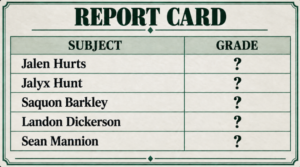
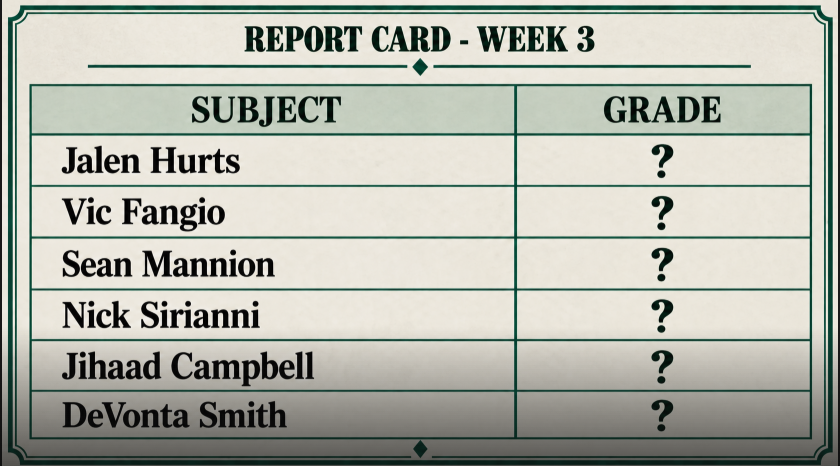
That is why this report card is going to be ugly. If whatever happened Monday night continues, we may eventually say the same thing about the season.
Team Grade: F
Philadelphia entered Monday night 2-0, but the record had hidden a growing number of problems. The Eagles had not forced a turnover, the offense had been inconsistent for long stretches, the running game had struggled against Tennessee and both Washington and Tennessee remained alive deep into the fourth quarter.
Chicago exposed all of it at once. The Eagles lost the turnover battle 3-0, committed 10 penalties for 61 yards and ran only 47 offensive plays because Chicago controlled the football for 36:53. Philadelphia scored one touchdown despite Saquon Barkley averaging more than five yards per carry, while the defense allowed a third-string quarterback making his first NFL start in nearly three years to account for three touchdowns without committing a turnover.
There was no single unlucky play that decided this game. Philadelphia was outplayed, outcoached and eventually overwhelmed by a team that entered the night dealing with major problems of its own. It was the Eagles’ largest margin of defeat since late 2023, and hopefully their worst performance of the season.
Offensive Player Grades
Jalen Hurts: F+
Jalen Hurts deserves credit for returning from a concussion evaluation and producing Philadelphia’s only touchdown drive of the night. That cannot erase what happened during the rest of the game, and it does not change the fact that Philadelphia needed much more from its quarterback once Chicago began taking control.
Hurts finished 16-of-25 for 153 yards with no passing touchdowns, one interception and a 64.2 passer rating. He added 25 rushing yards and Philadelphia’s only touchdown, but most of the positive production came before halftime.
The interception to T.J. Edwards was particularly poor. Hurts stared down the route, Edwards read his eyes and stepped directly into the passing lane on fourth down, ending another possession when Philadelphia desperately needed something positive to happen.
That interception was different from the mistakes we discussed in the Tennessee report card. Bleed Green Sports gave Hurts an A against Tennessee despite two interceptions because those mistakes came while he was attempting to expand the aggressive part of his game, and because he responded by leading a game-winning touchdown drive with no timeouts.
Against Chicago, Hurts looked increasingly uncomfortable as the game progressed. The passing offense became compressed, the middle-of-the-field progress we praised one week earlier largely disappeared and several receivers were open without ever becoming realistic options in Hurts’ progression.
The quarterback is not solely responsible for that kind of offensive collapse. Sean Mannion deserves enormous criticism for the structure around him, while the offensive line played its best game of the season but still had moments where the offense fell behind schedule. Philadelphia also inexplicably reduced Barkley’s involvement after he had already demonstrated that the running game could work.
Hurts is still the quarterback, though, and the standard has to be higher than surviving whatever the offensive coordinator gives him. When the structure began failing, Philadelphia needed Hurts to elevate the offense and prevent the game from becoming a runaway loss. That never happened in Chicago.
The performance also fits into the larger organizational question discussed in Jalen Hurts Is Done in Philadelphia and Nothing He Does in 2026 Will Change It. His relationship with Nick Sirianni looked strained at best and broken beyond repair at worst, especially after the two were seen arguing on the sideline.
Many believe the organization is still evaluating whether Hurts can become the quarterback it wants beyond 2026. BGS believes the front office made that decision before the season began, and Monday night’s game only validated our position.
Saquon Barkley: B+
Saquon Barkley was one of the few Philadelphia offensive players who looked capable of controlling the game during the first half. He consistently found running lanes and finished with 82 yards on 15 carries, averaging 5.5 yards per attempt.
The problem is that Philadelphia stopped leaning on him once the game reached the second half. Barkley had already demonstrated that Chicago could be attacked on the ground, but Sean Mannion, Jalen Hurts or some combination of the two increasingly moved away from the most productive component of the offense while the passing game deteriorated.
Barkley believes the team needs to become more accountable and honest with each other. He did not mention anyone by name, but the message was difficult to misunderstand.
“Be honest with each other,” Barkley said. “Accountability. When we’re watching film, when we’re talking about it, be truthful with each other. We have an old enough team and guys who are able to accept accountability. It’s all of us. We all have to own it and got to do a better job.”
Barkley also played an important role during the possession that ended with Andy Dalton’s interception, ripping off runs of 17 and 14 yards to move Philadelphia all the way to the Chicago 1-yard line. There are games where Barkley needs to manufacture something when the blocking fails, but this was a game where Philadelphia simply needed to keep giving him the football because the running game was working.
He was not perfect, but the biggest problem involving Saquon Barkley was Philadelphia’s decision to stop giving him the ball.
DeVonta Smith: A-
DeVonta Smith once again looked like Philadelphia’s most dependable receiving option. He finished with six catches for 65 yards on eight targets and played a major role in the touchdown drive before halftime, including Philadelphia’s biggest reception of the game on a 30-yard completion.
Chicago knew Smith was the primary receiving threat and still had difficulty completely removing him. Philadelphia simply did not sustain enough possessions or create enough opportunities to allow him to affect the outcome after halftime.
Smith has played like a legitimate No. 1 receiver through three weeks. The offense needs to give him more opportunities to prove it, and eventually he may need a legitimate QB1 capable of consistently finding him.
Dontayvion Wicks: C+
Dontayvion Wicks finished with two catches for 32 yards, including a 19-yard reception that again showed the vertical and intermediate value he can provide. Five targets were not enough to make him a major part of the game, especially when Philadelphia rarely maintained possession long enough to create a meaningful distribution of opportunities.
He did not play poorly. There were also a couple of occasions where Wicks appeared open for potential deep touchdowns, but Hurts did not find him before the rush forced the quarterback out of rhythm. Wicks became another player trapped inside an offense that stopped functioning at the quarterback’s direction.
Makai Lemon: C+
Makai Lemon caught three passes for 29 yards on four targets, including a 19-yard reception. Those numbers are not spectacular, but the rookie again showed that Philadelphia has useful young receiving talent beyond Smith and Wicks.
The larger question is how Sean Mannion plans to use him and whether Hurts will actually throw him the ball. Lemon appeared open on several routes, particularly while crossing the field, but Hurts either did not see him, did not trust him or did not trust himself enough to attempt the throw.
Monday night provided no reason to blame Lemon for the offense’s problems. If anything, it provided more evidence that he is becoming a sacrificial lamb inside a broken passing game.
Tank Bigsby: F
Tank Bigsby’s fumble was one of the biggest mistakes of the first half. Philadelphia was already trailing when Bigsby caught a short pass and allowed Austin Booker to knock the football loose, giving Chicago possession at the Eagles’ 15-yard line.
The defense bailed him out with an excellent goal-line stand, but that does not erase the turnover. Philadelphia finished minus-three in turnover differential, and Bigsby directly contributed to that number while putting an already struggling team into another dangerous situation.
Turnovers and poor pass protection were part of the reason Bigsby became available to Philadelphia in the first place. Monday night was an ugly reminder of both concerns.
Jordan Mailata: C
Jordan Mailata was not Philadelphia’s biggest offensive-line problem, but the unit struggled to maintain control as the game progressed. Chicago increasingly pushed the Eagles into uncomfortable down-and-distance situations, and Hurts was sacked twice while the offense lost whatever rhythm it had established.
Mailata remains one of the players Bleed Green Sports worries about least on this roster, but an elite left tackle is not exempt from criticism when the offense scores seven points. This was an ordinary performance from a player Philadelphia needs to be extraordinary, and it may be time to wonder whether his 2026 season will resemble his very average 2025 campaign.
Drew Kendall: C-
Drew Kendall continues learning one of the most demanding positions on the field while Philadelphia reshuffles the interior offensive line. Monday night included another false start and several moments where the Eagles struggled to establish clean interior control.
Young centers are going to make mistakes, and Kendall deserves some patience, but Philadelphia cannot afford penalties killing possessions when the offense is already struggling to generate first downs. The performance was uneven without making Kendall one of the primary reasons Philadelphia lost.
Cam Jurgens: C-
Cam Jurgens remains part of an offensive-line configuration Philadelphia hoped would stabilize the interior. The Eagles ran the football effectively for stretches, particularly behind Barkley, but the unit could not maintain the same control once Chicago began dictating the game.
Jurgens has enough athletic ability to play guard at a high level, but Philadelphia needs him to become a stabilizing presence rather than another player participating in an offensive line still trying to figure itself out. The running production keeps the grade from falling further, while the overall offensive performance prevents it from rising.
Tyler Steen: D
Tyler Steen continues to be one of the biggest questions on the offensive line. Philadelphia needs reliability from the interior, and Steen has not consistently provided the level of play necessary to make the position disappear as a concern.
The Eagles were not completely overwhelmed up front, but the passing offense became increasingly difficult to operate as Chicago gained control. Philadelphia has championship expectations, and the interior offensive line still does not consistently look like one of the strengths of a championship roster.
Lane Johnson: C
Lane Johnson’s holding penalty on the play where Hurts took the late hit became particularly damaging because it offset D’Marco Jackson’s unnecessary-roughness penalty. Instead of Philadelphia receiving the benefit of the late hit, the penalties canceled each other, and Barkley’s excellent run on the next play merely moved the Eagles toward the goal line instead of putting seven points on the board.
“You go look at the tape, there’s some things we did well,” Johnson said. “But when it comes to self-sabotage, we did that a lot today. That’s on us. But if we can move forward and capitalize on the stuff that we did improve on tonight and avoid the costly mistakes, then hopefully we’ll get a different outcome.”
Johnson is still one of the best and most dependable offensive linemen on the roster. This was not a catastrophic performance, but Philadelphia needed a cleaner game from one of its veteran leaders.
Defensive Player Grades
Quinyon Mitchell: A-
Quinyon Mitchell was Philadelphia’s best player Monday night and repeatedly prevented Chicago from turning an ugly game into an even bigger blowout. He produced the fourth-down breakup in the end zone after Bigsby’s fumble and later made another important third-down breakup that forced the Bears to settle for a field goal.
His recognition against a screen later in the game was another example of how quickly he processes what offenses are trying to do. Chicago found plenty of other places to attack, but Mitchell consistently handled his assignment and gave Philadelphia opportunities to get off the field.
Riq Woolen: F
Riq Woolen is one of the most physically gifted cornerbacks in football, but none of that matters if he does not understand his assignment when an offense uses motion to force the secondary to communicate. Chicago exposed that problem repeatedly, with the most damaging example coming on Kalif Raymond’s 41-yard touchdown in the third quarter.
Andrew Mukuba partially slipped out of position, but Woolen was initially responsible for Raymond before Chicago’s motion forced Philadelphia to sort out the coverage. The communication broke down, Raymond crossed the formation without anyone properly accounting for him, and Case Keenum found him with enough open field to turn the mistake into a touchdown.
Being 6-foot-4 with elite speed gives Woolen physical tools most cornerbacks could only dream about, but height and speed become irrelevant when a receiver goes in motion and the defense does not know who is supposed to cover him. The penalties made the performance worse, as Woolen repeatedly gave Chicago free yards at moments when Philadelphia desperately needed its secondary to get off the field.
Philadelphia did not acquire Woolen because it needed another athletic project. The Eagles need him to understand Fangio’s coverage rules, communicate through motion and switches, and use his physical ability without turning difficult reps into busted assignments or penalties. Against Chicago, he failed in all three areas, and Philadelphia is beginning to understand why Seattle benched him late in 2025 and allowed him to leave in free agency without offering him another contract.
Marcus Epps: F
Marcus Epps was simply awful against Chicago. Philadelphia needed veteran stability from Epps while a secondary filled with younger players tried to handle Ben Johnson’s motion, crossing routes and coverage adjustments, but instead he became part of the problem.
That is especially damaging because Epps is supposed to be one of the players who understands how the pieces fit together. A veteran safety needs to recognize formations, communicate changes before the snap and help prevent coverage breakdowns from becoming explosive plays. None of that looked dependable Monday night.
Epps also offered very little to compensate for the problems in coverage. If a safety is struggling with assignments, he needs to make an impact through tackling, physicality or a game-changing play, and Philadelphia did not get enough of any of those things.
For a veteran safety, this was more than simply a bad game. It was the kind of performance that makes Philadelphia question whether Epps should continue receiving any meaningful role moving forward.
Jalen Carter: B-
Jalen Carter contributed to Philadelphia’s strong early run defense and helped the Eagles survive the sudden-change possession created by Bigsby’s fumble. His penetration near the goal line helped put the defense in position to escape without allowing a touchdown.
Philadelphia eventually needed Carter and the defensive front to become increasingly dominant as the game progressed, but that never happened. He was still one of the Eagles’ better defenders, although not dominant enough to completely change a game where Philadelphia desperately needed its best defensive lineman to take over.
Jalyx Hunt: C+
Jalyx Hunt continues to create pressure and affect plays without producing enough finished sacks. He flashed against both the run and pass Monday night and remains one of the more disruptive edge defenders on the roster.
The next step is obvious. Philadelphia cannot continue generating pressures that quarterbacks escape or neutralize with quick throws while the official sack total remains empty. Keenum was never sacked Monday night, and the Eagles need players like Hunt to begin turning disruption into drive-ending production.
Jonathan Greenard: B-
Jonathan Greenard finally made his Eagles debut and immediately showed why Philadelphia has been waiting for him. He generated a quarterback hit and forced a fumble, although Chicago recovered before the Eagles could record their first takeaway of the season.
The immediate disruption was encouraging, particularly for a defense desperate for another edge player capable of creating negative plays. His workload should increase as he becomes healthier, making Greenard one of the few genuinely encouraging developments to come out of Chicago.
Zack Baun: C+
Zack Baun was involved in several successful run stops and helped Philadelphia contain Chicago’s backs early. The problem developed when Keenum began working the middle of the field and repeatedly finding easy completions before the pass rush could get home.
Some of those completions belong to the linebackers, some to the safeties and some to Vic Fangio’s structure. Baun was part of a defense that never made Keenum uncomfortable, so he cannot completely escape responsibility, and it is fair to wonder whether a lack of trust in the players around him is beginning to affect how aggressively he handles his own assignment.
This was not a disastrous game from Baun individually. It was an ordinary performance inside a defense that needed far more.
Jihaad Campbell: C+
Jihaad Campbell again showed the athleticism that makes him one of the most intriguing defenders on Philadelphia’s roster. He closed quickly against the run and was involved in several plays where Chicago’s blocking collapsed before the runner could generate meaningful yardage.
Coverage looked worse on the surface because Keenum repeatedly found easy throws in the intermediate middle of the field, but Campbell’s individual numbers were actually improved. According to NFL Pro’s Next Gen Stats, he allowed only two catches for eight yards on four targets, with Keenum posting a 56.3 passer rating when targeting him. In the previous two games combined, Campbell had allowed five catches on six targets for 92 yards and a passer rating above 114.
The tape suggests those improved numbers may have come partly because some of his responsibilities were shifted elsewhere. Campbell is still developing and the physical ability remains obvious, but Philadelphia needs the mental processing and coverage consistency to catch up quickly. If they do not, Jeremiah Trotter Jr. may eventually begin taking his snaps.
Andrew Mukuba: F
Andrew Mukuba’s night included two mistakes with enormous consequences. The first came on Kalif Raymond’s 41-yard touchdown, where confusion between Riq Woolen and Cooper DeJean already compromised the coverage before Mukuba slipped to the ground looking like he was about to do a push-up.
Mukuba later committed a defensive holding penalty that erased what would have been an important Moro Ojomo sack. Instead of putting Chicago behind the chains, Philadelphia gave the Bears another first down during the possession that eventually helped turn the game into a 27-7 blowout.
Young safeties are going to make mistakes. Philadelphia cannot afford mistakes that directly erase sacks and contribute to touchdowns, especially when they are not the first mistakes of their kind.
Special Teams Grade: B-
Philadelphia’s special teams did not create the kind of major positive play that could have changed the game, but the unit was not responsible for the collapse either. Braden Mann spent far too much time punting because the offense could not sustain possession, while Jake Elliott converted Philadelphia’s only extra-point attempt.
Britain Covey produced a useful return before a penalty erased much of its value, becoming another example of Philadelphia sabotaging itself with avoidable mistakes. The unit was adequate, which on this particular night made it considerably better than most of the roster.
Sean Mannion: F
Bleed Green Sports published The Mannion Honeymoon Is Over! before the regular season because the concern surrounding Sean Mannion was never about one preseason game. Philadelphia handed a championship-caliber offense to a first-time coordinator, and eventually he was going to face a defense that forced him to abandon the original script and prove he could adjust in real time.
Monday night was that test, and Mannion did not simply fail it. He bombed it.
The most troubling part was what happened after halftime. Mannion had an entire half of information, 15 minutes to process it and an offense that had already demonstrated it could move the football on the ground. Philadelphia then opened the second half with three punts, followed by a turnover and a failed fourth-down attempt.
Barkley becoming less important made even less sense. He had been one of Philadelphia’s most effective offensive players, yet the Eagles moved away from him while the passing game became increasingly ineffective. Unless Hurts demanded at halftime that the offense be placed more heavily in his hands, there was little justification for abandoning the part of the game plan that had actually worked.
The passing structure also began looking disturbingly familiar. The middle-of-the-field aggression we praised against Tennessee disappeared, receivers faded from the offense for long stretches and too many plays depended on Hurts creating something after the original design broke down. This is exactly what Mannion was hired to change.
The preseason praise surrounding him now looks very different. Jordan Mailata famously described Mannion as an “evil genius,” called him a “wizard” and joked that if the three smartest people in the Eagles facility were placed in one room, Mannion might be the only person who needed to be there.
“Sean is an evil genius. That is my first impression,” Mailata gushed. “He just knows ball. The guy knows ball. If I were to lock the three smartest people in the facility in one room, Sean would be there. And I think Sean would just be by himself. It would just be Sean. He’s a wizard. And, man, I’m super excited. As the year goes on, we get to display what is in that beautiful mind of his.”
Chicago finally forced Philadelphia to show what was inside that beautiful mind when the original plan stopped working, and the answer Monday night was not much. The honeymoon ended in August, and if performances like this continue, whetstones, pull-through sharpeners and electric sharpeners are going to be working overtime while Eagles fans move from discussing the honeymoon to filing for divorce.
Vic Fangio: F
Vic Fangio spent the week preparing to stop the problem Chicago created last season, and Ben Johnson used that expectation against him. Philadelphia devoted resources to containing the run, but Johnson responded by putting the game in Case Keenum’s hands and using motion, quick throws and coverage manipulation to attack the areas Fangio left vulnerable.
That is where the coaching mismatch became obvious. Johnson treated his third-string quarterback like someone capable of executing the plan, while Fangio kept waiting for Chicago to become the offense he had prepared to defend. Keenum was rarely forced to hold the football, decipher complicated pressure looks or make difficult throws outside the structure because Chicago consistently gave him defined reads before the pass rush could matter.
The 41-yard touchdown to Kalif Raymond captured the problem better than any statistic. Chicago used motion to stress Philadelphia’s communication rules, Riq Woolen and Cooper DeJean failed to sort out the coverage, and Raymond crossed the field essentially uncovered. That was not Keenum making an extraordinary play. It was Chicago creating confusion and Philadelphia failing to solve it.
The larger concern is that Fangio never appeared to take control of the chess match. Philadelphia’s improved run defense mattered far less once Johnson recognized where the Eagles were vulnerable and repeatedly attacked it, while the lack of takeaways meant Fangio’s defense had no game-changing plays to compensate for its breakdowns.
Fangio gets an F because the issue was not simply that Keenum played well. Chicago understood what Philadelphia wanted to stop, built its plan around that knowledge and stayed one move ahead of Fangio for most of the night.
FIRE VIC FANGIO!
Nick Sirianni: F
Nick Sirianni’s worst moments came in situations where the Eagles needed their head coach to provide clarity, and instead Philadelphia looked indecisive and disorganized.
The first came while Hurts was being evaluated for a concussion. The medical evaluation itself was obviously outside Sirianni’s control, but Philadelphia still had timeouts available while Hurts waited to be cleared. Sirianni acknowledged afterward that calling one crossed his mind, saying, “You think about maybe calling a timeout in a situation like that,” before explaining that he did not know how long the evaluation would take.
That uncertainty is exactly why using one deserved serious consideration. Hurts was cleared shortly after Andy Dalton’s interception ended a possession that had reached the Chicago 2-yard line, leaving Philadelphia with nothing.
The more indefensible decision came later. Philadelphia trailed 20-7 and faced fourth-and-a-long-1 at its own 49-yard line, yet Sirianni tried to draw Chicago offside, accepted the delay of game and punted. This is a team built around one of the most effective short-yardage quarterbacks in football, and Sirianni admitted afterward that he regretted the decision.
The sequence became even more troubling when Lane Johnson suggested that the offense may not have even shared the same understanding of what was supposed to happen.
“There was a play, but I don’t think we’re all on the same play. I think there’s a lot of miscommunication.”
That turns the fourth-down decision from a questionable strategic choice into a larger concern about whether Philadelphia was even organized enough to execute whatever Sirianni originally intended.
Hurts was visibly furious afterward and was shown yelling at Sirianni, while Sirianni appeared to disengage rather than respond to his quarterback. Hurts being angry does not automatically make him right, but when the starting quarterback is openly frustrated over a consequential decision and the head coach appears unwilling to engage with him, the optics are terrible. It looked less like a disagreement being managed and more like two people who were no longer communicating.
The contradiction became impossible to ignore on Philadelphia’s next possession. Sirianni had refused to attempt fourth-and-a-long-1 while trailing by 13, but after Chicago increased the lead to 20 points, he allowed the offense to attempt fourth-and-5. Hurts threw the interception to T.J. Edwards, and Sirianni later said he still liked the fourth-and-5 decision while admitting he should have gone for the earlier fourth-and-1.
Those were Sirianni’s decisions. He passed on the higher-percentage fourth down while the game was still within two scores, oversaw an offense that apparently was not even clear on what play it was supposed to run, had his quarterback confronting him afterward, and then became more aggressive only after the deficit had grown.
Sirianni deserves credit for angrily confronting Jackson after the hit on Hurts, but the responsibility of a head coach extends far beyond yelling at an opponent. If a team quits on its quarterback, somebody eventually gets fired or somebody gets benched.
FIRE NICK SIRIANNI!
The Hit on Hurts Changed the Game
The second-quarter hit on Hurts deserves more attention because it became the emotional dividing line of the night. Hurts was scrambling toward the Chicago sideline when D’Marco Jackson delivered a late hit that sent him hard to the ground and drew an unnecessary-roughness penalty.
Lane Johnson’s holding call offset the flag, so Philadelphia gained nothing from it, but the bigger consequence was Hurts being pulled for a concussion evaluation in the middle of the Eagles’ best drive of the game. Only a couple of Philadelphia players immediately confronted the Bears afterward.
Somebody needed to start a fight. Somebody should have thrown a punch, risked an ejection or, at the very least, drawn an unnecessary-roughness flag. There is no alternative when it comes to protecting a teammate, and a few terse words do not cut it in the NFL. This did not look like an offensive unit furious that its quarterback had just been taken down in front of the opposing bench.
Dalton entered, Barkley moved Philadelphia to the 1-yard line and the Eagles eventually walked away with nothing after Dalton threw an interception on third down. Hurts then returned and gave Philadelphia exactly what it needed emotionally, driving the Eagles 67 yards in 1:52 and finishing the possession himself with a Tush Push touchdown as time expired.
That should have changed the game. Philadelphia went into halftime down only three, set to receive the second-half kickoff, with its quarterback having just returned from a concussion evaluation to give the entire team a second chance.
Instead, the response looked lifeless. Philadelphia’s offense immediately stalled, the defense never found a way to make Keenum uncomfortable and the game gradually turned into one long Bears possession while the Eagles appeared to wait for the clock to run out.
Nobody outside the locker room can know what individual players were thinking, but BGS can say what it looked like. It looked like the team quit. For a roster that expects to compete for a championship, that may be more troubling than the final score.
Player of the Game: Quinyon Mitchell
Quinyon Mitchell gets the game ball because Philadelphia would have been embarrassed even worse without him. His fourth-down breakup after Bigsby’s fumble prevented Chicago from immediately converting the turnover into seven points, and another third-down breakup later forced a field goal.
Mitchell also diagnosed Chicago’s screen game and consistently played with the kind of urgency that was missing elsewhere on the field. This was not an empty statistical performance because Mitchell directly prevented points and repeatedly gave Philadelphia opportunities to remain competitive.
On a night with very few positives, he was the clearest one.
Scapegoat of the Game: Sean Mannion
There are enough candidates that this could easily become a four-way selection between Sean Mannion, Vic Fangio, Nick Sirianni and Jalen Hurts. Mannion gets the designation because this game exposed the concern that has followed him since Philadelphia handed its offense to a first-time play caller: when the original plan stopped working, there was no convincing Plan B.
Mannion never found a way to make Chicago uncomfortable. Barkley was effective without becoming the centerpiece of the attack, the passing game became increasingly predictable and nothing Philadelphia tried forced the Bears to reconsider how they were defending Hurts.
Players still have to execute, but the person designing and calling the offense has to provide answers when the defense takes the first ones away. Monday night, Mannion never found them.
Top Five Eagles
- Quinyon Mitchell: A-
Mitchell repeatedly prevented Chicago possessions from becoming touchdowns and produced Philadelphia’s best individual defensive plays of the night. While the rest of the defense struggled to stop Keenum, Mitchell consistently handled his responsibilities. - DeVonta Smith: A–
Smith caught six passes for 65 yards and remained Philadelphia’s most dependable receiving option. He produced the biggest reception on the Eagles’ only touchdown drive and continued looking like a legitimate No. 1 receiver. - Saquon Barkley: B+
Barkley rushed for 82 yards on 15 carries and repeatedly showed that Philadelphia could attack Chicago on the ground. The biggest problem involving his second half was how rarely the Eagles allowed him to remain the center of the offense. - Jonathan Greenard: B-
Greenard generated immediate disruption in his season debut, including a quarterback hit and forced fumble. Philadelphia needs more production from its edge defenders, and Greenard at least provided evidence that help may finally be arriving. - Jalen Carter: B-
Carter helped Philadelphia control Chicago’s rushing attack early and contributed to the goal-line stand after Bigsby’s fumble. He did not dominate the entire game, but he was still one of Philadelphia’s more disruptive defensive players.
Honorable Mention: Jalyx Hunt
Hunt continued creating pressure and disrupting running plays even though Philadelphia could not turn enough of those pressures into sacks. The next step is finishing those opportunities and providing the drive-ending plays this defense currently lacks.
Bottom Five Eagles
- Riq Woolen: F
Woolen’s combination of size and speed means very little if he cannot consistently understand his assignment when offenses use motion to stress Philadelphia’s coverage rules. He was initially responsible for Kalif Raymond on the 41-yard touchdown before the motion created a communication breakdown, and he compounded those issues with multiple coverage penalties. The Eagles need Woolen’s athleticism to become an advantage, not something constantly undermined by assignment mistakes and flags. - Marcus Epps: F
Epps was supposed to provide veteran stability to a secondary dealing with motion, crossing routes and communication responsibilities, but he became part of the problem. His tackling was poor, his coverage offered little resistance and Philadelphia did not get the steadying presence expected from an experienced safety. Expect to see Kenny Moore siphoning snaps from Epps if this continues. - Jalen Hurts: F+
Hurts finished with only 153 passing yards, threw a bad fourth-down interception to T.J. Edwards and may have contributed to the offense completely collapsing after halftime. The circumstances around him were poor, but Philadelphia still needed much more from its quarterback, and his sideline argument with Nick Sirianni was another bad look for an offense that already appeared increasingly frustrated and disconnected.When asked about his takeaways from the Chicago film, Hurts called it “a lot of opportunity for growth” and admitted that “it can go a number of ways,” before saying the Eagles need to “test our rules, test the details of what we’re asked to do and ultimately, you know, find clarity in what we’re doing.” Coming from a quarterback who had just been shown yelling at his head coach, that sounds less like a cliché and more like a warning. - Andrew Mukuba: F
Mukuba was involved in the breakdown that became Raymond’s 41-yard touchdown after partially slipping out of position, and he later committed a defensive holding penalty that erased an Ojomo sack. Those mistakes came when Philadelphia desperately needed the secondary to stabilize itself, and they were not the first mistakes of their kind. - Tank Bigsby: F
Bigsby’s first-quarter fumble handed Chicago possession at the Philadelphia 15 while the Eagles were already struggling to establish themselves offensively. The defense bailed him out with a goal-line stand, but that does not erase another turnover from a Philadelphia team that finished minus-three in turnover differential. The Tank stans may have to keep quiet after this performance.
Final Word
The most concerning part of this loss was not the score. It was what Philadelphia looked like once the game became uncomfortable.
This roster has enough talent to recover from a bad night, but talent does not repair broken communication, distrust between coaches and players or a team that appears to retreat into separate corners when adversity arrives. Those problems are harder to fix than a busted coverage or a missed throw.
Chicago did not simply expose a weakness. It exposed a team that, for one night, looked like it no longer trusted itself.
That is what Philadelphia has to fix before anything else matters.