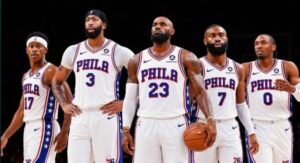




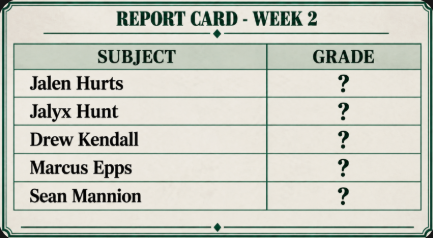
For nearly two full minutes Sunday afternoon, the Bleed Green Sports prediction looked almost uncomfortably accurate. Tennessee took a 20-17 lead at the two-minute warning, exactly matching our predicted final score, and Philadelphia had no timeouts with one final opportunity to prevent the Titans from pulling off the upset.
Jalen Hurts had already thrown two interceptions, the running game had accomplished very little, the offensive line was struggling, and Tennessee had just converted an absurd third-and-22 on its way to the go-ahead field goal. Then Hurts took the football and did exactly what you want a franchise quarterback to do when everything that happened before no longer matters.
Hurts completed six of eight passes for 61 yards on the final possession, moved Philadelphia 65 yards in nine plays and found Darius Cooper for the game-winning touchdown with 14 seconds remaining. DeVonta Smith and Dontayvion Wicks made crucial third-down receptions along the way, and the Eagles escaped Nashville with a 24-20 victory and a 2-0 record.
The final score does not tell the entire story. Philadelphia outgained Tennessee 341-291, produced 23 first downs to Tennessee’s 14, converted 11 of 18 third downs and controlled possession for more than 36 minutes, but the Eagles also lost the turnover battle 2-0, averaged only 2.8 yards per rushing attempt and allowed Tennessee to average 5.7 yards per offensive play.
The Eagles were supposed to prove something against Tennessee after barely surviving Washington in Week 1. They did prove something, but it was not that this team is ready to casually steamroll inferior opponents. They proved they can absorb mistakes, injuries and a late deficit on the road and still find a way to win.
Team Grade: C+
Philadelphia deserves credit for winning a road game played in extreme conditions while losing Saquon Barkley and Dallas Goedert for significant portions of the afternoon. The offense was also dramatically more sustainable than it was against Washington, increasing from 10 first downs in Week 1 to 23 against Tennessee and converting an excellent 61 percent of its third downs.
The problem is that the Eagles again made their margin for error unnecessarily thin. Tennessee entered Sunday after producing only 195 yards against the Jets, yet the Titans were leading Philadelphia with 14 seconds remaining. The Eagles struggled badly to run the football, allowed three sacks, gave up 122 rushing yards and turned the ball over twice.
Those two interceptions were expensive in the context of the game, but that does not mean Bleed Green Sports views them the same way when grading the quarterback. There is a difference between grading the cost of a turnover to the team and evaluating whether the quarterback is playing the aggressive style of football we want him developing in September.
The final drive also matters. Teams that expect to play meaningful football in January need quarterbacks, receivers and offensive lines capable of functioning when the entire game has been reduced to one possession with no timeouts. Philadelphia faced that situation Sunday and executed.
A C+ reflects the entire performance. The Eagles were not consistently good enough against an opponent they were favored to beat comfortably, but the most important players were excellent when the game demanded it.
Offensive Player Grades
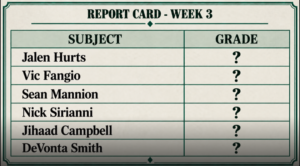
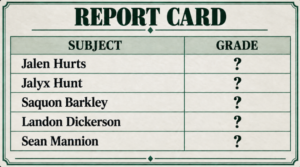
Jalen Hurts: A
Jalen Hurts threw two interceptions Sunday, and Bleed Green Sports is not going to treat those interceptions as evidence that he needs to become more conservative. Quite the opposite, because these are exactly the types of mistakes we wanted to see Hurts willing to make during training camp and early in the regular season.
The first interception was especially valuable as a teaching play. Hurts appeared to read Tennessee’s coverage as man when the Titans were actually playing zone, allowing Amani Hooker to pass the route correctly, jump the throwing lane and intercept the football in the end zone. Hooker returned it 92 yards, and Tennessee scored four plays later, so the mistake was extremely costly in the game.
But this was not a “meatball sub” interception where Hurts stared at a receiver in one-on-one coverage, threw the football directly into danger and simply hoped his guy would make a miracle happen. He was fooled by the coverage, made the wrong read and now has a clear piece of film showing exactly how Tennessee manipulated what he thought he saw.
That is the kind of mistake a quarterback can learn from. Hurts can study the pre-snap presentation, identify the post-snap indicator he missed and add that information to his mental database for the next time a defense presents the same picture.
The second interception was closer to an aggressive mistake, but even that play deserves context. DeVonta Smith had an opportunity vertically, Hurts attempted to attack it with Jeffery Simmons bearing down on him, and the pressure prevented him from getting enough on the throw. Marcus Harris intercepted the underthrown ball with the score tied in the fourth quarter.
It was still a mistake. The answer is to study why it happened and make the throw better next time, not to stop attempting difficult throws.
That distinction is the entire story of Hurts’ afternoon. He did not throw two interceptions and then retreat into a conservative shell where protecting his interception percentage became more important than attacking Tennessee’s defense.
Hurts kept firing.
That is what Bleed Green Sports wants from its quarterback. There is a version of quarterback play that looks wonderfully efficient statistically because the quarterback almost never throws interceptions, but some of that efficiency can come from refusing difficult opportunities altogether. Eventually the playoffs arrive, defenses remove the easy answers and the quarterback is asked to make throws he spent four months avoiding.
Training camp and September are where those mistakes should happen. Attack a coverage, learn why the window closed, discover what you can and cannot get away with, and build a larger collection of answers before the games become elimination games.
Sam Darnold’s 2025 season in Seattle provides a useful example, although it does not prove that throwing interceptions automatically produces better playoff football. Darnold threw 14 regular-season interceptions, third-most in the NFL, but Seattle continued allowing him to attack. When the postseason arrived, he threw five touchdown passes and zero interceptions across three playoff games, including Seattle’s Super Bowl victory.
Darnold’s example illustrates the larger point. Quarterbacks need opportunities to find the limits of aggressive football before the season reaches the point where one mistake sends everyone home.
Hurts also began attacking an area of the field Bleed Green Sports has repeatedly wanted to see him use more often. According to NFL Next Gen Stats, he finished 5-of-9 for 73 yards and one touchdown on throws over the middle against Tennessee.
That is a start, not a finished product. Philadelphia still needs more throws between the numbers, particularly because middle-of-the-field passing can punish defenses for expanding to contain Hurts’ legs and protecting the sidelines against DeVonta Smith, but nine attempts represent movement in the right direction.
The final drive is ultimately why Hurts receives an A. Philadelphia got the ball back with 1:56 remaining, no timeouts and a three-point deficit, and Hurts completed six of eight passes for 61 yards while also scrambling for four yards. He hit Wicks for 20 yards on third-and-6, found Smith for 19 yards on another third down and then worked through the final play before locating Cooper in the back of the end zone.
The interceptions belong on the teaching tape. So does the response.
Hurts was fooled once, made another aggressive mistake under pressure, and then continued playing quarterback rather than allowing those mistakes to change who he was for the remainder of the afternoon. When Philadelphia needed him to attack one final time, he did.
That is what we want from the position, and that earns an A.
Saquon Barkley: INC
Saquon Barkley’s afternoon effectively ended on Philadelphia’s first offensive snap when he suffered a stinger. He eventually returned wearing additional neck protection but finished with only four carries for nine yards and one reception for 11 yards, which is not enough work to assign a meaningful performance grade.
The bigger takeaway is how dramatically Philadelphia’s running game changed without him. Barkley cannot fix every blocking problem, but his ability to create yards when the offensive line fails to produce clean space was noticeably absent for most of Sunday.
This is an incomplete, not a poor grade. His health matters significantly more than four carries in Nashville.
Tank Bigsby: B-
Tank Bigsby unexpectedly became Philadelphia’s primary running back and finished with 33 yards on 13 carries, including the two-yard touchdown that tied the game in the second quarter. The 2.5-yard average is poor, but the offensive line rarely provided clean running lanes and Bigsby was frequently making contact near the line of scrimmage.
His best sequence came before his touchdown when he powered through contact for nine yards and followed it by finishing the drive himself. Bigsby did not create enough extra production to rescue the running game, but he handled an unexpected workload without becoming another problem Philadelphia needed Hurts to solve.
Will Shipley: B-
Will Shipley carried seven times for 24 yards and caught two passes, numbers that look ordinary until his pass protection on the final drive is considered. Shipley helped keep Hurts clean long enough to deliver the third-down completion to Wicks that moved Philadelphia across midfield.
Running backs have responsibilities beyond rushing statistics, particularly when the quarterback is trying to conduct a no-timeout comeback drive. Shipley was dependable when Philadelphia needed him to understand that part of the assignment.
DeVonta Smith: A+
Philadelphia traded A.J. Brown believing DeVonta Smith could operate as the unquestioned No. 1 receiver, and Sunday was the clearest evidence yet that he is ready for that responsibility. Smith caught 10 of 13 targets for 117 yards and a touchdown, producing his first 100-yard performance of the season while repeatedly delivering on critical downs.
His 22-yard touchdown late in the first half was excellent, but Smith’s most important work came with Philadelphia trailing. He caught four passes for 38 yards on the final possession, including the 19-yard third-down reception that put the Eagles at Tennessee’s 3-yard line with enough time for one more controlled shot at the end zone.
Smith did not simply produce a large receiving total. Hurts repeatedly went to him when Tennessee knew where the football was likely to go, and Smith still won.
That is WR1 football
Dontayvion Wicks: A-
Dontayvion Wicks followed his explosive Week 1 debut with five catches for 74 yards, giving him another game where his production mattered far beyond the raw target count. He caught a 27-yard pass over the middle on Philadelphia’s opening possession, converted a fourth down later in the first half and repeatedly gave Hurts a dependable secondary option while Tennessee concentrated on Smith.
His biggest reception came with the Eagles facing third-and-6 on the game-winning drive. Wicks went up over Marcus Harris for a contested 20-yard catch that moved Philadelphia into Tennessee territory and prevented the final possession from dying almost immediately.
Wicks has followed a strong debut with another legitimate contribution. Philadelphia needed somebody to emerge behind Smith, and two games into the season Wicks is making a serious argument that the answer may already be on the roster.
Darius Cooper: A
Darius Cooper finished with two catches for 26 yards, which normally would not produce an A on any report card. Those numbers look considerably different when one reception gained 23 yards in the fourth quarter and the other won the football game.
Cooper’s first catch helped Philadelphia recover after falling behind the sticks. His second became the biggest reception of his professional career when Hurts worked through the play, floated the football toward the back of the end zone and Cooper secured his first NFL touchdown with 14 seconds remaining.
Cooper was initially supposed to help create space for Smith on the final concept, but Tennessee covered the primary action and Cooper became available behind the defense. Hurts found him, Cooper finished the play, and Philadelphia went from a 20-17 loss to a 24-20 victory.
A supporting player does not need 10 targets to change a game. Cooper needed two catches.
If you want to read more about Darius Cooper, check out his rise with the Eagles here.
Makai Lemon: C+
Makai Lemon caught one pass for 14 yards, but that reception came on third-and-8 and extended Philadelphia’s second touchdown drive. His ability to fight through contact and finish the catch was a much more encouraging use of his skill set than the receiver-screen package that produced negative yardage again Sunday.
Philadelphia also gave Lemon one designed rush that lost five yards. The continued obsession with getting him the ball behind the line of scrimmage remains questionable, but the 14-yard conversion showed why the Eagles should continue expanding his route tree rather than treating him like a gadget player.
Dallas Goedert: INC
Dallas Goedert caught one pass for four yards before leaving with a knee injury and did not return. There simply was not enough football to assign him a responsible grade.
His absence still mattered because Philadelphia lost one of Hurts’ most dependable middle-of-the-field options against a defense specifically trying to force the Eagles into patient underneath football. That makes the five-of-nine middle-field performance from Hurts more encouraging because much of it occurred without Goedert available.
Johnny Mundt: D+
Johnny Mundt was forced into a larger role after Goedert left and finished with two catches for eight yards. His receiving production was never going to determine his grade because Philadelphia primarily needs Mundt to provide value through blocking and assignment reliability.
A fourth-quarter holding penalty created another difficult situation for an offense already struggling to stay on schedule, and his blocking was not consistently good enough to compensate for the limited receiving value. Philadelphia needed a cleaner afternoon from its veteran backup tight end.
Offensive Line Grades
Jordan Mailata: C
Jordan Mailata was one of the more stable members of an offensive line that struggled throughout the afternoon, but this still was not one of his better performances. Tennessee generated pressure through movement and interior games, and Mailata was involved in several reps where the front failed to sort out who was supposed to handle Simmons and the Titans’ looping rushers.
Mailata was not Philadelphia’s primary offensive-line problem, and he remains one of the two linemen about whom Bleed Green Sports has the least concern. Still, the Eagles need their elite left tackle to raise the floor of a unit dealing with instability everywhere inside.
Cam Jurgens: D+
Philadelphia responded to Landon Dickerson’s injury by moving Cam Jurgens from center to left guard and starting Drew Kendall at center. The experiment did not provide the stability Philadelphia hoped it would create.
Jurgens struggled against Simmons and John Franklin-Myers in the running game and was badly beaten on Jacob Martin’s third-quarter sack of Hurts. The athleticism that makes Jurgens an intriguing guard theoretically did not translate into consistent control against Tennessee’s front.
Moving Jurgens weakened the position where Philadelphia already knew it had a high-level starter in order to solve left guard. After Sunday, it is fair to ask whether that tradeoff actually improved the offensive line.
Drew Kendall: D+
Drew Kendall’s introduction to the starting lineup included the unenviable assignment of trying to organize Philadelphia’s protection against Robert Saleh while Jeffery Simmons attacked the interior. That is not an easy first major test for any young center.
Kendall lost several early reps, struggled to consistently anchor against Tennessee’s power and was part of an interior that allowed pressure to reach Hurts too quickly. Philadelphia still converted 11 third downs and sustained several long drives, so Kendall did enough to survive the afternoon, but surviving and playing well are not the same thing.
There is no reason to declare the experiment a failure after one game. There is also no reason to pretend Sunday looked comfortable.
Tyler Steen: D
Tyler Steen was probably Philadelphia’s weakest offensive lineman against Tennessee. He lost too many individual battles inside, committed a holding penalty to begin the second half and contributed to a rushing attack that averaged only 2.8 yards per carry as a team.
Philadelphia entered 2026 needing Steen to prove he could become a dependable piece of the interior offensive line. Two games into the season, the evidence remains incomplete at best, and performances like Sunday make the Dickerson injury considerably more concerning.
Lane Johnson: B-
Lane Johnson was generally solid in pass protection but did not deliver the type of dominant performance Philadelphia needed while the interior line struggled. He was involved in the first-play breakdown on which Barkley suffered the stinger and later received an illegal-formation penalty.
Johnson and Mailata are the least concerning members of the offensive line, which means Philadelphia does not need perfection from them every week. It does need its two veteran tackles to provide enough dominance on the edges to compensate while the interior searches for answers, and Sunday was still below Johnson’s standard.
Defensive Player Grades
Jalen Carter: B
For three quarters, Jalen Carter was surprisingly quiet, particularly for a player Philadelphia needed to help overwhelm a Tennessee offensive line that had struggled one week earlier. Then the game reached the moment where Philadelphia desperately needed its highest-paid defensive player to change something.
After the Eagles somehow allowed Tennessee to convert third-and-22 late in the fourth quarter, the Titans reached the red zone with an opportunity to score the touchdown that could have effectively ended the game. Carter changed the possession.
Playing with protection on his injured wrist, Carter beat the interior protection and sacked Ward on first-and-goal for a nine-yard loss. According to NFL Next Gen Stats, Carter reached Ward in 3.4 seconds, the fastest sack recorded by either team Sunday.
That sack changed Tennessee’s scoring calculus. Instead of operating from first-and-goal at the 9 with an opportunity to turn a three-point game into a seven-point game, the Titans were pushed backward and eventually settled for the field goal that made the score 20-17.
Those four potential points became the game because Hurts answered with a touchdown rather than merely forcing overtime. Carter did not dominate snap after snap, but his biggest play arrived at exactly the moment Philadelphia could least afford to be without one.
Moro Ojomo: B
Moro Ojomo again provided useful rotational snaps and delivered one of Philadelphia’s better run-defense plays when he drove Peter Skoronski backward and tackled Tyjae Spears for a three-yard loss in the fourth quarter. His overall disruption was not as noticeable as it had been against Washington, but he remained active during a game where Philadelphia’s defensive front was dealing with extreme heat and long second-half possessions.
Ojomo continues to look like a legitimate starting-caliber defensive tackle even when the splash plays are not constant. Philadelphia needs that reliability because Carter and Jordan Davis cannot be expected to play every defensive snap.
Jordan Davis: C+
Jordan Davis was not as dominant against Tennessee as he was in the opener. The Titans rushed for 122 yards, Tony Pollard averaged 4.6 yards per attempt and Tyjae Spears averaged 5.9, numbers that reflect too much successful movement against Philadelphia’s front.
Davis still contributed to several early-down stops and helped keep Tennessee from consistently hammering the middle, but Philadelphia needs him to dictate the line of scrimmage more forcefully. A C+ is not a bad game, but it is well below the standard he established against Washington.
Jalyx Hunt: B+
Jalyx Hunt continues to look like Philadelphia’s most consistently disruptive edge defender even though the sack numbers have not caught up to the pressure. He opened the game with a tackle for loss on Tony Pollard, forced Ward to abandon the pocket several times and helped maintain discipline against Tennessee’s attempts to get Ward outside.
The next step remains finishing. Hunt is creating enough disruption to affect possessions, but Philadelphia needs some of those pressures to become sacks and quarterback hits if the pass rush is going to flourish this season.
Nolan Smith: B+
Nolan Smith finally turned pressure into the statistic Philadelphia needs from its edge defenders. He tracked Ward down for a five-yard sack late in the second quarter and added another tackle for loss later in the game.
Smith was not overwhelmingly dominant, but the Eagles needed an edge defender to finish a rush after generating plenty of pressure without sacks against Washington. This was a meaningful step toward becoming the player Philadelphia needs opposite Hunt.
Zack Baun: C+
Zack Baun followed an outstanding Week 1 performance with a much more ordinary afternoon. He over-pursued on Tony Pollard’s 13-yard third-down conversion and was part of a linebacker group that allowed Tennessee to find several useful gains underneath and after play action.
Baun still made positive plays and remained active around the football, but the standard changed after what he showed against Washington. This was not a disaster, but it was not the Fred Warner-level performance we saw one week earlier either.
Jihaad Campbell: B-
Jihaad Campbell led Philadelphia with 10 tackles, including six solo stops, and continued showing why his athleticism gives Fangio options at the second level. He flashed against screens and underneath concepts and repeatedly closed ground quickly when Tennessee tried to get the ball into space.
There were still coverage issues, particularly when play action manipulated Philadelphia’s linebackers and opened windows behind them. One major issue is that while Campbell’s 10 tackles look impressive in the box-score, few of those tackles were at the line of scrimmage.
While the positive plays outweighed the mistakes, and Campbell continues to look increasingly comfortable carrying a significant defensive workload, it makes you wonder if Vic Fangio may play Jeremiah Trotter Jr. next to Zach Baun in the coming weeks.
Riq Woolen: A-
Riq Woolen continues to justify Philadelphia’s belief that his length and speed could become a perfect fit opposite Quinyon Mitchell. Tennessee never consistently established an outside passing game, forcing Ward to find much of his production through intermediate crossers, broken tackles and coverage manipulation elsewhere.
Woolen’s physical tools allow Fangio to ask him to survive isolation while resources are used in other areas of the defense. Two games into his Eagles career, that gamble is looking increasingly intelligent.
Quinyon Mitchell: B
Quinyon Mitchell once again gave Philadelphia dependable outside coverage and prevented Tennessee from consistently attacking the perimeter. Calvin Ridley did beat him on a 25-yard completion over the middle, but the Titans never built a passing game around targeting Mitchell.
That has become part of Mitchell’s value. A relatively quiet game can still represent high-level cornerback play because offenses are increasingly reluctant to make him the center of their plan.
Cooper DeJean: B
This was a cleaner performance from Cooper DeJean than the opener. He tackled Carnell Tate short of the sticks on an important third down and generally avoided becoming the matchup Tennessee repeatedly targeted.
There were still zone-coverage openings, including Wan’Dale Robinson’s third-down reception after DeJean blitzed, but the secondary did a better job communicating around those pressures. After the Washington performance, a boring game from DeJean is progress.
Andrew Mukuba: C
Andrew Mukuba played through a knee issue and contributed some physical tackles, including useful work near the goal line. His effort was not the concern, but his consistency was.
Mukuba lost track of Robinson on one third-down conversion and failed to finish on Pollard’s 18-yard fourth-quarter run. Philadelphia’s safeties were involved in too many successful Tennessee plays after the catch or after the initial point of contact.
The knee issue deserves consideration, but the tape was still uneven enough to hold the grade at a C.
Marcus Epps: D-
Marcus Epps receives the lowest defensive grade because third-and-22 has to end the possession. Tennessee was staring at exactly the situation Philadelphia wanted late in a tie game, yet Tyjae Spears took a handoff for 27 yards after Epps overran the play and the Titans suddenly had first-and-goal.
Epps was also involved around several other explosive plays and struggled to consistently finish in space. Carter eventually prevented the third-and-22 mistake from becoming a touchdown, and Hurts prevented it from becoming the defining play of the game, but neither rescue changes what happened on the snap itself.
Special Teams Grade: A
Jake Elliott continues to make difficult kicks look routine. His 58-yard field goal in the third quarter extended Philadelphia’s lead to 17-10, and he converted all three extra points, including the final one after Cooper’s touchdown. Is Jake Elliot Back?
Braden Mann also gave Philadelphia solid field-position work, while Britain Covey provided useful punt-return yardage. In a game where the offense repeatedly left points available and the defense allowed Tennessee to hang around, special teams did its job without creating another problem.
The Eagles Special Teams should be the story of the first two weeks of the season, but since they are Special Teams, no one cares.
Sean Mannion: B
Sean Mannion’s second game as Philadelphia’s play caller was considerably more encouraging than his first. The Eagles generated 23 first downs, converted 11 of 18 third downs, held the football for more than 36 minutes and punted only twice, a dramatic improvement from the drive-to-drive inconsistency against Washington.
Mannion also had to adjust after losing Barkley for much of the afternoon and Goedert for the remainder of the game. Philadelphia continued producing answers through Smith, Wicks and the other receivers, and the offense became increasingly willing to attack intermediate areas rather than surviving almost exclusively through sideline throws and isolated explosives.
The Next Gen Stats numbers over the middle were particularly encouraging. Hurts went 5-of-9 for 73 yards and a touchdown on throws between the numbers, meaning nearly a third of his 32 live pass attempts came in an area of the field Bleed Green Sports has repeatedly wanted Philadelphia to attack more often. That does not mean the issue is suddenly fixed, but it represents meaningful progress toward a more balanced passing distribution and an offense that forces defenses to defend the entire field.
Mannion also deserves credit for the game-winning concept. Cooper’s initial responsibility was to help create space for Smith, but Tennessee covered the primary action, and the secondary option became available in the back of the end zone. Hurts correctly worked through it and Cooper finished the play.
The biggest negative remains the running game. Philadelphia averaged only 2.8 yards per carry, and the offense still reached too many difficult third downs because first- and second-down rushing plays produced very little.
Still, the offense looked more sustainable Sunday. Mannion receives a B because the structure gave Hurts enough answers to keep attacking, and when the game reached its decisive possession, Philadelphia had a functional two-minute offense ready to execute.
Vic Fangio: C
Philadelphia allowed only 20 points and 291 total yards, numbers that normally suggest a strong defensive performance. The problem is that Tennessee entered the game after producing only 195 yards against New York, yet averaged 5.7 yards per play and found enough explosive gains to lead with seconds remaining.
The defense allowed 122 rushing yards and surrendered several plays that should not happen against this offense, with the third-and-22 conversion standing above everything else. Fangio’s outside corners again played well, and Ward finished with only 183 passing yards and no passing touchdowns, but Tennessee repeatedly found just enough offense to stay alive.
The pass rush did improve from Week 1. Nolan Smith and Carter finished two important sacks, and Carter’s 3.4-second takedown on first-and-goal may have been the most important defensive play of the afternoon.
Holding an NFL team to 20 points is not a bad performance, but allowing this Tennessee offense to control portions of the second half and threaten an upset prevents a higher grade. Fangio gets a C because his defense bent much more than expected but still produced the red zone stop that preserved Hurts’ opportunity to win the game.
Player of the Game: Jalen Hurts
DeVonta Smith was Philadelphia’s most consistently dominant player and deserves serious consideration after catching 10 passes for 117 yards and a touchdown. The Player of the Game, however, goes to Jalen Hurts because the defining story of Sunday was not that he played perfectly, but that mistakes never convinced him to stop attacking.
Hurts threw two interceptions that could have ended Philadelphia’s chances. Instead of becoming cautious, he continued targeting tight windows, continued using the middle of the field and ultimately went 6-of-8 on a game-winning drive with no timeouts and virtually no room for another mistake.
That mentality matters more to Bleed Green Sports than preserving a spotless interception column in September. We want the quarterback learning what aggressive football looks like now so that when the playoffs demand those throws, he has already lived through the mistakes that can come with them.
Hurts receives the game ball because when Philadelphia needed its quarterback to keep firing, he did.
Scapegoat of the Game: Marcus Epps
There were several legitimate candidates for this distinction because Philadelphia’s interior offensive line struggled badly and the running game never established itself. Marcus Epps gets the final selection because the third-and-22 conversion was the most indefensible individual mistake of the afternoon.
Tennessee should have been punting or attempting a long field goal after that snap. Instead, Spears gained 27 yards and gave the Titans first-and-goal, setting up the possession that eventually produced their 20-17 lead.
Carter’s sack prevented the mistake from becoming a touchdown, and Hurts’ final drive prevented it from becoming the reason Philadelphia lost. Epps still owns the play that nearly changed the entire afternoon.
Top Five Eagles
- Jalen Hurts: A Hurts threw two interceptions, learned from them in real time, kept attacking and finished the afternoon with a 6-of-8 game-winning drive when Philadelphia had no timeouts and no margin for error.
- DeVonta Smith: A+ Smith caught 10 passes for 117 yards and a touchdown while repeatedly winning the downs Tennessee knew Philadelphia needed him most.
- Darius Cooper: A Cooper only caught two passes, but one gained 23 yards and the other became his first NFL touchdown while giving Philadelphia the lead with 14 seconds remaining.
- Dontayvion Wicks: A- Wicks produced 74 yards on five catches and made the contested third-and-6 reception that prevented the final drive from dying before it reached midfield.
- Jake Elliott: A Elliott drilled a 58-yard field goal and remained perfect on extra points in a game where Philadelphia could not afford to leave additional points on the field.
Honorable mention: Jalen Carter
Carter’s overall afternoon was quieter than expected, but his 3.4-second sack on first-and-goal changed a potential touchdown possession into the field goal that kept Philadelphia within three points.
Bottom Five Eagles
- Marcus Epps: D- Third-and-22 became a 27-yard run because Epps lost the angle on Spears, turning what should have been the end of Tennessee’s possession into first-and-goal.
- Tyler Steen: D Steen lost too many interior battles, committed a holding penalty and remains part of an offensive line that cannot consistently create a functional running game.
- Cam Jurgens: D+ Philadelphia moved Jurgens from center to left guard to stabilize the interior, but he struggled with Tennessee’s power and allowed one of the game’s ugliest pressures.
- Drew Kendall: D+ Kendall was handed an extremely difficult assignment against Simmons and survived, but Tennessee consistently generated interior disruption against Philadelphia’s new center configuration.
- Johnny Mundt: D+ Mundt’s expanded role after Goedert’s injury included inconsistent blocking and a fourth-quarter holding penalty when Philadelphia badly needed to stay ahead of the chains.
Final Word
The Eagles are 2-0, and there is real value in being able to win games that do not unfold the way they were supposed to. Philadelphia has now beaten two opponents despite significant stretches where the offense stalled, the defensive front failed to dominate and the game reached the final minutes with virtually no margin for error.
Sunday was different from Washington in one important way. The Eagles produced a much more sustainable offensive performance, generating 23 first downs and converting 61 percent of their third downs instead of relying almost entirely on a few enormous plays.
The quarterback performance was different too. Hurts’ two interceptions will dominate any analysis built around a box score, but Bleed Green Sports views the game through a different lens. We wanted Hurts to become more willing to attack, make mistakes, learn from them and continue attacking instead of becoming obsessed with playing mistake-free football at the expense of creating offense.
He did exactly that.
The first interception gave Hurts film showing how Tennessee disguised zone as man. The second taught him about the limits of attacking vertically while pressure is arriving directly in his face. Neither mistake convinced him that the answer was to stop throwing the football.
Then the game reached its most important possession, and the quarterback who had already thrown two interceptions calmly completed six of eight passes while delivering Philadelphia its second win of the season. That is the kind of experience September is supposed to provide.
There are still significant problems. The offensive line is unsettled without Dickerson, the running game has not established the identity this offense expected, the pass rush remains inconsistent and the defense allowed a weak Tennessee offense to produce enough explosives to nearly steal the game.
Yet there were also meaningful signs of progress. Hurts attacked the middle of the field more frequently, Smith looked every bit like a true No. 1 receiver, Wicks continued establishing himself, Cooper produced the first defining moment of his NFL career and Carter made the defensive play Philadelphia needed when one more Tennessee touchdown probably ends the game.
With two minutes remaining, the scoreboard read Titans 20, Eagles 17, exactly as Bleed Green Sports predicted before kickoff. Fourteen seconds from the end, Hurts changed the ending.
I can live with being wrong that way.
Sources
- Philadelphia Eagles official Week 2 game recap and play-by-play.
- Philadelphia Eagles official Week 2 box score.
- Philadelphia Eagles breakdown of the final drive and postgame takeaways.
- NFL 2025 passing statistics for the Sam Darnold regular-season comparison.
- Seattle Seahawks postseason statistics for Sam Darnold’s 2025 playoff run.
- NFL Next Gen Stats for Hurts’ middle-of-field passing and Carter’s sack timing.