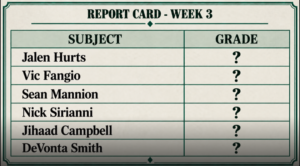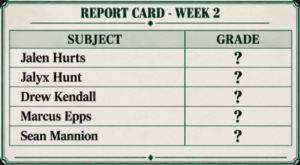




The Philadelphia Eagles have won their first two games of the 2026 season, which is exactly what a team with championship expectations should accomplish against Washington and Tennessee.
The process has been far less convincing than the record.
Philadelphia beat the Commanders by two points and escaped Nashville by four after Tennessee took the lead with two minutes remaining. The Eagles have failed to cover the spread in both games, tied Washington in the turnover battle and committed the only two turnovers against Tennessee. The Eagles have failed to record a turnover in their first two games.
Jalen Hurts, DeVonta Smith and Darius Cooper rescued Philadelphia against the Titans. Hurts completed six of eight passes on the final possession, Smith produced four catches for 38 yards on the drive, and Cooper scored the winning touchdown with 14 seconds remaining.
That was an impressive response to adversity. It also allowed the Eagles to avoid a much harder conversation about how a seven-point favorite nearly lost to a Tennessee team that entered the afternoon looking like one of the NFL’s worst.
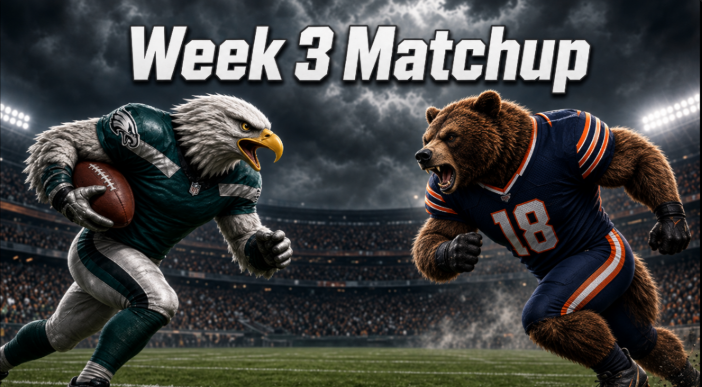
Monday night in Chicago should provide a clearer evaluation.
The Bears won the NFC North last season, beat Philadelphia at Lincoln Financial Field and return the rushing attack that embarrassed Vic Fangio’s defense. Chicago may have to play without Caleb Williams and Tyson Bagent, but the quarterback uncertainty does little to erase what happened when these teams met ten months ago.
The Eagles are 2-0, but the question remains, can we stop the run in Chicago?
Eagles vs. Bears Game Information
Philadelphia and Chicago will meet Monday, September 28, at 8:15 p.m. Eastern at Soldier Field. The game will be broadcast nationally on ESPN and ABC, with Joe Buck, Troy Aikman, Lisa Salters and Laura Rutledge on the broadcast. (Philadelphia Eagles game information)
Weather Should Stay Out of the Way
Soldier Field weather often becomes part of the game plan, but the current Monday night forecast looks unusually cooperative. Temperatures are expected to sit around 64 to 66 degrees, with clear skies, almost no chance of rain and winds of only three to five miles per hour. Those conditions should allow both teams to use their complete passing and kicking games, although forecasts along the Chicago lakefront can change quickly. (Soldier Field forecast)
Teams Records
Philadelphia enters the game 2-0 after victories over Washington and Tennessee. Chicago is 1-1 after opening with a 59-37 victory over Carolina and losing 9-3 to Minnesota in a monsoon.
The records create a matchup between two teams that have reached the same week through dramatically different experiences. Philadelphia has played two close games and survived both. Chicago has already experienced the highest-scoring game in the NFL this season and one of its ugliest defensive battles.
The Betting Market Has Made a Massive Adjustment
Chicago opened as a 1.5-point favorite before injuries changed the market. The line has moved approximately six points, with Philadelphia now favored by 4.5 at Soldier Field.
The total has experienced a similarly dramatic adjustment. It opened at 46.5 and has fallen to 41.5, reflecting the possibility that Chicago will start Case Keenum while Philadelphia may play without Dallas Goedert and with Saquon Barkley limited.
The current consensus market lists Philadelphia at approximately -225 on the moneyline, with Chicago around +185. The Eagles are -4.5 against the spread, while the total sits at 41.5. (Eagles-Bears odds)
DraftKings’ betting splits show that the public is heavily backing Philadelphia, although the money distribution becomes more interesting when the spread is examined.
On the spread, 73 percent of bets are on Philadelphia -4.5, accounting for 59 percent of the money. Chicago has attracted only 28 percent of spread bets, but those wagers represent 41 percent of the money. The larger average wager appears to be coming on Bears +4.5, even though Philadelphia remains the more popular selection. (DraftKings spread splits)
The moneyline action is far more decisive. Philadelphia is receiving 88 percent of the bets and 72 percent of the money at -225. Chicago is attracting 13 percent of the bets and 28 percent of the handle at +185. Bettors overwhelmingly expect the Eagles to win outright, while the average Bears moneyline wager is considerably larger.
The total presents another split between ticket count and money. The over at 41.5 has received 55 percent of bets but only 43 percent of the handle. The under has attracted 45 percent of bets and 57 percent of the money. The public is slightly more interested in the over, while the larger wagers are backing a lower-scoring game. (DraftKings total splits)
The market’s overall position is clear. Bettors expect Philadelphia to win, although there is greater resistance to laying 4.5 points than the ticket percentages initially suggest. Larger wagers have shown more interest in Chicago against the spread and the under, a combination that points toward a competitive, lower-scoring game.
That fits the conditions surrounding Monday night. Chicago may have limited quarterback play, but its rushing attack can shorten the game and reduce the number of possessions. Philadelphia has also won both games without covering, while its offense could be missing Goedert and operating with questions surrounding Barkley.
Chicago Has Already Shown Two Completely Different Teams
The Bears opened the season by scoring a franchise-record 59 points in a 59-37 victory over Carolina.
Williams produced 334 total yards and four touchdowns, including 269 passing yards and 65 rushing yards. Chicago accumulated 552 yards, rushed for 291 and scored touchdowns on three consecutive possessions during a decisive second-half run. (Bears Week 1 recap)
One week later, the Bears scored three points.
Chicago gained 297 yards in a 9-3 loss to Minnesota, failed to score a touchdown and lost Williams during a fourth-quarter scramble. The Bears still reached the Minnesota 6 with an opportunity to tie the game, but Cairo Santos had a 23-yard field-goal attempt blocked. Bagent later moved Chicago to the Vikings’ 12 before taking a fourth-down sack on the final play.
The 56-point scoring decline was the second-largest drop from Week 1 to Week 2 in NFL history. Weather contributed to the ugliness, with heavy rain affecting both offenses throughout the afternoon, but Chicago still committed two turnovers and repeatedly found itself behind the chains. (Bears Week 2 recap)
Philadelphia therefore has to prepare for an offense with an unusually wide range of possible outcomes. The Bears have demonstrated that they can produce explosive plays, control the line of scrimmage and score in bunches. They have also shown how quickly the offense can become compressed when early-down efficiency disappears.
The quarterback decision will influence which version appears Monday night, although Chicago’s offensive identity remains built around something far more dependable.
The Quarterback Situation Could Reach Case Keenum
Williams is considered week-to-week with a right hamstring injury and was not expected to practice early in the week. Ben Johnson has declined to rule him out, but the betting movement suggests the market expects Chicago to proceed without its starting quarterback.
Bagent is also in the concussion protocol after replacing Williams against Minnesota. If neither quarterback is cleared, 14-year veteran Case Keenum will start, with undrafted rookie Miller Moss likely elevated from the practice squad to serve as the backup. (Bears quarterback update)
Keenum has started 66 regular-season games and has enough experience to operate an offense without the entire plan collapsing. He also lacks Williams’ improvisational ability, arm talent and mobility.
Williams presents Fangio with the same type of structural problem the Eagles faced against Jayden Daniels in Week 1. A successful coverage call can still fail when the quarterback escapes, extends the play and creates a throw that never existed within the original design.
Keenum changes that calculation. Philadelphia can attack the pocket more aggressively, close throwing windows underneath and force Chicago to survive third-and-long without worrying that every broken play will become a 20-yard scramble.
The Eagles should possess a major advantage if Keenum starts. That advantage disappears quickly if Philadelphia allows Chicago to run the football the way it did last season.
Philadelphia Cannot Forget 281 Rushing Yards
Chicago did more than beat Philadelphia 24-15 on Black Friday last season. The Bears controlled the game physically from the opening possession.
Kyle Monangai rushed for 130 yards and one touchdown on 22 carries. D’Andre Swift added 125 yards and another touchdown on 18 attempts. Chicago finished with 281 rushing yards, 28 first downs and 39 minutes, 18 seconds of possession.
The Bears ran 47 first-half plays while the Eagles ran 17. They held advantages of 222-83 in total yards and 16-2 in first downs before halftime. Philadelphia spent most of the afternoon reacting to Chicago’s movement, misdirection and commitment to running through favorable numbers. (2025 Bears-Eagles recap)
That performance was not created by Williams dominating through the air. He completed 17 of 36 passes for 154 yards, one touchdown and one interception.
Chicago won because the Eagles could not stop the run.
The same running backs return Monday night, and both have opened the season in excellent form. Swift has 169 rushing yards and three touchdowns through two games. Monangai has 147 yards and a touchdown while averaging 7.3 yards per carry. (Eagles analysis of Chicago’s running game)
Combined, Swift and Monangai have produced 316 rushing yards in two weeks. The Eagles therefore have recent evidence, current statistics and 281 unpleasant reasons to make Chicago’s running game the center of their defensive plan.
Chicago’s Running Game Does Not Depend on Williams
Fangio made an important point when discussing Chicago’s offense this week. The Bears operate extensively from under center, which means their rushing attack does not require quarterback reads or designed quarterback runs to function.
Chicago can use motion, condensed formations, split-flow action and multiple tight ends to manipulate defensive fits before handing the ball to Swift or Monangai. The offensive line includes Joe Thuney, Garrett Bradbury, Jonah Jackson and Darnell Wright, giving the Bears enough strength and experience to create movement without relying on deception alone.
Swift supplies acceleration and receiving ability. Monangai gives Chicago a powerful downhill runner who consistently finishes through contact. The contrast forces defenses to tackle two different styles without receiving an obvious personnel clue about the play coming next.
That becomes especially valuable if Keenum starts. Johnson can protect his quarterback by keeping the offense in manageable situations, building play action from the under-center running game and asking Keenum to make defined throws toward Rome Odunze, Luther Burden III, Cole Kmet and Colston Loveland.
Philadelphia’s first responsibility is preventing that environment from developing.
If the Eagles allow Chicago to average five or six yards on early downs, Keenum will spend the evening throwing against favorable looks with the entire playbook available. If Philadelphia wins first down and forces third-and-seven, Fangio can turn the game over to Jalen Carter, Nolan Smith and Jalyx Hunt.
The quarterback matchup becomes important after the Eagles earn the right to make it important.
The Eagles’ Run Defense Has Been Ordinary
Philadelphia has allowed 254 rushing yards through two games, with opponents averaging 4.2 yards per carry.
Washington rushed for 132 yards in the opener. Tennessee added 122 yards despite spending portions of the game playing from behind. Tony Pollard averaged 4.6 yards per attempt, Tyjae Spears averaged 5.9, and the Titans converted a third-and-22 late in the fourth quarter with a 27-yard Spears run.
That final play came from an obvious passing situation, which made the breakdown especially concerning. Marcus Epps overran the play, the second level failed to close the lane, and Tennessee suddenly reached first-and-goal with an opportunity to take control of the game.
Jalen Carter rescued the defense with a sack that forced Tennessee to settle for a field goal. Hurts then rescued the team with the winning drive.
Chicago has far more reason than Tennessee to believe it can build an entire game plan around the run.
Carter, Jordan Davis and Moro Ojomo have to prevent Chicago’s interior line from creating immediate displacement. Zack Baun, Jihaad Campbell and Jeremiah Trotter Jr. must process the motion and blocking action without abandoning their gaps. The safeties need to finish tackles before eight-yard runs become 25-yard gains.
Fangio can make life miserable for Keenum if the Eagles stop the run. Chicago can make Keenum’s limitations far less relevant if the Eagles fail again.
Jalen Hurts Is Playing Better
Hurts has completed 40 of 62 passes for 467 yards, five touchdowns and two interceptions through two games, producing a 100.7 passer rating. (Jalen Hurts season statistics)
The two interceptions against Tennessee were costly, and the Eagles cannot continue losing the turnover battle while expecting late drives to erase every mistake. Hurts has still shown several encouraging developments within Sean Mannion’s offense.
He has attacked downfield more aggressively, distributed the football beyond one receiver and operated efficiently on third down. Philadelphia converted 11 of 18 third downs against Tennessee, a significant improvement from an opener in which the Eagles generated only 10 total first downs.
The final drive also matters when evaluating the quarterback.
Hurts took over at his own 35 with 1:52 remaining, no timeouts and Philadelphia trailing 20-17. He completed six passes, converted three third downs and delivered the winning touchdown without giving Tennessee another meaningful possession.
That is exactly the situation in which a franchise quarterback is supposed to control the game.
Chicago’s defense presents a different challenge. Dennis Allen can generate pressure through simulated rushes and defensive-back blitzes, which helped the Bears record three sacks while holding Minnesota to 246 yards and a 23.1 percent third-down conversion rate. (Bears defensive improvement)
Hurts needs to recognize where the extra rusher is coming from and punish the space being vacated. That may create opportunities for Smith, the running backs and whichever tight ends are available.
DeVonta Smith Has Become the Center of the Offense
Smith caught 10 passes for 117 yards and a touchdown against Tennessee. Four of those receptions came on the final drive, when the Titans knew Hurts was likely to target him.
Through two games, Smith has 13 catches for 170 yards, averaging 13.1 yards per reception. (DeVonta Smith season statistics)
Chicago can place Jaylon Johnson across from Smith, use safety help and challenge Philadelphia’s other receivers to win. Tyrique Stevenson’s hamstring injury could complicate that plan because he is considered week-to-week, potentially reducing the Bears’ outside cornerback depth.
Dontayvion Wicks and Darius Cooper therefore become important. Wicks caught four passes for 54 yards in Tennessee, while Cooper finished the final drive with his first NFL touchdown. Makai Lemon also converted an important third down after struggling to establish himself in the opener.
Smith should remain the featured receiver because he has earned that responsibility. Philadelphia still needs enough production around him to prevent Allen from tilting the entire coverage plan toward one player.
The absence of Goedert increases that pressure.
Philadelphia’s Injuries Change the Offensive Plan
Barkley suffered a stinger on Philadelphia’s first offensive play in Tennessee. He eventually returned with additional neck protection but finished with four carries for nine yards.
Goedert left with a knee injury after one reception and did not return. Landon Dickerson is already on injured reserve, leaving Philadelphia to continue rearranging an offensive line that struggled to create consistent rushing lanes against the Titans.
The Eagles responded to Goedert’s injury by bringing Zach Ertz back to Philadelphia. Ertz is approaching his 36th birthday and is returning from a knee injury that ended his 2025 season, so expectations for an immediate major role should remain reasonable. His familiarity with Hurts and his understanding of spacing could still make him useful on third down and in the red zone. (Eagles sign Zach Ertz)
Barkley’s availability may be even more important.
Chicago allowed Carolina to rush for 125 yards in Week 1 and played much better against Minnesota in the rain. The Bears have enough defensive-line depth to challenge an Eagles interior that is still adjusting without Dickerson, especially with Grady Jarrett attacking the middle and Montez Sweat threatening the edge.
Tank Bigsby and Will Shipley handled the unexpected workload in Tennessee, but the Eagles averaged only 2.8 yards per carry. Philadelphia becomes considerably easier to defend if Barkley is limited and Hurts has to carry the offense from obvious passing situations.
The extra day before Monday night gives Barkley and Goedert more recovery time. Their status will influence the final prediction more than most injury updates on Philadelphia’s side.
Sean Mannion Has to Keep Philadelphia Ahead of the Chains
The Bears want Hurts operating on third-and-long against Allen’s pressure packages. The Eagles can avoid that situation by running efficiently, using quick completions and giving Hurts answers before the protection begins breaking down.
Mannion should use Smith’s route-running throughout the formation rather than leaving him isolated outside for an entire evening. Motion can identify coverage, stacks can create clean releases, and play action can take advantage of linebackers reacting to Barkley.
Philadelphia also needs to accept efficient gains.
Chicago held Minnesota without a touchdown by rallying to the football, disguising pressure and forcing the Vikings to execute one snap at a time. The Eagles cannot become impatient simply because they are favored or because Chicago may start its third quarterback.
Sustained drives also keep Swift and Monangai standing on the sideline. Last season, Chicago ran 78 offensive plays and possessed the football for more than 39 minutes. Philadelphia can prevent a repeat by producing its own version of the physical, patient game the Bears used against them.
Chicago’s Defense Remains Difficult to Evaluate
The Bears allowed 37 points and 478 yards to Carolina in Week 1. Bryce Young threw for 353 yards and three touchdowns, while the Panthers averaged 7.7 yards per offensive play.
Chicago looked completely different against Minnesota.
The Bears held the Vikings to nine points, 246 yards, 11 first downs and three conversions on 13 third-down attempts. Minnesota failed to score a touchdown, and Chicago’s defense kept the game within one possession despite receiving almost no offensive support.
The weather complicates the comparison between Chicago’s first two defensive performances. The opener against Carolina was played in hot, humid conditions and produced 96 combined points. Persistent rain shaped the Minnesota game, limiting both offenses and encouraging a heavier rushing approach.
Chicago’s defense still deserves credit for improved tackling, pressure execution and third-down performance, but the weather contributed to the dramatic statistical improvement
Allen has enough pieces to create problems. Sweat remains a dangerous edge rusher, Jarrett can attack Philadelphia’s weakened interior, T.J. Edwards is somewhat familiar with the Eagles’ offensive structure, and Jaylon Johnson gives Chicago a legitimate matchup option against Smith.
The Bears are also dealing with questions in the secondary. Stevenson is week-to-week with a hamstring injury, which may force Chicago to adjust its cornerback rotation against an Eagles offense that has started producing more explosive passes.
Hurts should find opportunities if the offensive line protects him. The danger comes from allowing Chicago’s pressure plan to create the negative plays that turn manageable possessions into punts.
The Recent History Belongs to Philadelphia
Chicago leads the all-time series 31-17-1 and owns a 16-8 advantage against Philadelphia at home.
The modern history has been much kinder to the Eagles. Philadelphia won six consecutive meetings before Chicago’s victory last season, including the 2018 Wild Card game remembered for Cody Parkey’s double-doink missed field goal.
The Eagles beat Chicago 54-11 in 2013, won consecutive games at Soldier Field in 2016 and 2018, and added victories in 2017, 2019 and 2022. Chicago’s 24-15 victory last November ended a Philadelphia winning streak that had lasted more than a decade. (Eagles-Bears series history)
Last season’s result still carries more relevance than the larger historical record. The Bears return the coaching staff, offensive structure and running backs that controlled Philadelphia. Fangio also returns with many of the defenders who spent the afternoon getting moved off the line of scrimmage.
The Eagles do not need emotional revenge to win this game. They need technical corrections, stronger tackling and far more disciplined run fits.
Chicago’s Path to Victory
The Bears can win without receiving an exceptional quarterback performance. They already demonstrated that formula against Philadelphia last season.
Chicago needs to run the football efficiently, control possession and prevent Keenum from facing obvious passing situations. Allen’s defense then needs to create one or two short fields through pressure, a tipped pass or another mistake from Hurts.
The Eagles enter Monday with a minus-two turnover differential. Chicago generated two takeaways in last year’s meeting, including the Tush Push fumble that changed the game during the third quarter.
Soldier Field also gives the Bears an environment where a close game can become increasingly uncomfortable. Philadelphia’s first two opponents remained within one possession during the fourth quarter, and Chicago has a better roster than either Washington or Tennessee.
If the Bears protect the football, rush for more than 150 yards and force Philadelphia into a slow, compressed game, they can keep this within one possession deep into the fourth quarter. That scenario also explains why larger spread wagers and under money have shown interest in Chicago’s side.
Philadelphia’s Path Is Clearer
The Eagles need to stop Swift and Monangai before Chicago’s running game gains control of the night.
Once the Bears reach third-and-long, Philadelphia should have a significant advantage against Keenum or Bagent. Fangio can disguise coverage, attack Chicago’s tackles and force the quarterback to hold the football while Quinyon Mitchell and Riq Woolen limit opportunities outside.
Offensively, the Eagles need to protect the football and continue building around Smith. If Barkley is available, Philadelphia should test Chicago’s run defense early and force the Bears to commit additional bodies near the line of scrimmage. That creates the intermediate and vertical opportunities where Hurts has shown more willingness to attack this season.
The Eagles have the better quarterback, the stronger secondary and the deeper overall roster. They also possess the best defensive player in this game if Carter controls the interior.
Philadelphia’s job is to make those advantages matter before Chicago’s running game and home crowd turn the evening into another fourth-quarter fight.
The Final Verdict
The uncertainty surrounding Williams and Bagent removes much of Chicago’s margin for error. Keenum can operate Johnson’s offense, though he is unlikely to manufacture explosive plays when protection fails or Philadelphia’s coverage wins the original snap.
Chicago’s running game will still cause problems. Swift and Monangai have already punished this defense once, and Philadelphia’s work against Washington and Tennessee provides little reason to assume the issue has disappeared.
I trust Hurts more than any Chicago quarterback available Monday night. Smith is playing like a legitimate No. 1 receiver, Philadelphia’s secondary should control the Bears outside weapons, and the Eagles can commit additional resources to the run if Keenum starts.
The game stays uncomfortable because Philadelphia has yet to play a complete performance and because Chicago can control stretches of the night on the ground. Giving Ben Johnson an extra day to gameplan around his QB uncertainty may give the Bears an element of surprise in Week 3. The Eagles should eventually force Keenum into a mistake, and Jalen Hurts will generate another second-half scoring drive, allowing Philadelphia to leave Soldier Field with its most credible victory of the season.
My prediction is Eagles 20, Bears 17. That result covers the Bears +4.5 spread, and the game goes under the 41.5-point total.
We are 2-0 against the spread, 0-2 vs the over/under, and 1-1 vs the money-line.
One important caveat is focus. Los Angeles awaits in Week 4 with a more imposing roster and national profile, but Philadelphia cannot begin preparing for the Rams before finishing its work in Chicago. The Eagles should win as long as they give the Bears their full attention, respect the running game and avoid treating Monday night like a stop on the way to a bigger matchup.
If I am already thinking about the Rams game, I have to wonder whether some people inside the Eagles’ building are thinking about it too.