



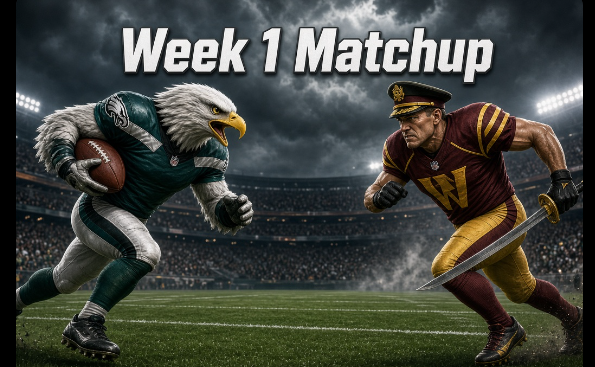
There are NFL games in which victory can change the way a team is viewed.
This probably is not one of them for the Philadelphia Eagles.
Beat the Washington Commanders on Sunday afternoon at Lincoln Financial Field, and the reaction around the NFL will likely be some variation of: Of course they did.
Lose?
That is an entirely different conversation.
Philadelphia enters the 2026 season as a 5.5-point home favorite against a Washington team that went 5-12 last season. The Commanders finished dead last in total defense, 27th in scoring defense, 30th against the run and 31st in turnover differential. Philadelphia, meanwhile, won the NFC East at 11-6 and finished sixth in scoring defense. (Washington Commanders: Week 1 game preview)
The public has noticed. At DraftKings, 68% of spread tickets and an extraordinary 94% of the money wagered on the spread is backing Philadelphia. The Eagles are attracting 88% of moneyline bets and 90% of the money. FOX’s betting data similarly shows the majority of both tickets and money backing Philadelphia. One consensus tracker has 87.5% of its Week 1 selections on the Eagles, the largest public lean on its entire Week 1 board. (DraftKings Sportsbook betting splits)
Almost everyone expects the Eagles to win.
History, the quarterback matchup, the trenches, and Saquon Barkley’s history against Washington strongly suggest they should.
And Washington is bringing a reconstructed defense into Philadelphia that, at least to most Eagles fans, looks like it was assembled using a collection of names they vaguely remember from old draft broadcasts.
That is exactly what makes this game dangerous.
Because Philadelphia can win Sunday and prove almost nothing.
Washington can lose Sunday and surprise almost nobody.
But if the Commanders walk out of Lincoln Financial Field at 1-0?
The Eagles’ season will be approximately four hours old, and Philadelphia will already be conducting a citywide investigation.
Eagles vs. Commanders: The Rivalry by the Numbers
Washington still owns the historical advantage in one of the NFL’s oldest rivalries. Entering Sunday, the Commanders lead the all-time series 91-88-6. (Philadelphia Eagles: Commanders–Eagles Week 1 preview)
The modern history, however, belongs to Philadelphia.
Since the beginning of the 2000 season, the Eagles are 32-20 against Washington in the regular season. Add Philadelphia’s 55-23 victory over Washington in the 2024 NFC Championship Game and that record becomes 33-20 including the postseason. (StatMuse: Eagles record against Washington since 2000)
During the 2010s alone, Philadelphia went 12-8 against Washington. The series has occasionally produced the type of bizarre outcomes expected from NFC East football, but over a quarter-century the Eagles have won nearly two-thirds of the meetings.
There is one historical warning for Philadelphia: Washington has been considerably more competitive at Lincoln Financial Field than the overall record might suggest. The Commanders are 44-44-2 all time on the road against Philadelphia, and Washington is actually 6-5 in Week 1 meetings between the franchises. (Washington Commanders: series and Week 1 history)
There is also a recent Washington victory at the Linc sitting in the record book. The Commanders won 24-17 in Philadelphia in Week 18 last season.
Context matters considerably there.
Jalen Hurts did not play. Tanner McKee started at quarterback, most of Philadelphia’s offensive starters were rested, and Washington was starting Josh Johnson. That game tells us very little about Sunday’s matchup other than the fact that NFC East games have a habit of refusing to behave normally. (The Philadelphia Inquirer: Eagles–Commanders Week 18 context)
When Philadelphia has played Washington with its actual starting quarterback, the picture has been much different.
Jalen Hurts Has Owned Washington
For all of the discussion surrounding Jalen Hurts entering 2026, Washington has rarely been the team to solve him.
Hurts is 8-3 against the Commanders when the regular season and playoffs are combined. Across those 11 games, he has completed 198 of 298 passes — 66.4% — for 2,398 yards, 15 touchdowns and only three interceptions. His passer rating is 103.6. (StatMuse: Jalen Hurts record vs. Washington, including playoffs)
And those numbers leave out one of the primary reasons Hurts is so difficult for Washington to defend.
He has also rushed for 340 yards and nine touchdowns against the Commanders. Combine his passing and rushing scores and Hurts has accounted for 24 touchdowns against Washington while turning the ball over through the air only three times. (StatMuse: Jalen Hurts rushing production vs. Washington)
Even the 8-3 record undersells the advantage somewhat.
One of those three losses came on December 22, 2024, when Hurts left the game after completing just one of four passes. Washington ultimately won 36-33, but Hurts essentially did not participate in the game beyond its opening minutes. (StatMuse: Jalen Hurts record vs. Washington, including playoffs)
His postseason meeting with Washington was significantly more representative.
In the 2024 NFC Championship Game, Hurts completed 20 of 28 passes for 246 yards and a touchdown without an interception. He then added three rushing touchdowns as Philadelphia annihilated Washington 55-23 to advance to Super Bowl LIX. (StatMuse: Jalen Hurts record and game logs vs. Washington)
Washington has beaten Hurts before.
It simply has not done it very often.
Jayden Daniels Has Seen the Other Side of This Rivalry
Jayden Daniels’ history against Philadelphia is considerably shorter.
And considerably less successful.
Daniels is 1-2 against the Eagles including the postseason. In those three games, he has completed 75 of 119 passes for 704 yards, seven touchdowns and four interceptions, producing an 84.9 passer rating. (StatMuse: Jayden Daniels record vs. Philadelphia, including playoffs)
His lone victory is also the game Eagles fans remember most painfully.
On December 22, 2024, Daniels threw for 258 yards and five touchdowns as Washington rallied to beat Philadelphia 36-33 after Hurts exited early.
That game remains the best evidence for why Daniels cannot simply be dismissed Sunday. He possesses exactly the type of improvisational ability capable of turning a well-defended play into 25 yards and transforming a game that should be controlled into chaos.
But his other two appearances against Philadelphia were losses.
In his first trip to Lincoln Financial Field, Daniels managed 191 passing yards with one touchdown and one interception in a 26-18 Eagles victory.
Then came the NFC Championship Game.
Philadelphia held him to 255 yards on 48 attempts. Daniels threw one touchdown and one interception, finished with a 72.8 passer rating and watched the Eagles score 55 points on the other side. (StatMuse: Jayden Daniels game logs vs. Philadelphia)
He did not face Philadelphia last season during an injury-disrupted 2025 campaign.
So Sunday’s game is the fourth chapter of Daniels versus Philadelphia — and his first opportunity to prove that the spectacular five-touchdown performance in 2024 was more meaningful than the two losses surrounding it.
The Traditional Matchup Says Philadelphia Should Win
Strip away the rivalry, narratives and Week 1 uncertainty and the football matchup itself favors the Eagles.
Start with Saquon Barkley.
Few players have tortured Washington as consistently.
In 12 career regular-season games against the Commanders, Barkley has rushed for 1,222 yards and 13 touchdowns on 220 carries, an average of 5.6 yards per attempt. (StatMuse: Saquon Barkley career numbers vs. Washington)
His recent numbers are even worse for Washington.
As an Eagle, Barkley rushed for 146 yards and two touchdowns against Washington in November 2024. He followed that with 150 yards and two more touchdowns in December. Then, in the NFC Championship Game, he exploded for 118 yards and three touchdowns on only 15 carries. Last December he added another 132 rushing yards and a touchdown. (StatMuse: Saquon Barkley game-by-game vs. Washington)
Now consider what Washington was defensively last season.
The Commanders surrendered 384 yards per game, worst in the NFL. They allowed 141.5 rushing yards per game, 30th in the league, and opponents averaged 4.8 yards per rushing attempt. They finished 27th in scoring defense at 26.5 points allowed per game. (Washington Commanders: Week 1 game preview)
If Sean Mannion’s new Eagles offense really does intend to make the outside-zone running game its foundation, this is about as logical an opponent as Philadelphia could ask for in its debut.
There are questions elsewhere.
A.J. Brown is gone after Philadelphia traded him to New England in June for a 2028 first-round pick and a 2027 fifth-rounder. DeVonta Smith moves into the unquestioned No. 1 receiver role. The Eagles are introducing Mannion’s new offense. Hurts will be operating more frequently from under center and the offense is expected to incorporate more traditional play-action concepts. (Philadelphia Eagles: A.J. Brown trade announcement)
Those are legitimate changes.
But they also make the obvious strategy even more obvious.
Run the football.
Make Washington demonstrate that its reconstructed defense can stop Barkley.
Force the Commanders’ new front to survive against Philadelphia’s offensive line for four quarters.
And only then ask Hurts to consistently solve the exotic coverage structures Washington wants to present.
On the Other Side, Philadelphia Should Attack Washington’s Offensive Line
Washington’s offense is more dangerous than its 2025 record suggests.
Daniels remains a legitimate dual-threat quarterback. Terry McLaurin is still one of the league’s better receivers, and Washington added Stefon Diggs to play opposite him. Jacory Croskey-Merritt is back after rushing for 805 yards last season, with Rachaad White behind him. (Washington Commanders: Week 1 roster and matchup preview)
That is enough skill-position talent to punish an Eagles defense that becomes undisciplined.
The problem is getting Daniels enough time to use it.
Washington enters Week 1 without left tackle Laremy Tunsil, who was placed on injured reserve after suffering a torn triceps. The Commanders are instead listing Brandon Coleman at left tackle. (Washington Commanders: Tunsil and Newton placed on injured reserve)
That offensive line has to survive against a Philadelphia interior built around Jalen Carter and Jordan Davis.
Jonathan Greenard has been ruled out with a pectoral injury, which removes one significant edge weapon from Vic Fangio’s defense, but Philadelphia should still possess a major advantage in the trenches. (Washington Commanders: Week 1 injury report)
The assignment becomes more complicated because Daniels cannot be rushed like a stationary quarterback.
Philadelphia’s defensive linemen need to compress the pocket without creating escape lanes. An edge rusher flying five yards behind Daniels while trying to produce a highlight-reel sack is effectively an invitation for Daniels to take off.
The Eagles need pressure, but more importantly, they need discipline.
Force Daniels to beat a secondary featuring Quinyon Mitchell, Cooper DeJean and Riq Woolen from inside a deteriorating pocket rather than allowing him to turn broken plays into Washington’s best offense.
On paper, Philadelphia should be able to do it.
Which brings us to the actual story of this game.
Nothing to Gain, Everything to Lose
The Eagles face an unusual psychological equation Sunday.
A convincing victory will be treated as confirmation.
A close victory may still produce complaints.
A loss will produce panic.
That is what happens when expectations become this lopsided.
Philadelphia is favored by 5.5 points. The Eagles are at home. They won the division last season. Washington went 5-12. The Commanders had the NFL’s worst defense by yardage. Their starting left tackle is unavailable. Their defense is installing an entirely new system with a first-time NFL defensive play-caller.
Hurts is 8-3 against them.
Barkley has spent most of his professional career treating Washington’s defense like a personal rushing drill.
Nick Sirianni is 5-0 in season openers as Eagles head coach. Philadelphia is 13-2 on opening weekend since 2011. (Philadelphia Eagles: Commanders–Eagles Week 1 preview)
What exactly is Philadelphia supposed to prove by winning?
Beat Washington 30-17 and everyone goes home saying the Eagles handled a team they were supposed to handle.
Beat them 24-20 and the discussion probably becomes why the offense did not look better.
Win 20-17 and Monday morning may somehow still contain complaints about Hurts, Mannion, the passing game and the wisdom of trading A.J. Brown.
But lose?
Then every unresolved offseason question gets thrown into the same blender.
Was not doing more to replace Brown a mistake, can Hurts operate Mannion’s offense, did Philadelphia underestimate the loss of Jeff Stoutland, is the receiver room good enough?
Was last year’s offensive regression more serious than the organization admitted?
Can this team still control the NFC East?
Did Washington just expose something?
None of those questions could legitimately be answered by one September football game.
Philadelphia will nevertheless ask all of them before breakfast Monday.
That is the asymmetry surrounding this opener.
The Eagles have plenty to lose and very little reputationally to gain.
But Who Exactly Are These Commanders on Defense?
This is where Washington becomes more interesting.
Because looking at last year’s defensive rankings and simply assuming Philadelphia will face the same defense would be a mistake.
It is not the same defense.
In some ways, it is barely the same roster.
Washington could have as many as eight new defensive starters, and the Commanders hired Daronte Jones to replace Joe Whitt Jr. as defensive coordinator after last year’s collapse. (Axios: Washington’s rebuilt 2026 defense)
Jones spent the previous several seasons in Minnesota, eventually serving as defensive pass-game coordinator and defensive backs coach under Brian Flores. During Jones’ 2022-25 stretch with Minnesota, the Vikings finished in the top 10 in scoring defense twice and the top 10 in takeaways three times. Minnesota tied for the NFL lead with 33 takeaways in 2024, and in 2025 it finished third in total defense. (Washington Commanders: Daronte Jones hired as defensive coordinator)
That background matters because Flores’ defensive philosophy is almost the opposite of lining up in the same front every snap and asking four stars to beat five offensive linemen.
It is about uncertainty.
Pressure presentation.
Changing who is rushing, and who is dropping.
Showing one structure before the snap and becoming something else after it.
Making the quarterback and offensive line determine which defenders actually matter before the play clock reaches zero.
Jones has described his approach as adaptable and aggressive, saying Washington wants to dictate terms and “change the math.” He has studied under coaches including Flores, Mike Zimmer, Vance Joseph and Lou Anarumo, and he has made it clear that Washington will not live exclusively in either a 4-3 or 3-4 world. (Washington Commanders: Daronte Jones on his defensive philosophy)
During training camp, however, one structural change became obvious: Washington shifted toward a 3-4 base and significantly more five-man fronts.
Why?
Five offensive linemen. Five potential defenders occupying gaps.
Make every blocker account for somebody.
Then start disguising where the actual pressure is coming from. (The Washington Post: Inside Daronte Jones’s defensive scheme)
That can be especially irritating in Week 1.
Philadelphia has no regular-season film of Jones calling this defense.
Washington has no regular-season film of Mannion calling Philadelphia’s offense.
There is an element of football poker happening here.
The “No-Name” Defense Is Not Completely Without Talent
At first glance, Washington’s starting defense does not exactly read like an All-Pro ballot.
The current depth chart starts Daron Payne, Tim Settle Jr. and Javon Kinlaw across the defensive line; Odafe Oweh and K’Lavon Chaisson on the edges; Sonny Styles and Frankie Luvu inside; Amik Robertson and Mike Sainristil at corner; and Nick Cross and Jeremy Reaves at safety. (Washington Commanders: 2026 Week 1 depth chart)
To an Eagles fan who has not followed Washington’s offseason closely, the understandable response might be:
Who the hell are half of these guys?
But anonymous is not the same thing as untalented.
Payne is an established veteran defensive tackle.
Kinlaw is a former first-round pick.
Oweh is another former first-round pick and finished the second half of last season with 7.5 sacks before recording three more sacks in the Chargers’ playoff game against New England. He has been cleared to play Sunday after dealing with a calf injury. (Washington Commanders: Week 1 player availability)
Chaisson is yet another former first-round selection and gives the defense more speed off the opposite edge.
Luvu is probably the most recognizable second-level player and gives Jones exactly the kind of linebacker he wants: someone who can rush, move around the formation and become part of the disguise.
And then there is Sonny Styles.
Washington used the No. 7 overall pick on the rookie linebacker, and his physical versatility may make him the most interesting piece in the entire scheme. The Commanders believe he can play off the ball, align on the edge, mug an interior gap and blitz from multiple positions. (Washington Commanders: 2026 first-round draft transcript)
The secondary is less imposing, especially with Trey Amos beginning the season on injured reserve. Mike Sainristil did lead Washington with four interceptions last season, but asking Sainristil, Robertson, Cross and Reaves to hold up when Philadelphia isolates them against Smith, Dallas Goedert and the Eagles’ other receiving options is a different matter. (Washington Commanders: Week 1 secondary and matchup preview)
Washington is also missing defensive tackle Jer’Zhan Newton, while Dorance Armstrong is suspended and Deatrich Wise Jr. is on the PUP list. (Washington Commanders: injured-reserve roster moves)
So this is not some secretly loaded defense waiting to introduce itself as the 1985 Bears.
It is something potentially more annoying for a Week 1 opponent:
an unfamiliar defense with enough athletic pieces to cause problems if the offense is confused.
How Washington Could Actually Ruin the Opener
The Commanders probably cannot beat Philadelphia by simply lining up and being better at football for 60 minutes.
The Eagles have too many personnel advantages.
Washington’s realistic path involves making the game strange.
Jones needs to manufacture free rushers or protection mistakes rather than expecting his front to simply overwhelm Philadelphia’s offensive line.
Washington needs an early negative play — a sack, tipped interception, strip, fourth-down stop — that changes field position and gives Daniels an abbreviated field.
The Commanders have to make Philadelphia hesitate.
That matters because this is the first real game of the Mannion offense.
Every new protection rule that looks clean on a whiteboard becomes more complicated when Washington puts six defenders near the line, moves another defender late and makes Hurts determine in seconds whether five, four or three of them are actually coming.
One busted protection can kill a drive, one turnover can change a half, one Daniels scramble can convert third-and-12, and one deep ball to McLaurin or Diggs can suddenly make a game Philadelphia controlled for 25 minutes a 17-17 game in the fourth quarter.
That is the upset formula.
Not Washington consistently overpowering Philadelphia.
Washington creating just enough chaos that Philadelphia never gets to play the comfortable game everyone expects.
And there is another reason the Commanders may be dangerous early: their defense has been built specifically to create the thing it almost never produced last season.
Turnovers.
Washington finished 31st in turnover differential at minus-13 in 2025. Jones’ Minnesota background comes from a defense that repeatedly finished near the top of the league in takeaways. Washington emphasized turnovers throughout training camp, and the entire philosophy of disguise and pressure is designed to force the quarterback into rushed decisions. (Washington Commanders: Week 1 game preview)
If Hurts protects the football, Washington’s upset path becomes considerably narrower.
If Philadelphia gives the Commanders two short fields?
Forget the records and the spread. Now it is an NFC East game.
Philadelphia’s Simplest Answer: Make Them Prove It
There is a temptation in Week 1 to showcase everything an offense spent eight months designing.
Philadelphia does not need to do that.
The Eagles should force Washington to answer the most basic question first:
Can this defense stop Saquon Barkley?
Last year’s defense could not stop the run.
Washington changed the coordinator, the front, the linebackers, the edges, and much of the secondary.
Great.
Prove it!
Put Payne, Settle and Kinlaw through 60 minutes against Philadelphia’s offensive line.
Force Styles to diagnose NFL run fits in his first regular-season game.
Make those new outside linebackers repeatedly decide whether Hurts kept the football, and force Washington’s safeties to come downhill.
Then throw behind them.
The worst thing Philadelphia could do is allow Washington’s complexity to dictate the game before establishing whether Washington has fixed the fundamental weakness underneath all that complexity.
You can disguise a pressure, but you cannot disguise getting moved five yards off the football.
So, Can These No-Name Commanders Really Send Philadelphia Into Crisis Mode?
Absolutely.
That does not mean they are likely to.
Those are two different questions.
The neutral football assessment favors Philadelphia fairly clearly. The Eagles have the better roster, the stronger offensive line, the better recent defense, home-field advantage, an extraordinary matchup history from Barkley, an 8-3 record from Hurts against Washington and a significant trench advantage against a Commanders offensive line missing its starting left tackle.
There is a reason Philadelphia is favored, the public’s money is piling onto the Eagles, and almost every Eagles prediction begins with Philadelphia winning.
But Week 1 is probably the best possible time for Washington to try this.
Nobody has NFL tape on Jones’ defense in Washington.
Daniels is capable of creating offense when the structure of the play breaks down.
And divisional games have an annoying habit of ignoring how obvious they looked on Tuesday.
Washington does not need its anonymous defense to suddenly become elite.
It needs that defense to be disruptive for a handful of possessions.
Create two turnovers. steal a sack through disguise and hold Philadelphia to a field goal in the red zone.
Give Daniels one short field and keep the score within one possession entering the fourth quarter.
Do that, and the pressure changes sides.
Because Washington can play this game loose while Philadelphia cannot.
The Commanders are supposed to lose, but the Eagles are supposed to win.
The Final Verdict
Philadelphia should win this game.
The Eagles should probably cover it, too.
The matchup is simply too favorable in too many important areas to arrive at another conclusion. Washington’s defensive reconstruction is interesting, but there is a substantial difference between being interesting in September and being capable of stopping Hurts, Barkley and Philadelphia’s offensive line for four quarters.
My prediction: Eagles 23, Commanders 17.
But the score is almost secondary to the larger story.
If Philadelphia wins 23-17, nobody outside Philadelphia will reconsider the Eagles. Nobody will suddenly declare Hurts an MVP candidate because he beat Washington. Nobody will crown Mannion because his offense scored two touchdowns against a defense that finished last in the NFL in yards allowed one year ago.
The Eagles will simply be 1-0.
Exactly where everyone expected them to be.
If Washington wins 24-23?
The Philadelphia gets seven days of Hurts and Mannion questions.
Seven days of debates about the offensive line, the (lack of) receivers, the defense and whether the defending NFC East champions are already in cooked.
It would be absurd to declare a season in crisis after 60 minutes.
This is Philadelphia.
Absurdity has never prevented the crisis.
That is what makes Sunday’s opener unusual.
For Washington, it is an opportunity.
For Philadelphia, it is an obligation.
The Commanders arrive with a new defense, a new coordinator, an athletic quarterback and almost nothing to lose.
The Eagles arrive with the better roster, the better history, the better matchup, the betting public, the home crowd and virtually every expectation pointing in the same direction.
Philadelphia has almost nothing to gain from beating Washington.
But it has a hell of a lot to lose.
For the Gamblers
Normally I would be all over Philadelphia like a cheap suit, but after doing my research, I have too many doubts. Throughout my long gambling history, I have seen opportunities like these and dove in the pool without a second thought.
But when I look back into the past, I can hear the same statements that marked a betting loss.
“I don’t see how they can score”
“If I tease the points down, all they have to do is win outright, that’s a lock!”
History cruelly taught me how that team could score and the team winning the game outright was not a lock.
Because of those flashbacks, I will only recommend betting the game’s under, 44.5 points, and will not recommend either of the teams.