



Philadelphia opened the Sean Mannion era with a win, but not with a finished product. The Eagles generated 318 net yards on 53 official offensive plays, protected the football and scored touchdowns on two of three red-zone trips. They also produced only 10 first downs, punted seven times and ran just 55 total offensive snaps while Washington controlled possession for 33:20. The result was a tense two-point win decided by a blocked extra point and a stop on the Commanders’ potential game-tying conversion.
Team Grade: B-
The Eagles deserve credit for winning a divisional game despite losing the down-to-down battle for long stretches. They averaged 6.0 yards per play, went 6-for-14 on third down and committed no turnovers, while the defense held Jayden Daniels to 164 passing yards and forced six punts. But Philadelphia’s margin for error was unnecessarily thin: three sacks allowed, five penalties, only one defensive sack and three consecutive three-and-outs to begin the second half kept Washington alive. Special teams—especially Braden Mann’s four punts inside the 20 and Jalen Carter’s blocked extra point lifted an otherwise uneven team performance.
Offensive Player Grades
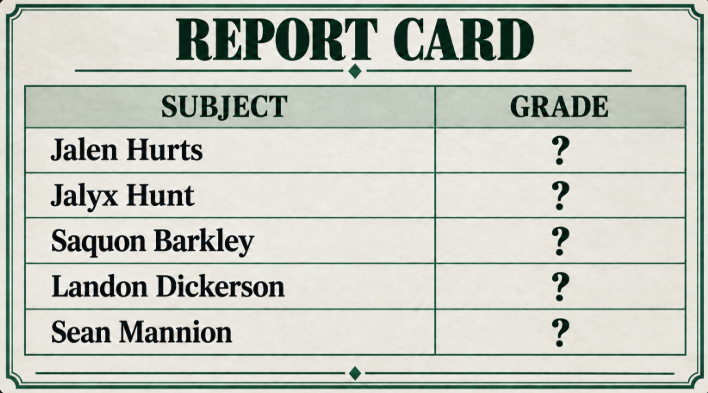
Jalen Hurts —> A-
Jalen Hurts, the offensive star of the game, completed 14 of 25 passes for 203 yards, three touchdowns, no interceptions and a 122.2 passer rating, then added 46 rushing yards. His finest work came in high-leverage situations: the 64-yard deep ball to Dontayvion Wicks, the 31-yard sideline strike to DeVonta Smith on third down, the 22-yard scramble on third-and-18 and two third-down touchdowns to Dallas Goedert. The completion rate and three sacks prevent an A+ or A, but Jalen repeatedly solved problems the structure around him created. Jalen made his first argument in his case to Howie and Jeffrey that they should reconsider their decision to move on from Jalen after this season.
Saquon Barkley —> B-
Saquon Barkley’s 15 carries produced 83 yards, including a 42-yard run that set up Philadelphia’s second touchdown. He generated 78 yards after contact and forced five missed tackles, an impressive effort behind a line that frequently allowed penetration. Two pressures surrendered in pass protection, including one resulting in a sack, and a dropped pass kept the performance from being one of his best.
Dallas Goedert —> A-
Goedert was the offense’s most consistent skill player, catching four of five targets for 77 yards and two touchdowns. He won through contact for a 17-yard score, then broke free on a 43-yard catch-and-run that restored an eight-point lead in the fourth quarter. He also played 52 of 55 offensive snaps, evidence of how central he is to Mannion’s new design. Dallas’s run blocking was inconsistent and prevents him from getting an A+ grade.
DeVonta Smith —> B-
Smith caught three of six targets for 53 yards, with most of his production arriving on a superb 31-yard toe-tap along the sideline on third-and-5. He was quiet for stretches, but that catch rescued a stalled second half and led to Jake Elliott’s field goal. Smith also cleanly recovered Washington’s late onside kick to finish the game. DeVonta must get used to the cloud and bracket coverages that will be used against him all season long by opponents.
Dontayvion Wicks —> B+
Wicks made his Eagles debut count: two catches, 73 yards and a touchdown. His 64-yard vertical reception from a heavy 13-personnel, under-center look created Philadelphia’s first scoring opportunity, and his sharp outside break produced a nine-yard touchdown on his other catch. Four targets leave room for a larger role, but his efficiency was great. Dontayvion must flash more with Smitty getting so much attention from defenses this season.
Makai Lemon —> D+
The rookie caught three of four targets but finished with minus-5 yards because Washington repeatedly diagnosed Philadelphia’s receiver screens. Lemon’s grade was raised due to his valuable downfield block on Hurts’ 22-yard scramble, showing effort away from the ball. The usage was encouraging; the results were not. Lemon had 3 catches on 5 targets for ONE YARD in the final preseason game, but this game was much worse.
Johnny Mundt —> B+
Mundt played 20 offensive snaps and did not record a target, but his value came as the blocking tight end in Philadelphia’s heavier packages. He helped sell the run presentation on Wicks’ 64-yard reception and was identified as the Eagles’ best run blocker in one postgame evaluation.
Jordan Mailata —> B-
Mailata played every offensive snap. A fourth-quarter false start contributed to a second-and-18, however, and the line as a whole never established the clean edges that Mannion’s wide-zone concepts require.
Landon Dickerson —> F
Dickerson had the roughest afternoon on the offense. He allowed repeated interior pressure, was charged with a holding penalty that erased a completion and struggled to generate movement in the run game. The Eagles’ new offense asks the guards to move laterally and communicate through changing fronts. Dickerson’s play probably played a role in the team abandoning that offensive scheme.
Dickerson has been placed on injured reserve, as of Tuesday night, due to a bone bruise that ‘supposedly’ occurred weeks ago in training camp.
Cam Jurgens —> D+
Jurgens was flagged twice for holding, including one penalty that wiped out a run to Washington’s 2-yard line. The center also shared responsibility for the immediate interior leakage that prevented Philadelphia from sustaining drives. His athleticism should fit the new scheme, but this was a poor opening test. Hopefully some of Cam’s issues was due to Landon being the weak link.
Tyler Steen —> C-
Steen played all 55 offensive snaps at right guard and was part of a line that surrendered three sacks and too many negative runs. He avoided the obvious penalties that hurt the left side and center, but the interior as a unit did not create dependable space or sort out Washington’s pressure packages quickly enough. Tyler was the best interior lineman vs the Commanders but that’s not saying much. We need more from a healthy Tyler Steen in the interior if the Eagles are going to have a competent run game.
Lane Johnson —> B
Johnson completed all 55 snaps without a penalty. Washington still created pressure with stunts and second-level rushers, so this was not a dominant line-wide performance, but Johnson was not the source of the offense’s most damaging breakdowns. Lane played well but we need dominating Lane for the Eagles to be their best.
Defensive Player Grades
Zack Baun —> A+
Baun played all 70 defensive snaps and led both teams with 12 tackles, adding a tackle for loss and two passes defended. Next Gen Stats credited him with allowing three catches for minus-2 yards on six targets, and his fourth-quarter breakup helped force Washington into its final fourth down. This was an elite three-down linebacker performance and Zack’s performance puts him on par with Fred Warner.
Jihaad Campbell —> B-
Campbell collected nine tackles, a tackle for loss and Philadelphia’s only sack while playing 67 of 70 snaps. His speed was apparent, but he was also late to a few zone landmarks, most notably on Antonio Williams’ 33-yard crossing-route gain. The impact outweighed the 2nd year player’s mistakes.
Jalen Carter —> A-
Carter registered three pressures, forced a fourth-quarter fumble that Washington recovered, and blocked a second-quarter extra point. That block became the final margin in a two-point game. Playing 66 of 70 defensive snaps was a heavy workload, but Carter continued to affect the game even when he did not finish with a sack. While this was a great performance by Jalen Carter, I feel like there is another gear to his game that hasn’t been reached.
Moro Ojomo —> A-
Ojomo generated four pressures and saved his biggest play for the most important snap. He diagnosed Washington’s shovel pass on the two-point attempt, beat the block and stopped John Bates behind the goal line to preserve the lead. Ojomo has gained much praise for his stop to prevent a tie-game, yet I feel Ojomo may have left some meat on the bone.
Jordan Davis —> B+
Davis finished with eight tackles in only 34 defensive snaps, unusually strong volume for an interior nose tackle. Washington rushed for 132 yards, but its lead back averaged only 3.9 yards per carry, and the Eagles repeatedly clogged the interior on early downs. Jordan was everywhere and recorded counting stats on roughly 25% of his plays.
Jalyx Hunt —> B+
Hunt played 53 snaps and produced three tackles and led the team with seven pressures. He did not finish a rush with a sack or quarterback hit, but he was one reason Daniels was pressured on half of his drop backs. After dominating the training camp and being earmarked as the team’s breakout superstar,
Nolan Smith —> B
Smith logged 47 defensive snaps and two tackles and was tied for second on the team with 6 pressures, but he did not record a sack or quarterback hit. He contributed to disciplined early-down defense, yet Philadelphia needed more finishing production from its starting edges, particularly with Jonathan Greenard unavailable.
Riq Woolen —> A
Woolen’s Eagles debut was excellent: he played all 70 snaps and allowed no receptions on four targets across 37 coverage snaps. This was an elite game by Riq.
Quinyon Mitchell —> A
Mitchell also played every defensive snap and helped erase Washington’s outside receivers for much of the afternoon. He and Woolen combined to allow only three catches on eight targets for fewer than 20 yards, keeping Terry McLaurin to two receptions for 14 yards overall. Q was incredible vs Washington.
Cooper DeJean —> D+
DeJean had eight tackles, but Washington repeatedly found favorable matchups against him in the slot. He was involved in two illegal-contact calls—one declined—and surrendered the fourth-quarter touchdown to Stefon Diggs; postgame charting credited him with 83 yards allowed. His tackling stats were buoyed by his inability to cover anyone in the slot. Cooper must stop chasing women and cheerleaders, and start covering wide receivers before he gets shipped to Dallas permanently.
Andrew Mukuba —> B
Mukuba played all 70 snaps at safety and generally kept explosive passes from getting over the top. He recorded only one tackle and was nearest the completion on one 15-yard crosser, but the rookie’s communication and depth helped the outside corners play aggressively. He made a nice hit right after Jalen Carter forced a fumble.
Marcus Epps —> B-
Epps totaled seven tackles on 53 snaps and was active as a run-support defender. Washington found him in coverage for a few chain-moving completions, including a fourth-down throw to McLaurin on the final touchdown drive, so the afternoon was solid rather than clean. This is probably one of the better performances we hope to see from Epps this season.
Sean Mannion —> C
Mannion’s first game as an NFL play caller produced enough evidence to justify optimism while festering doubt. Philadelphia scored 24 points without a turnover, averaged 6.0 yards per official offensive play, converted 43 percent of its third downs and finished two of three red-zone trips with touchdowns. His best designs created stress through personnel and alignment: on Wicks’ 64-yard catch, Hurts went under center in 13 personnel with Wicks as the lone receiver, allowing the run-heavy picture to create a favorable vertical opportunity. Mannion also leaned into Goedert, whose two touchdowns came in the middle of the field—the area this offense was hired to attack more consistently.
The under-center change was real, though not overwhelming. Based on the NFL gamebook’s formation notation, Philadelphia ran approximately 17 of its 53 official offensive plays from under center, or 32.1 percent; remove the final two kneel-downs and the estimate is 15 of 51 meaningful plays, or 29.4 percent. That is materially higher than the Eagles’ 21.8 percent regular-season rate in 2025, though slightly below the 35.3 percent reported during 2026 training camp. Because this figure is derived from plays not labeled “Shotgun” in the official play-by-play, it should be treated as a gamebook-based estimate rather than proprietary formation charting. NFL gamebook PhillyVoice training-camp charting
The concern is that the offense was far too dependent on isolated explosions. Philadelphia’s five longest gains—64, 43, 42, 31 and 22 yards—accounted for 202 of its 318 net yards, nearly 64 percent. The Eagles managed only 10 first downs, possessed the ball for 26:40 and opened the second half with three consecutive three-and-outs. Receiver screens to Lemon lost more yardage than they gained, wide-zone runs were frequently disrupted by immediate penetration, and the protection plan did not provide enough answers against Washington’s simulated pressure and blitz packages. Seven punts are too many for an offense with this much talent vs an opponent that lacks the necessary talent.
Mannion did make an important practical adjustment: when the new structure was not consistently winning, he returned to Hurts’ best tools. The fourth-quarter go-ahead drive was predominantly shotgun, and the critical sequence featured Barkley runs, Hurts’ 22-yard scramble on third-and-18 and a 43-yard touchdown to Goedert up the seam. Earlier, after the third-quarter lull, Mannion dialed up the deep sideline opportunity to Smith that finally moved the chains. The response was more pragmatic than revolutionary, but good play calling is ultimately about finding the answers available that day.
The B- reflects a winning debut with creative flashes, excellent high-leverage calls and a willingness to pivot, offset by poor drive-to-drive consistency. Mannion’s next challenge is to build reliable five- and seven-yard answers—quick-game throws, better protection checks and runs that punish light boxes—so the offense does not need Hurts to manufacture miracles on third-and-long.
Player of the Game: Zack Baun
Baun was the most complete player on the field. His 12 tackles, two pass breakups and extraordinary coverage efficiency helped Philadelphia hold Washington to 4.4 yards per play, and his closing speed repeatedly ended possessions before they could become scoring threats. Ojomo made the defining snap, but Baun controlled the game from start to finish.
Scapegoat of the Game: Landon Dickerson
Dickerson is the choice because the Eagles’ most persistent problem was immediate interior disruption, and the veteran left guard had the roughest individual performance in that group. His holding penalty erased a completion, his pass protection leaked and his run blocking never settled. This was not solely his loss—the Eagles won, after all—but no player bears more responsibility for the offense’s inability to stay on schedule.
Top Five Eagles
- Zack Baun —> A+: Dominated in coverage, led the game in tackles and repeatedly erased Washington’s underneath answers.
- Dallas Goedert —> A-: Turned four receptions into 77 yards and two touchdowns, including the winning score.
- Jalen Hurts —> A-: Accounted for 249 yards, threw three touchdowns without a turnover and delivered four of the game’s biggest third-down plays.
- Moro Ojomo — A-: Produced four pressures and made the game-saving tackle on the two-point conversion.
- Dontayvion Wicks —> B+: Supplied 73 yards and a touchdown on only two catches in an explosive Eagles debut.
Honorable mention: Braden Mann, whose seven punts averaged 51.6 yards and included four downed inside the 20.
Bottom Five Eagles
- Landon Dickerson —> F: Allowed repeated interior pressure and committed a drive-killing hold.
- Cam Jurgens —> D+: Two holding penalties and inconsistent interior control disrupted both the run and pass games.
- Cooper DeJean —> D+: Washington found 83 yards in his coverage and beat him for a fourth-quarter touchdown.
- Makai Lemon —> D+: Three catches produced minus-5 yards as the receiver-screen package repeatedly failed.
- Tyler Steen —> C-: Played 55 snaps and was the best interior lineman vs the Commanders but that is not necessarily a compliment.