



The Philadelphia Eagles got what they needed in Week 1 with a 24-22 victory over the Washington Commanders. It was not particularly comfortable, it did not erase every offseason concern, and it certainly was not four quarters of dominant football, but Philadelphia avoided disaster and started the season 1-0.
Now the standard changes. The Eagles travel to Nashville on Sunday to face a Tennessee Titans team that looked like one of the worst teams in football during Week 1, and another narrow escape would create a very different conversation.
The Eagles Need to Dominate
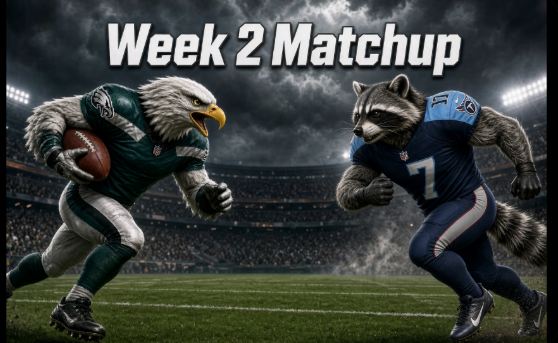
On Sunday, September 20, the Eagles travel to Nashville to face a Tennessee Titans team that opened its season with a 23-10 loss to the New York Jets, a game that was even less competitive than the final score suggests.
Tennessee generated only 195 total yards, averaged 4.0 yards per play and possessed the football for fewer than 22 minutes. Through three quarters, the Titans had produced just six first downs and 112 total yards.
Philadelphia is a seven-point road favorite, with the over/under sitting around 39.5 to 40 points at most sportsbooks. The Eagles are also roughly -310 to -350 on the moneyline, depending on the sportsbook, while Tennessee is around +250 to +280.
The public clearly sees the same mismatch. As of Thursday night, 89% of spread bets and 95% of spread money tracked by VegasInsider were backing Philadelphia.
That combination tells its own story. The Eagles are favored by a full touchdown on the road, while the relatively low total suggests the market is not expecting Tennessee’s offense to suddenly become dangerous after producing only 195 yards and 10 points against the Jets.
In other words, Philadelphia is not simply expected to win this game. The Eagles are expected to control it.
Last week, the danger was obvious, but this week’s danger is not as obvious. Washington had Jayden Daniels, it was a divisional game, the Commanders had a new defensive system, and history told us NFC East games can become bizarre regardless of talent disparities.
Yet Tennessee does not come with the same list of excuses. This is a team that went 3-14 last season, then lost by 13 points at home to another team that went 3-14. Its offense looked dysfunctional, its quarterback was pressured relentlessly, and its defense allowed the Jets to possess the football for nearly 39 minutes.
And now the Titans have to play the Eagles. Philadelphia does not necessarily need to win 40-10, but after scraping past Washington, this is the kind of game where merely escaping again would raise a different question: Can the Eagles beat the good teams they are about to face, with their first serious test starting Week 3 against the Chicago Bears?
A Strange History That Actually Favors Tennessee
Philadelphia and Tennessee do not play often. The franchises have met only 13 times entering Sunday’s game, dating back to when the Titans were still the Houston Oilers. The Eagles own the overall series advantage at 8-5, but the modern history is considerably stranger.
Since 2000, Philadelphia is just 2-5 against Tennessee. The Titans beat the Eagles four consecutive times from 2000 through 2010, winning 15-13 in Philadelphia in 2000, 27-24 in Tennessee in 2002, 31-13 in Philadelphia in 2006 and 37-19 in Tennessee in 2010.
Philadelphia finally broke through with a 43-24 victory in 2014. Then came one of the more frustrating losses of the Carson Wentz era in 2018, when Philadelphia led Tennessee 17-3 before Marcus Mariota and the Titans came back to win 26-23 in overtime.
The most recent meeting looked nothing like that. Philadelphia destroyed Tennessee 35-10 in 2022.
The Last Time Jalen Hurts Saw Tennessee, He Destroyed Them
Jalen Hurts has faced Tennessee exactly once, and it might have been one of the best games of his career.
On December 4, 2022, Hurts completed 29 of 39 passes for 380 yards, three touchdowns and no interceptions, producing a 130.3 passer rating. He added another rushing touchdown in Philadelphia’s 35-10 victory.
The Eagles finished with 453 yards while Tennessee managed only 209. Philadelphia sacked Ryan Tannehill six times, Derrick Henry was held to 30 rushing yards, and A.J. Brown caught eight passes for 119 yards and two touchdowns against his former team.
DeVonta Smith added 102 yards and another touchdown. Hurts finished the afternoon with 380 passing yards, four total touchdowns and zero interceptions.
That version of Tennessee obviously has little connection to the team Philadelphia will see Sunday. Still, Hurts could hardly have a better personal history against the Titans.
Cam Ward Is Still the Entire Tennessee Conversation
Everything Tennessee is trying to build revolves around Cam Ward. The Titans selected Ward with the No. 1 overall pick in the 2025 NFL Draft, and his rookie season demonstrated both why Tennessee invested so heavily in him and why the rebuild was never going to happen overnight.
Ward remains talented. He can make throws outside structure, he has enough mobility to punish undisciplined pass rushes, and his arm allows Tennessee to attack areas of the field that many quarterbacks cannot.
The problem is pressure. In Week 1, the Jets pressured Ward on roughly 41% of his dropbacks and sacked him three times. He completed 19 of 32 passes for only 140 yards and one touchdown, while Tennessee’s longest offensive gain was just 14 yards.
That touchdown came late in the fourth quarter after New York had already built a 20-3 lead. For most of the afternoon, Tennessee’s passing game simply did not function.
This Is a Matchup Built for Vic Fangio
Philadelphia’s defensive performance against Jayden Daniels produced one statistic that looks much better on paper than it did on film. The Eagles pressured Daniels on 47.4% of his dropbacks while blitzing him only 23.7% of the time, which sounds like Philadelphia’s defensive front spent the afternoon terrorizing him with four-man rushes.
That really was not what happened. The Eagles recorded only one sack, the pocket did not consistently collapse quickly, and some of those pressures were created because Daniels held the football while Philadelphia’s secondary continued covering receivers downfield.
That distinction matters. A pressure recorded four seconds after the snap because a quarterback cannot find anybody open is not the same thing as Jalen Carter destroying a guard in two seconds and forcing the quarterback off his spot before the play develops.
Philadelphia did plenty of the former against Washington and not nearly enough of the latter. At least some of that appears to have been intentional because Fangio had to account for what Daniels could do once the original play broke down.
The Eagles used what can be described as a mush rush, contain rush or cage rush. Instead of simply turning the defensive line loose, Philadelphia’s rushers maintained their lanes and tried to surround Daniels inside the pocket.
Against Daniels, a pass rusher can technically beat his blocker and still lose the play. Run too far beyond the quarterback and Daniels steps underneath. Collapse too aggressively inside and he gets outside. Lose lane integrity and suddenly one of the most dangerous running quarterbacks in football has open space in front of him.
Even when Daniels escapes without crossing the line of scrimmage, the play can become more dangerous. He can extend it long enough for coverage to break down and then punish the defense with his arm.
That is why Philadelphia’s coverage mattered so much against Washington. The secondary forced Daniels to keep searching while the rush slowly closed around him, which means the 47.4% pressure rate needs context. It was partly the product of coverage, partly the product of Daniels holding the football and partly the result of a defensive plan designed to surround him rather than attack him recklessly.
Cam Ward gives Fangio a different decision.
Ward is athletic, can escape pressure and can throw while moving, so Philadelphia cannot treat him like a stationary quarterback. But there is still a substantial difference between respecting Ward’s mobility and treating him like Jayden Daniels.
Daniels can make losing containment fatal. Ward has not demonstrated that same ability consistently at the NFL level.
That may give Fangio permission to let Philadelphia’s defensive front attack much more aggressively without necessarily increasing the blitz rate.
Against Washington, the priority was to keep Daniels inside the cage first and get to him second. Against Tennessee, Fangio may be willing to reverse that order and make Ward prove he can punish Philadelphia for it.
That could mean sharper edge-rush angles, more interior penetration and more stunts against a Tennessee offensive line that struggled badly with communication in Week 1. Fangio can also use simulated pressure to manipulate protection while still rushing only four and keeping numbers in coverage.
The Eagles do not have a dominant pass rush right now, and Week 1 should not convince anyone otherwise. Philadelphia generated plenty of recorded pressures against Washington but only one sack, and the film did not show a defensive front consistently winning immediately after the snap.
Sunday therefore gives us a useful test. Was Philadelphia’s slow pressure mostly the result of Fangio deliberately containing Daniels, or is this simply a pass rush that struggles to get home quickly?
Ward should give us a better answer. If Fangio lets Jalen Carter, Jordan Davis, Moro Ojomo, Jalyx Hunt and Nolan Smith attack instead of constantly worrying about constructing a cage, they should have more opportunities to create genuine early pressure.
The question is whether Philadelphia’s pass rush is capable of taking advantage of that freedom.
Tennessee’s Offensive Line Is Where Philadelphia Should Take Control
Tennessee cannot allow this game to become a series of obvious passing situations. If the Titans repeatedly reach third-and-eight and Ward has to stand behind an offensive line that struggled to protect him against the Jets, Fangio gains control of the chessboard.
That means Tennessee has to run the football, create manageable downs, use quick throws and find screens or RPOs that punish Philadelphia for becoming aggressive. Ward is talented enough to make the Eagles pay if their rush loses discipline, so Philadelphia cannot simply assume Tennessee will repeat every Week 1 mistake.
Still, if Tennessee cannot protect Ward better than it did against New York, this is exactly where Philadelphia should be able to take control.
Tennessee Has Weapons, Even If Week 1 Made Them Invisible
Calvin Ridley played nearly every passing situation against the Jets and finished with zero targets. That cannot continue.
Tennessee also has Wan’Dale Robinson, Elic Ayomanor and rookie Carnell Tate, giving Ward more receiving talent than the Week 1 stat sheet suggests. Ayomanor caught Tennessee’s late touchdown against New York, while Tate has enough talent to become a legitimate part of the offense.
Ridley remains the player Philadelphia cannot forget simply because Tennessee forgot about him for a week. After spending an entire week being criticized for failing to involve its best receiver, it would be surprising if the Titans did not manufacture targets for Ridley early.
Philadelphia should expect quick screens, motion, crossing routes and anything else that gives Ward an easy completion while putting Ridley in position to run after the catch.
Jeffery Simmons Is Tennessee’s Upset Path
Tennessee’s offense looks like a major advantage for Philadelphia. The Titans’ defense is where this game becomes more complicated, and that starts with Jeffery Simmons.
Simmons is not merely Tennessee’s best defensive player. He is one of the best interior defenders in football, and Philadelphia enters Sunday with its biggest interior offensive-line vulnerability exposed.
Landon Dickerson is on injured reserve, Drew Kendall is expected to replace him, and his first major assignment comes against Simmons. That is about as unfriendly an introduction to the starting lineup as Philadelphia could have arranged.
Interior pressure is especially disruptive against Hurts because he cannot simply step forward and escape it. Simmons can collapse the pocket directly into the quarterback while Tennessee’s edge defenders concentrate on keeping Hurts contained.
Simmons also does not need three sacks to control the game. He can push the pocket on first down, disrupt Barkley on second down and force Hurts off his spot early on third down. Three plays later Philadelphia is punting, even though Simmons may barely appear in the box score.
That is why Simmons is Tennessee’s clearest path toward making this game look nothing like the seven-point spread suggests. The Titans do not need their entire defensive front to become dominant. They need one elite player to create enough negative plays that Saleh can dictate the situations that follow.
Philadelphia has the better roster, but Tennessee happens to have one of its best players lined up directly against one of the Eagles’ biggest current vulnerabilities. That matchup is difficult to ignore when looking for a reason this game could become uncomfortable.
The Titans’ Coaches Know Jalen Hurts Better Than Most
There is another reason Tennessee is more dangerous than its roster and Week 1 performance might suggest. The Titans have two coaches with unusually extensive history against Jalen Hurts.
Brian Daboll coached Hurts at Alabama, while Robert Saleh has already helped hand Hurts two of the more frustrating losses of his NFL career.
That makes this considerably more interesting than a normal Week 2 matchup between a veteran quarterback and a new coaching staff.
Brian Daboll Knew Jalen Hurts Before the NFL Did
Brian Daboll’s familiarity with Hurts goes back nearly a decade. Before Daboll became an NFL head coach, before Hurts transferred to Oklahoma and long before Philadelphia selected him in the second round, Daboll was Hurts’ offensive coordinator at Alabama.
Daboll arrived in Tuscaloosa in 2017, when Hurts was entering his sophomore season after taking Alabama to the National Championship Game as a freshman. He did not simply study Hurts from across an NFL division. He coached him, installed offense for him and saw how Hurts processed concepts as a 19-year-old quarterback.
That relationship also ended in one of the defining moments of Hurts’ college career. With Alabama trailing Georgia 13-0 in the 2017 National Championship Game, Daboll and Nick Saban replaced Hurts with Tua Tagovailoa at halftime, and Alabama eventually won the championship.
There may not be another offensive coach in football who watched Hurts’ development from such an early and consequential stage. Daboll knows the quarterback Hurts is now, but he also knows where that quarterback started.
Robert Saleh Has Already Beaten Hurts with Zach Wilson
Before discussing Saleh eliminating Philadelphia from the playoffs last January, go back to October 15, 2023.
Philadelphia entered MetLife Stadium 5-0 as the defending NFC champion. The Jets were 2-3, Aaron Rodgers was injured and Zach Wilson was starting at quarterback.
Philadelphia had also never lost to the Jets. The Eagles entered that afternoon 12-0 all time in the series and left 12-1.
Jets 20, Eagles 14.
Saleh’s defense was the reason.
Hurts completed 28 of 45 passes for 280 yards and one touchdown, but he also threw three interceptions and finished with a 59.5 passer rating. Philadelphia turned the football over four times.
The Jets did it despite entering the game without Sauce Gardner, D.J. Reed and Brandin Echols. New York intercepted Hurts three times, recovered another Eagles fumble and held Philadelphia’s running backs to 2.3 yards per carry.
Philadelphia led 14-9 at halftime and did not score another point. Saleh’s defense shut the Eagles out over the final 30 minutes while Zach Wilson completed 19 of 33 passes for only 186 yards with zero touchdowns on the other side.
The Jets offense did not win that game. Saleh’s defense did.
Then Saleh Ended the Eagles’ 2025 Season
If the 2023 Jets game could be dismissed as a bizarre regular-season upset, the most recent meeting cannot.
Saleh returned to San Francisco as defensive coordinator in 2025, and the 49ers walked into Lincoln Financial Field for the Wild Card round on January 11, 2026. The Eagles were the defending Super Bowl champions, playing at home with Saquon Barkley, A.J. Brown, DeVonta Smith and Hurts.
The afternoon ended 49ers 23, Eagles 19.
Hurts completed only 20 of 35 passes for 168 yards and one touchdown, averaging 4.8 yards per attempt. Philadelphia possessed the football for more than 35 minutes, ran 72 offensive plays and still produced only 19 points.
Saleh did not accomplish that by constantly blitzing Hurts. San Francisco officially recorded only one sack and did not intercept him. Instead, Saleh’s defense compressed Philadelphia’s passing game until almost everything became short, difficult and inefficient.
Philadelphia could run the football, but when the Eagles needed Hurts and the passing game to manufacture points, Saleh’s defense kept them from doing it.
That gives us two real Hurts-Saleh meetings in which Hurts actually started. Saleh’s teams won both, Philadelphia scored 14 points in one and 19 in the other, and the Eagles have never reached 20 points against a Saleh-led defense with Hurts at quarterback.
That does not mean Saleh has permanently solved Hurts. It does mean he has already demonstrated twice that his basic philosophy can make this quarterback and this offense uncomfortable.
Eight months after Saleh’s defense ended Philadelphia’s season, Hurts gets another opportunity against him.
Robert Saleh Wants Four-Man Pressure
The Titans hired Robert Saleh as head coach after Tennessee’s 3-14 season, and his defensive philosophy does not require constant blitzing. At its best, Saleh’s system wants the front four to create disruption while allowing seven defenders to remain in coverage.
Against Hurts, that matters even more because Saleh already has two games worth of evidence that the basic formula can work. Rush four, keep the quarterback surrounded, flood the throwing lanes and force Philadelphia to patiently earn everything underneath.
The problem is that the formula requires Tennessee’s defensive line to win consistently. Jeffery Simmons can do that, but the larger question is whether enough of the players around him can also create pressure.
Tennessee acquired edge rusher Jermaine Johnson II after moving T’Vondre Sweat, but Johnson generated only one pressure against the Jets in Week 1. The Titans did not sack Geno Smith at all, which allowed New York to work through short completions, sustain drives and control possession.
Philadelphia should see opportunity there. If Tennessee cannot create pressure with four, Saleh eventually has to choose between giving Hurts time or committing additional defenders and weakening the coverage behind them.
Saquon Barkley Should Be the Test
The easiest way to neutralize Tennessee’s pass rush is to make the Titans stop Saquon Barkley before Philadelphia worries about anything else. The Jets ran the ball 32 times against Tennessee, while Breece Hall finished with 102 rushing yards and a touchdown. New York controlled possession so thoroughly that Tennessee spent nearly 39 minutes playing defense.
Philadelphia should try to recreate that type of game, although the Eagles’ own running attack was not completely convincing against Washington. That makes Sunday more than simply an opportunity to beat Tennessee. It is also a chance to see whether Philadelphia’s offensive line can begin establishing the physical identity everyone expected from this offense.
That challenge becomes more difficult without Dickerson and with Simmons waiting across the line of scrimmage. Still, the Eagles should attack the problem rather than allow Tennessee’s best defender to dictate the game.
If Simmons shoots gaps aggressively, Philadelphia can punish the space he vacates. If Tennessee widens its edges to contain Hurts, Barkley should have opportunities inside. If the Titans load the box, play action becomes available behind it, and if they remain light in the box with two safeties deep, Philadelphia should continue handing Barkley the football until Tennessee proves it can stop him.
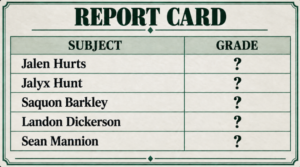
The Eagles should not spend the first quarter trying to prove how creative Mannion’s offense can be. Hand Barkley the football and make Tennessee demonstrate that it can stop the most obvious thing Philadelphia wants to do. If the Titans cannot, there is no reason to rescue them by getting cute.
This Is Also a Sean Mannion Test
Week 1 was Sean Mannion’s first regular-season game running Philadelphia’s offense, so some unevenness was inevitable. Week 2 provides a much more useful evaluation because Tennessee’s defense presents a clear and recognizable challenge.
Saleh will try to prevent explosive plays, force Philadelphia to execute long drives and test whether the Eagles become impatient. This is where Mannion can create problems for himself if he starts coaching against the point spread instead of the defense in front of him.
There is nothing wrong with an eight-yard Barkley run or a seven-yard completion to Dallas Goedert. If Tennessee wants to concede those plays, Philadelphia should take them and make Saleh watch his defense slowly get walked down the field.
Third-and-long is where Simmons can attack without worrying about the run, where Saleh can widen the rush and where Dickerson’s absence becomes most noticeable. If Philadelphia stays ahead of the chains, Tennessee becomes considerably less threatening.
DeVonta Smith Should Have Opportunities
The 2022 meeting with Tennessee is remembered largely as the A.J. Brown revenge game, but DeVonta Smith also had an excellent afternoon. He caught five passes for 102 yards and a touchdown, and four years later he enters this matchup as Philadelphia’s unquestioned top wide receiver.
Saleh’s defensive philosophy may naturally create more intermediate opportunities than constant deep shots, which should fit Smith well. Philadelphia can move him around the formation, use motion and stacks to create favorable releases, and let him attack the intermediate areas behind linebackers occupied by Barkley and Hurts.
If Tennessee begins rolling extra coverage toward Smith, the rest of Philadelphia’s receiving options have to respond. Dallas Goedert should become especially important in those situations.
The Eagles cannot allow this to become an offense where Hurts repeatedly waits for Smith to defeat double coverage while Simmons has extra time to attack the pocket. Smith should be featured, but Philadelphia has to make Tennessee defend the entire field.
Makai Lemon Has a Chance to Settle In
Week 1 was never going to define Makai Lemon’s rookie season, and Philadelphia does not need him to suddenly become a finished NFL receiver on Sunday. It does need some evidence that the answer behind DeVonta Smith is not simply hoping somebody else eventually gets open.
Tennessee is the kind of opponent where Mannion should be able to manufacture two or three manageable opportunities for Lemon. A quick screen, shallow crossing route or motion release can put the football in his hands without asking him to win a complicated coverage battle.
Philadelphia needs receiving depth after the departure of A.J. Brown. Developing Lemon has to begin somewhere, and this should be a reasonable place to continue the process.
The Injury That Matters Most Is Landon Dickerson
Philadelphia has several injuries worth watching, but Dickerson’s absence is the one Tennessee is best equipped to attack because Simmons is waiting directly across from his replacement.
That does not mean Drew Kendall is incapable of handling the job. It means Philadelphia cannot afford to treat Simmons like an ordinary defensive tackle and leave Kendall isolated all afternoon.
The Eagles can slide protection toward Simmons, give Kendall help from the center, change where they run depending on his alignment and use screens if he becomes overly aggressive. What they cannot do is allow one elite defensive tackle to repeatedly create the third-and-long situations Saleh wants.
This matchup is one of the primary reasons I am less comfortable with Philadelphia than the seven-point spread suggests. Tennessee may be the less talented team overall, but its best defensive player happens to attack exactly where the Eagles are currently most vulnerable.
Tennessee Lacks Explosiveness
The most alarming number from Tennessee’s Week 1 offense may not be its 195 total yards. It may be 14, which was the Titans’ longest offensive gain against New York.
NFL offenses cannot consistently survive that way. It is possible to string together a 10-play or 12-play drive without producing an explosive gain, but doing it repeatedly requires nearly perfect execution, and Tennessee came nowhere close to that level against the Jets.
Philadelphia’s defense is specifically designed to make offenses operate in that uncomfortable space. Fangio is willing to concede underneath completions because he wants quarterbacks to become impatient and eventually convince themselves that a bigger play is available.
This is also the hardest part of picking Tennessee to win the game. I can explain how Saleh keeps Philadelphia’s offense uncomfortable and how Simmons damages the interior, but it is much harder to explain where 20 Titans points come from if their longest offensive play looks anything like last week’s 14 yards.
That means Ward has to create something outside the structure. Ridley has to matter, somebody has to generate a chunk play, and Tennessee cannot spend another afternoon trying to move the football four and five yards at a time.
If the Titans cannot do that, Philadelphia’s defense should eventually suffocate them.
Do Not Let Cam Ward Become the Story
The most important defensive instruction for Philadelphia may be simple: do not give a talented young quarterback confidence early. Ward enters Sunday after one of the rougher Week 1 performances in football, while Nissan Stadium emptied early against the Jets and Tennessee enters Week 2 desperate for something positive.
That makes the opening quarter important. If Philadelphia starts slowly, allows Ward several easy completions and gives Tennessee an early touchdown, a quiet stadium can become loud very quickly.
Ward starts believing, the Titans begin believing and the crowd suddenly has something worth investing in. Philadelphia would then find itself in exactly the kind of uncomfortable road game it should avoid.
The Eagles should make Ward spend three hours being reminded that he is a young quarterback behind a shaky offensive line. The worst thing Philadelphia can do is spend the first quarter helping him forget.
Week 1 Was Survival. Week 2 Should Be Separation
Washington entered Philadelphia with legitimate reasons to believe it could compete. Jayden Daniels had already beaten the Eagles, the Commanders brought a new defensive system Philadelphia had never faced, and divisional games frequently ignore whatever talent difference appears to exist on paper.
Philadelphia won 24-22, and that was enough. The Eagles avoided the Week 1 disaster, started 1-0 and moved forward.
Tennessee presents a very different situation. The Titans were one of the worst teams in football last season, then opened 2026 by getting thoroughly beaten at home by another team that had won only three games the year before.
Tennessee generated just 195 yards against the Jets while allowing 367. The Titans struggled to protect Ward, failed to consistently pressure Geno Smith, tackled poorly and lost the time-of-possession battle by roughly 17 minutes.
At some point, good teams have to punish bad teams. Sunday gives Philadelphia an opportunity to demonstrate that Washington was simply an uncomfortable divisional opener rather than evidence of a larger problem.
That is why another close game would matter.
A 20-17 Philadelphia victory would still leave the Eagles 2-0, and nobody gives back victories because they were ugly. But if the offense again struggles to sustain drives, Barkley cannot establish himself, the offensive line has protection problems and another inferior opponent remains within one possession late in the fourth quarter, legitimate questions start replacing convenient explanations.
One ugly game can be dismissed as noise. Two begin to look more like a pattern.
If Philadelphia cannot separate from Tennessee either, Week 1 stops looking like an isolated scare and starts looking like evidence.
The Historical Warning: Nashville Has Been Weird
There is also one completely irrational reason Eagles fans should resist treating this game as already won. Philadelphia’s history in Tennessee is strangely poor.
Since 2000, the Eagles have played three games in Nashville and lost all three. Tennessee won 27-24 in 2002, 37-19 in 2010 and 26-23 in overtime in 2018.
Those games have virtually no direct football relevance to 2026. The coaches are different, the quarterbacks are different, the rosters are different and Hurts has never even played in Nashville.
Still, sports fans are allowed to notice strange patterns, and this one is difficult to ignore. Philadelphia has never won in Nashville since the Oilers became the Tennessee Titans.
Historical trivia is not a reason to pick Tennessee by itself. But once the Saleh history, Simmons matchup, Dickerson injury and overwhelmingly one-sided betting action already have me questioning the obvious Eagles pick, an 0-3 record in Nashville becomes one more uncomfortable detail to throw onto the pile.
The larger issue remains much more important than history. Philadelphia is supposed to be the superior football team, which means this game should provide separation rather than another escape.
If the Eagles dominate, they will have done what everyone expected them to do. If they struggle again, the questions heading into Week 3 become considerably harder to dismiss.
And if they lose, then the uncomfortable parts of the first two weeks stop being theoretical.
How Tennessee Can Actually Win
If Tennessee wins Sunday, I think the game has to look a very specific way.
Simmons has to be more than merely good. He needs to wreck enough plays to prevent Philadelphia from ever establishing offensive rhythm, particularly on early downs where one disruption can turn second-and-six into second-and-12 and allow Saleh to dictate everything that follows.
Tennessee also needs turnovers or short fields because I do not trust this offense to consistently drive 75 yards against Fangio’s defense. One Hurts interception, one strip or one special-teams mistake could completely change a game that Philadelphia otherwise controls statistically.
Ward then has to provide something Tennessee did not produce in Week 1: explosives. Ridley has to matter, Tate or another receiver has to win downfield, and Ward probably needs to manufacture yardage when Philadelphia’s coverage forces him outside the original structure of the play.
Most importantly, Philadelphia has to help. Penalties, protection mistakes, stalled red-zone possessions and another game where the offense spends long stretches accomplishing very little would give Tennessee exactly the environment it needs.
That is not an impossible scenario. In fact, after watching Philadelphia struggle to separate from Washington, seeing the Dickerson injury line up directly with Simmons and adding Saleh’s history against Hurts, I think it is plausible enough to pick.
Philadelphia’s Formula Is Much Simpler
Philadelphia’s path is considerably simpler. Run Barkley, keep Simmons from wrecking the game, make Ward beat Fangio from obvious passing situations and protect the football.
If the Eagles do those four things, I do not think Tennessee can beat them. The talent gap is too large, and Tennessee’s offense has shown too little.
The problem is that I am not convinced Philadelphia checks all four boxes Sunday.
The Final Verdict
The Eagles should win this game, and on paper they are still the better football team. They have the stronger roster, more proven talent and much higher expectations entering the season, but I do not think that will be enough this Sunday.
Tennessee has one defensive player who genuinely concerns me in Jeffery Simmons, especially with Landon Dickerson no longer standing across from him. Robert Saleh also deserves respect because he has already shown that he can make Jalen Hurts uncomfortable, first with the Jets in 2023 and then again last January when his San Francisco defense helped end Philadelphia’s season.
Brian Daboll adds another layer because his familiarity with Hurts goes all the way back to Alabama. Between Daboll’s history with Hurts and Saleh’s recent success against him, Tennessee’s coaching staff knows more about Philadelphia’s quarterback than the typical Week 2 opponent.
Then there is the betting market. Philadelphia is a seven-point road favorite, and the overwhelming majority of both tickets and money have landed on the Eagles.
Whenever I see extremely one-sided public action on one team, I become more willing to look seriously at the other side. Sometimes the obvious side is obvious because it is correct, but when nearly everyone reaches the same conclusion, I am at least willing to ask what happens if the obvious game never develops.
This feels like one of those games. Philadelphia has the better roster and should win based on talent alone, but Tennessee has several matchup-specific advantages that could make the talent difference matter much less for one afternoon.
Saleh has already shown he can frustrate Hurts. Simmons gets Philadelphia without Dickerson. The Eagles’ pass rush did not create quick pressure against Washington, and Tennessee is playing at home with virtually nobody expecting it to win.
The Titans still have to solve the biggest problem in this entire prediction: scoring enough points against Fangio’s defense. I think they find just enough offense, get one short field and make Philadelphia play the kind of ugly, compressed game Saleh wants.
My prediction is Titans 20, Eagles 17. Philadelphia should win this game, but I am picking Tennessee because the combination of Saleh, Simmons, the weakened Eagles interior, Nashville’s strange history and the overwhelmingly one-sided public action makes this feel like exactly the kind of game that looks obvious until it isn’t.