



Updated: August 31, 2026. The season recap covers 2025; personnel sections look ahead to 2026. 8-31-26 Added Projections section and Image
Leadership and Coordinators
- Owner: Terry and Kim Pegula The Pegulas have owned the Bills since 2014. Terry Pegula made the defining organizational call of the offseason by ending Sean McDermott’s nine-year tenure after another playoff exit.
- Decision Maker: Brandon Beane President of Football Operations and General Manager Beane added the president title after McDermott’s dismissal and now has clearer authority over the football operation. His mandate is no longer simply to keep Buffalo in contention; it is to turn the Josh Allen era into a Super Bowl appearance.
- Head Coach: Joe Brady Promoted from offensive coordinator, Brady inherits a veteran contender rather than a rebuild. His familiarity with Allen and Buffalo’s personnel should reduce the transition cost, but he must establish an identity for the entire team and not merely preserve the offense.
- Offensive Coordinator: Pete Carmichael The longtime New Orleans assistant supplies play-calling experience and an outside perspective. Brady’s influence will remain substantial, but Carmichael gives the first-time head coach an experienced offensive partner.
- Defensive Coordinator: Jim Leonhard Leonhard brings a reputation for adaptable, disguise-heavy defenses. His man-coverage preferences may change how Buffalo evaluates its young corners and should make the unit less predictable.
- Special Teams Coordinator: Jeff Rodger Rodgers replaces Chris Tabor after a season in which Buffalo cycled through kickers and lacked desired stability. His immediate job is to make the operation dependable again.
2025 Season Recap
Buffalo’s 2025 season was successful by almost every ordinary standard and unsatisfactory by the standard the franchise now applies to itself. The Bills finished 12–5, posted their seventh consecutive season with at least 10 victories and returned to the playoffs. Yet New England’s dramatic rise ended Buffalo’s five-year reign atop the AFC East, and another Divisional Round defeat prevented the team from reaching the Super Bowl. That combination—continued excellence without the ultimate breakthrough—defined the year and ultimately ended Sean McDermott’s tenure.
The offense remained among the league’s most productive, scoring 481 points, but it evolved from a Josh Allen-centered attack into a more balanced operation. James Cook led the NFL with 1,621 rushing yards, giving Buffalo a weekly source of efficiency that did not require Allen to manufacture every answer. The offensive line and Cook allowed the Bills to control lighter defensive boxes, punish opponents who focused on Allen and remain dangerous when the passing game was uneven. Cook’s rushing title was the clearest sign that Buffalo could win through more than quarterback improvisation.
Allen still supplied the offense’s ceiling. His combination of arm talent, designed rushing value and off-schedule creation continued to distort defenses, and he set the NFL record for games with both a passing and rushing touchdown. Buffalo remained extremely difficult to defend in the red zone because Allen could beat a coverage call with his arm or turn a broken play into a rushing score. Khalil Shakir provided reliability in the passing game, but the receiving corps lacked a consistent, field-stretching No. 1 target. Keon Coleman’s uneven development and disciplinary issues increased the burden on Allen to create explosive plays without a dominant outside receiver.
The regular season included enough defensive warning signs to make the playoff ending feel familiar. Buffalo allowed 365 points—respectable beside its offensive output, but not dominant—and could be stressed by physical rushing attacks and high-end quarterbacks. Injuries and inconsistency affected the front and secondary, while the pass rush did not always finish plays without blitz assistance. McDermott’s defenses were generally well organized, but in the biggest postseason losses they repeatedly failed to provide the decisive stop that would change the story of the Allen era.
Buffalo entered the postseason as a wild card and survived Jacksonville 27–24. The Bills then traveled to Denver for the Divisional Round and lost 33–30 in overtime. It was a competitive road defeat rather than a collapse, but context made it devastating: another 12-win season ended before the conference championship game, and the franchise again watched a prime Allen year disappear. Two days later, Terry Pegula fired McDermott. The decision acknowledged McDermott’s enormous role in transforming Buffalo from a drought-era franchise into a perennial contender while concluding that continuity had reached its limit.
The 2025 Bills therefore left a complicated legacy. They proved their competitive floor remains extremely high, found a rushing identity through Cook and continued to receive elite quarterback play. They also lost the division, showed familiar defensive vulnerabilities and failed to advance beyond the Divisional Round. The promotion of Brady represents an attempt to preserve everything functional while changing the voice and structure around it. Buffalo is not beginning again in 2026; it is trying to convert sustained relevance into the one outcome that has remained out of reach.
2025 AFC East Standing
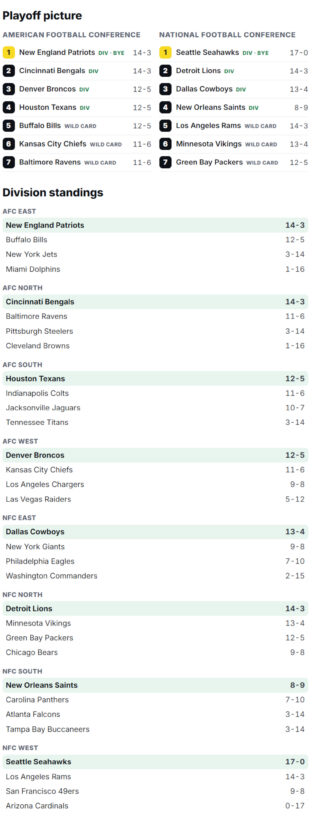
- 1. New England Patriots — 14–3 (5–1 division) — Lost SB PF: 490 · PA: 320
- 2. Buffalo Bills — 12–5 (4–2 division) — Lost DR PF: 481 · PA: 365
- 3. Miami Dolphins — 7–10 (3–3 division) — Missed Playoffs PF: 347 · PA: 424
- 4. New York Jets — 3–14 (0–6 division) — Missed Playoffs PF: 300 · PA: 503
Buffalo finished two games behind New England and qualified as a wild card. Its 4–2 division record was strong, but the Patriots’ 5–1 mark helped separate the teams.
Notable 2026 Player Additions
- WR D.J. Moore (trade, Bears): Buffalo paid a second-round pick, receiving Moore and a fifth-rounder, to acquire the established three-level receiver its offense lacked. He should immediately become Allen’s most complete outside target.
- EDGE Bradley Chubb: Chubb recorded 8.5 sacks for Miami in 2025 and adds a sturdy edge defender with proven pressure production. Health remains part of the calculation, but his arrival raises the front’s floor.
- DB C.J. Gardner-Johnson: The veteran brings ball skills, aggression and positional flexibility to a secondary learning Leonhard’s system.
- CB Dee Alford: Alford is a viable nickel option whose quickness and experience should matter in a division with increasingly varied passing attacks.
- OL Austin Corbett and Lloyd Cushenberry: Both are inexpensive veteran depth pieces. Corbett can compete at guard, while Cushenberry provides insurance at center.
- QB Kyle Allen: Allen returns as Josh Allen’s backup and offers system familiarity in a role Buffalo hopes never becomes prominent.
Notable 2026 Player Losses
- LG David Edwards: Edwards’ departure removes a 17-game starter from one of the league’s better lines and creates a competition at left guard.
- OT Ryan Van Demark: Losing the swing tackle reduces proven depth behind Dion Dawkins and Spencer Brown.
- EDGE A.J. Epenesa: His exit further reshapes a pass-rush rotation that had already been searching for more consistent finishing power.
- FB Reggie Gilliam: Gilliam’s special-teams and blocking work was quietly useful; Buffalo must replace those snaps even if it carries fewer traditional fullback packages.
2026 Draft Class
- Round 2, Pick 35 — EDGE T.J. Parker, Clemson A powerful, high-motor rusher who can join the rotation immediately and eventually become a foundational edge defender.
- Round 2, Pick 62 — CB Davison Igbinosun, Ohio State A physical man-coverage corner whose skill set aligns with Leonhard’s preferred approach. He can challenge for the CB2 job.
- Round 4, Pick 102 — OT Jude Bowry, Boston College A developmental power blocker expected to cross-train at guard and tackle, directly addressing lost line depth.
- Round 4, Pick 125 — WR Skyler Bell, UConn A productive route-and-run-after-catch target who can compete for rotational work while developing behind Moore and Shakir.
- Round 4, Pick 126 — LB Kaleb Elarms-Orr, TCU An athletic linebacker with a path to sub-package snaps and a longer-term chance to win a starting role.
- Round 5, Pick 167 — S Jalon Kilgore, South Carolina A versatile “star” defender in college whom Buffalo plans to develop as a true safety.
- Round 5, Pick 181 — DT Zane Durant, Penn State An undersized but explosive interior penetrator suited to passing downs and an attacking front.
- Round 7, Pick 220 — CB Toriano Pride Jr., Missouri A competitive depth corner whose quickest route to the roster may run through special teams.
- Round 7, Pick 239 — P Tommy Doman Jr., Florida State Draft status makes him the favorite to stabilize a position that lacked continuity.
- Round 7, Pick 241 — G Ar’maj Reed-Adams, Texas A&M A powerful run blocker competing for reserve interior-line work.
2026 Spotlight Watch
- Hot Seat — Keon Coleman: Buffalo has publicly challenged the former second-round receiver after an uneven 2025 that included missed meetings and multiple benchings. With Moore, Shakir, Palmer and rookie Skyler Bell competing for targets, Coleman must earn trust and show that his size can translate into consistent production.
- Breakout Watch — Maxwell Hairston: The 2025 first-round corner has the speed to become a major defensive piece, but he must prove he can thrive in Leonhard’s more man-oriented structure. Winning the CB2 competition would transform the secondary’s ceiling.
- Bust Watch — D.J. Moore: This is a value-and-expectations watch, not a claim that Moore lacks talent. Buffalo surrendered a second-round pick and needs him to perform as a legitimate No. 1 receiver; ordinary WR2 production would make the price look excessive.
- Team Superstar — Josh Allen: Cook’s rushing title deserves celebration, but the Bills’ championship ceiling still begins with Allen. His rare ability to create touchdowns as both passer and runner makes Buffalo dangerous against every opponent and keeps the franchise in the Super Bowl conversation.
Prediction
We have the Buffalo Bills making the playoffs and finishing with 12 wins in 2026. Good enough for the 5 seed in the AFC, and in second place in the AFC East because they were two games behind the Patriots.
Below is the complete 2026 regular season projections.