



Carson Steele does not exactly have the résumé of a typical NFL running back.
He grew up in Indiana, became one of the most productive high school runners in the state, broke records at Center Grove, stayed home to become a star at Ball State, transferred to UCLA, went undrafted, somehow worked his way into meaningful snaps for Patrick Mahomes and the Kansas City Chiefs as a rookie, spent another year fighting for his NFL career on a practice squad, and eventually landed in Philadelphia.
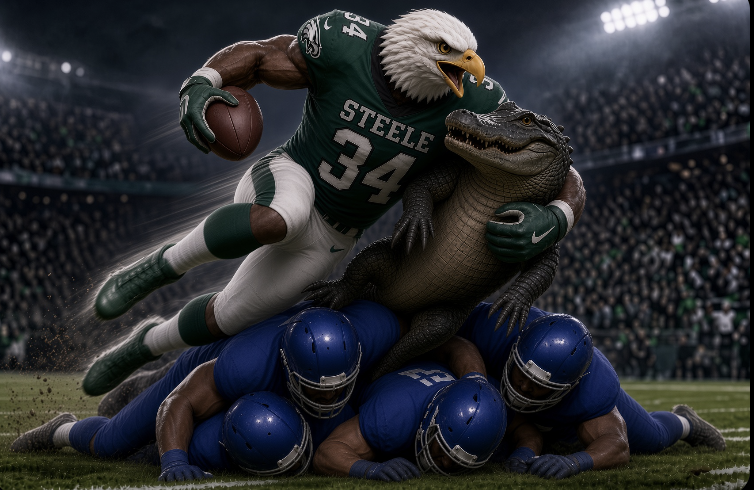
And, because apparently that story was not interesting enough, he also owns a roughly five-foot-long, 100-pound pet alligator named Crocky-J.
Now Steele may have found exactly the right place for the next chapter of his career.
After an explosive performance against the New England Patriots in the Eagles’ second preseason game of 2026, Steele has made a compelling case not only for Philadelphia’s 53-man roster, but potentially for a role that is a little more complicated than simply calling him the fourth running back.
At 6-foot and 228 pounds, Steele looks like a running back. He has played fullback. He can catch the football. He can contribute on special teams. And his ability to function in several different offensive roles raises an interesting possibility for Sean Mannion’s offense: could Steele eventually become something closer to a modern H-back?
Maybe even an occasional de facto tight end?
That versatility is also why, watching Steele, I keep thinking about an old Eagles name: Keith Byars. A childhood favorite of mine.
No, Steele has not earned a comparison to one of the most versatile offensive players in Eagles history based on one August preseason game. That is not the point.
The comparison is about the type of player.
Byars was technically a running back and fullback, but defining him by one position never really explained what he did. He ran the ball, caught passes, blocked, moved around formations and eventually even lined up as a tight end. Steele has a long way to go before belonging in that conversation historically.
But the idea?
That is where things become interesting.
An Indiana Kid Built to Run the Football
Carson Steele was born on October 21, 2002, in Greenwood, Indiana, the son of Joseph and Angela Steele. He grew up in the same area where he would eventually become one of the state’s most recognizable high school football players.
Football was not something Steele suddenly discovered late in high school.
He was already physically unusual when he arrived at Center Grove High School. Steele has recalled entering his freshman year at roughly 6-foot-1 and 200 pounds — already possessing the type of frame normally associated with upperclassmen rather than a kid just beginning high school.
It did not take long for Center Grove to figure out what it had.
As a 14-year-old freshman in September 2017, Steele erupted for 238 rushing yards and three touchdowns against Carmel. He finished that freshman season with approximately 1,700 rushing yards and 20 touchdowns before exploding for roughly 2,270 yards and 29 scores as a sophomore.
His junior season was disrupted by injuries, including a hamstring problem and broken ankle. Then came 2020, and Steele went from being an outstanding Indiana running back to Indiana Mr. Football.
Center Grove: Records, a State Championship and Mr. Football
Playing for head coach Eric Moore at Center Grove, Steele finished his senior season with 1,659 rushing yards and 31 touchdowns, helping lead the Trojans to a perfect 14-0 record and Indiana Class 6A state championship. He was named Indiana’s Mr. Football and MaxPreps Indiana Player of the Year while earning All-State honors.
His complete high school résumé was even more ridiculous.
According to UCLA’s official biography, Steele finished his Center Grove career with:
- 5,907 rushing yards
- 82 rushing touchdowns
- 16 school single-season or career records
- Multiple All-Conference selections
- Multiple Johnson County Player of the Year honors
- Indiana Mr. Football
- A Class 6A state championship
- Team captain honors
It was an extraordinary career, especially considering that injuries essentially took away most of his junior season.
Yet Steele was not treated like one of America’s elite running back recruits.
He was viewed as a relatively modest prospect coming out of high school and ultimately chose Ball State, keeping him in Indiana rather than heading immediately to one of college football’s traditional power programs.
That would become a theme throughout his career. Steele has rarely taken the easiest or most glamorous path. He has just kept producing.
Ball State: From Local Recruit to One of the MAC’s Best Running Backs
Steele arrived at Ball State in 2021 and immediately demonstrated that his high school production was not simply the result of overpowering Indiana teenagers.
As a true freshman, he carried the ball 192 times for 891 yards and six touchdowns, while adding 12 receptions for 157 yards and another score.
Then he exploded. In 2022, Steele became one of the most productive running backs in college football.
He rushed 289 times for 1,556 yards and 14 touchdowns, averaging 5.4 yards per carry. He also caught 29 passes for 166 yards and another touchdown.
There were monster individual performances along the way.
Steele rushed for a career-high 198 yards and three touchdowns against Toledo and had another 192-yard performance against Kent State. He was twice named MAC West Offensive Player of the Week and earned first-team All-MAC honors.
The two-star Indiana recruit had turned himself into a legitimate Power Five player. After two seasons at Ball State, Steele entered the transfer portal. His next stop would take him much farther from Greenwood.
UCLA: Proving He Could Produce at the Power Five Level
Steele transferred to UCLA in January 2023 and joined Chip Kelly’s Bruins.
The situation was different from Ball State. He was not going to receive nearly 300 carries. UCLA had other talented runners, including T.J. Harden, and Steele would operate in more of a shared backfield.
He still produced.
Steele appeared in 12 games and started nine, rushing 167 times for 847 yards and six touchdowns, an average of 5.1 yards per carry.
That total ranked sixth in the Pac-12, as did his rushing-yard average per game, while his yards-per-carry average ranked seventh in the conference.
He topped 75 rushing yards seven times and posted two 100-yard games: 141 yards against Washington State and 110 against Oregon State.
He also began showing more of the versatility that makes him intriguing today.
Steele caught 17 passes for 163 yards and two touchdowns, including receiving scores against Coastal Carolina and Colorado.
Across three college seasons between Ball State and UCLA, Steele accumulated:
| Statistic | College Total |
|---|---|
| Games | 37 |
| Rushing attempts | 648 |
| Rushing yards | 3,294 |
| Yards per carry | 5.1 |
| Rushing touchdowns | 26 |
| Receptions | 58 |
| Receiving yards | 486 |
| Receiving touchdowns | 4 |
That is 3,780 yards from scrimmage and 30 offensive touchdowns.
And yet when the 2024 NFL Draft arrived, Steele’s name was never called.
Undrafted — And Then Kansas City Called
Steele was not invited to the NFL Scouting Combine and went undrafted in 2024.
For a player who had rushed for nearly 6,000 yards in high school and more than 3,000 in college, the NFL was once again telling him that he would have to take the difficult route.
The Kansas City Chiefs offered him that route. Kansas City signed Steele as an undrafted free agent in May 2024.
He quickly became one of the stories of Chiefs training camp. Part of that was his running style. Part was the long blond hair. Part was his personality. And, naturally, part of it was the alligator.
Steele’s pet alligator, Crocky-J, was given to him as a Christmas gift when Steele was in second grade. Crocky-J has grown to around five feet and approximately 100 pounds and lives at the family’s Indiana home.
But Crocky-J was only going to make Steele famous during the preseason.
Football was what got him onto Kansas City’s roster.
From Undrafted Free Agent to Chiefs Starter
Steele did something that thousands of undrafted rookies never accomplish.
He made the defending Super Bowl champions’ 53-man roster.
And he did more than simply occupy a spot at the bottom of it.
Steele appeared in all 17 regular-season games for Kansas City in 2024 and made three starts. He was used as both a running back and fullback while also contributing significantly on special teams.
His rookie rushing numbers were:
56 carries, 183 yards, 3.3 yards per attempt.
He added seven receptions for 26 yards and returned five kickoffs for 138 yards, averaging 27.6 yards per return.
Those are hardly fantasy-football numbers.
But context matters.
Steele was an undrafted rookie attempting to carve out a role on a team trying to win another Super Bowl. When injuries affected Kansas City’s backfield, he was trusted enough to make starts and handle meaningful offensive snaps.
There were mistakes. Ball security was one of the biggest ones. Steele fumbled three times and lost two of them during the regular season. That can’t happen in the NFL!
That matters because there is a tendency with interesting preseason players to remember only the highlights. Steele’s first NFL season demonstrated both sides of the equation.
The power and physicality were real, but so were some of the rough edges.
Kansas City eventually went back toward more established options in the backfield, including Kareem Hunt, and Steele’s offensive role diminished.
Still, he had accomplished something significant: an undrafted running back had gone from UCLA to appearing in every game for an AFC champion.
The Chiefs eventually reached Super Bowl LIX, with Steele having contributed during their road to the championship game.
A Step Back in 2025
Steele’s second NFL season was much less eventful.
Kansas City released him during its final roster reduction on August 26, 2025, then brought him back on the practice squad the following day. He would spend the duration of the 2025 season there.
That could have been the beginning of the end of his NFL opportunity.
Running backs are replaceable, undrafted running backs are even more replaceable.
Players who spend an entire season on a practice squad are never guaranteed another real opportunity, but another team saw something worth developing and that team happened to be Philadelphia.
The Eagles Take a Chance
On January 13, 2026, the Eagles signed Steele to a reserve/futures contract.
It was hardly one of the headline moves of Philadelphia’s offseason.
But Steele entered a potentially fascinating situation.
The Eagles already possessed considerable talent at running back, meaning Steele was never going to arrive in Philadelphia and simply become the featured runner.
For him, making this roster required demonstrating something else.
Versatility.
The Eagles currently list Steele at 6-foot, 228 pounds and classify him as a running back. But his professional background already includes work at fullback.
And then came August 22 in Foxborough. The Carson Steele game.
Eagles-Patriots: The Night Steele Forced Everyone to Pay Attention
Philadelphia’s second preseason game against New England was technically a loss.
The Patriots won 24-21. But this was the Carson Steele game, and made everyone forget about A.J. Brown for a couple hours.
For Carson Steele, the result almost felt secondary.
This was the game in which he may have secured an NFL job.
Steele carried the ball 12 times for 33 yards, which by itself was nothing spectacular.
Then look at what happened as a receiver.
Six catches, 84 receiving yards and one touchdown.
His longest reception went for 28 yards.
That gave Steele 117 yards from scrimmage on 18 offensive touches.
The receiving production was particularly notable because Steele did not merely catch a collection of dump-offs and fall forward.
He looked explosive with the football.
On one reception, he caught the ball and hurdled a Patriots defender on a 14-yard gain.
Later came another highlight.
Steele caught a pass and turned it into a 20-yard fourth-quarter touchdown, once again going airborne over a New England defender on his way into the end zone.
It was exactly the kind of performance a player in Steele’s position needed.
Philadelphia already knows Steele can carry the football between the tackles.
Kansas City proved that.
What Steele needed to demonstrate was that keeping him on the roster could give the offense something that another reserve running back might not.
Against New England, he did exactly that.
The official Eagles and NFL statistical logs list Steele with six receptions for 84 yards, giving him 117 total yards from scrimmage for the night.
Put Carson Steele on the 53-Man Roster
There is still technically a roster decision to be made.
For this projection, I’m making it now.
Carson Steele is making my Eagles 53-man roster.
There is too much utility here to throw away.
Philadelphia does not need Steele to replace Saquon Barkley. It does not need him to become a conventional second-string tailback.
That may actually be the argument for keeping him.
The question should not be, “Is Carson Steele one of our three best traditional running backs?”
The better question is:
How many jobs can Carson Steele do with one roster spot?
He can carry the football, can catch it, has experience playing fullback, contributes on special teams and has returned kickoffs.
He weighs nearly 230 pounds, functions as a short-yardage runner, and now he has shown that he can catch the football in space and create yards after the catch.
That sounds less like a fourth running back and more like an offensive utility player.
Could Steele Become the Eagles’ H-Back?
This is where I think Philadelphia could get creative.
There has been outside discussion about Steele potentially helping himself through H-back versatility, although he has not primarily been practicing as an H-back during camp.
That distinction matters.
This is a projection of what Philadelphia could eventually do with him, not a description of a role the coaching staff has already installed.
I would like to see them explore it.
An H-back is essentially a movable offensive piece who can operate out of the backfield, align near the formation like a tight end, go in motion, lead block, release into the flat or attack linebackers in the passing game.
Steele’s body type is unusual for a pure tight end.
At 6-foot and 228 pounds, he is smaller than a conventional NFL in-line tight end. Nobody should expect him to line up next to Lane Johnson all afternoon and block 270-pound edge rushers.
That isn’t the idea.
Instead, imagine Steele:
- Aligned at fullback on one snap
- Offset behind the quarterback on another
- Motioning across the formation before the snap
- Releasing into the flat against a linebacker
- Running a wheel route from the backfield
- Lining up in the slot against certain personnel groups
- Functioning as a lead blocker
- Leaking behind the defense off play-action
- Carrying the ball in short yardage
- Becoming an extra receiving option when defenses expect a run
You do not necessarily have to call him a tight end, a fullback or an H-back.
Just call him Carson Steele and make the defense figure out what that means on a particular snap.
That is where the Keith Byars comparison comes into play.
Why Carson Steele Reminds Me of Keith Byars
For Eagles fans old enough to remember Buddy Ryan’s teams of the late 1980s, Keith Byars was one of Philadelphia’s most interesting offensive players.
The Eagles selected Byars 10th overall in the 1986 NFL Draft out of Ohio State. At approximately 6-foot-1 and 245 pounds, he was considerably bigger than many running backs and eventually became difficult to define by a conventional position.
Byars could run and block, but most importantly for this comparison, he could catch.
And boy could he catch.
He had some of the best hands on those Eagles teams.
In 1988, Byars rushed for 517 yards and six touchdowns while catching 72 passes for 705 yards and four more touchdowns.
That was 1,222 yards from scrimmage and 10 touchdowns from a player built more like a fullback than a conventional receiving back.
The following season, he caught another 68 passes for 721 yards.
Then in 1990, Byars caught an astonishing 81 passes for 819 yards and three touchdowns.
He even completed all four of his pass attempts that year for 53 yards and four touchdowns.
That is what made Byars special.
He wasn’t simply a fullback who happened to catch screens, instead he was an offensive chess piece.
And that is the part of Steele’s game that reminds me of him.
Again, this is not a prediction that Carson Steele is about to become Keith Byars.
Byars had 610 career receptions, 5,661 receiving yards and 3,109 rushing yards over 13 NFL seasons. Steele currently has seven regular-season NFL catches.
There is a canyon between those résumés.
But stylistically, the resemblance is worth exploring.
Both are unusually powerful backs with enough size to function around the formation and contribute as receivers.
And the most interesting version of Steele may eventually be the version in which nobody is quite sure whether to call him a running back, fullback or something else.
That something else is what intrigues me and reminds me of my childhood favorite player, Keith Byars.
The Alligator-Owning Undrafted Running Back Who Refuses to Go Away
There is something appropriately Philadelphia about Carson Steele’s career.
Nothing has been handed to him.
He was not a five-star high school recruit, but webt ti Ball State, transferred to UCLA and produced, wasn’t invited to the Combine, wasn’t drafted, but made Kansas City’s roster anyway.
He started NFL games as an undrafted rookie, then spent an entire season on a practice squad.
Philadelphia gave him another opportunity, and when that opportunity finally arrived in a preseason game at New England, he caught six passes for 84 yards, accumulated 117 yards from scrimmage and literally started hurdling defenders.
Now comes his next hurdle. Steele is not going to enter this season as one of Philadelphia’s offensive stars, but he doesn’t have to.
His value may come from being something much stranger — and potentially much more useful.
Philadelphia has seen this before, and it was marvelous. I was a child back then.
A running back who can also play fullback. A fullback who can become a receiving option. A special-teams contributor who can line up in multiple places. Maybe even an H-back or a pass-catching TE2-type weapon behind Dallas Goedert in certain packages.
In other words, a modern offensive utility player — the kind of role Keith Byars once filled so memorably for the Eagles.
Steele still has to prove that his performance against New England was more than one excellent preseason night. He has to protect the football, block consistently, contribute on special teams and earn the trust of Philadelphia’s coaching staff. But he has earned the opportunity.
And on an Eagles roster that could use more offensive playmakers beyond its established stars, Steele could make a name for himself in Philadelphia. The time is right for 2026 to be the Carson Steele season.
Put Carson Steele on the 53-man roster. Then let the “mad genius,” Sean Mannion, figure out just how many different ways the Eagles can use him.
If the Eagles don’t sign Carson Steele to the 53-man roster, I would sick Crockey-J on Howie Roseman, Nick Sirianni and Sean Mannion!
If you liked this article on Carson Steele, you will love this article about Jalyx Hunt, the Eagles next great edge defender.
Addiitonal Sources and Links
- Philadelphia Eagles — Carson Steele Player Profile
- Philadelphia Eagles — Carson Steele Career Information
- Philadelphia Eagles — Carson Steele 2026 Game Logs
- NFL.com — Carson Steele Player Profile and Career Stats
- UCLA Athletics — Carson Steele Football Bio
- Ball State Athletics — Carson Steele Football Bio
- Pro Football Reference — Carson Steele
- Pro Football Archives — Carson Steele
- ESPN — Carson Steele Player Profile
- Sporting News — Carson Steele, His Alligator, and His Rise with the Chiefs
- Bleeding Green Nation — Carson Steele and the Eagles Roster Competition
- Pro Football Reference — Keith Byars Career Stats
- NFL.com — Keith Byars Career Stats
- Philadelphia Eagles — Historical Team Statistics