













Editor’s Update | November 5, 2026
This article was originally published on September 3, 2026, before Jalen Hurts’ subsequent medical emergency. The original prediction and organizational analysis remain unchanged. However, the salary cap figures previously presented in the section discussing a potential 2027 release were incorrect and have been updated using Spotrac’s current contract projections.
Under the corrected figures, a March 2027 release with a post-June 1 designation would produce approximately $52.757 million in dead-cap charges for 2027 and another $54.478 million in 2028. Hurts’ scheduled 2027 cap charge if retained is $42.133 million, meaning the release would increase that year’s accounting expense by $10.624 million. Philadelphia could also avoid approximately $29.5 million in scheduled cash compensation under the existing contract assumptions.
The updated figures and additional analysis of the 2027 option bonus are examined in our November 2 follow-up, The $29.5 Million Exit: Why the Eagles Will Release Jalen Hurts. Our original position that Philadelphia’s leadership had completed its evaluation of Hurts before the 2026 season remains the foundation of this article.
The Decision Has Already Been Made
Jalen Hurts could have an extraordinary season in 2026. He could throw for 4,000 yards, challenge for another MVP award, win the NFC East, and lead Philadelphia back to the Super Bowl. Any of those accomplishments would strengthen an already impressive résumé that includes two Super Bowl appearances, a championship, and a Super Bowl MVP award.
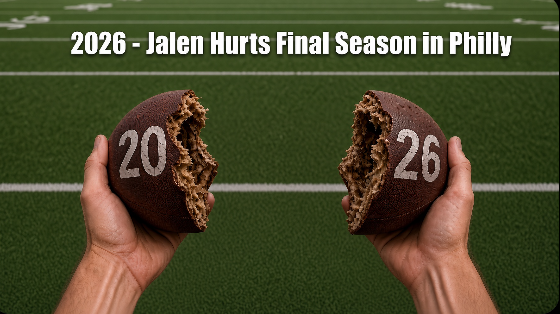
We believe Jalen Hurts is playing his final season as the Philadelphia Eagles’ quarterback, regardless of his individual performance or the team’s success.
That prediction may appear unreasonable considering Hurts’ accomplishments. He is only 28 years old, has established himself as one of the NFL’s most successful quarterbacks, and has received extensive public praise from Jeffrey Lurie and Howie Roseman. His leadership, preparation, and ability to deliver in important games have also earned the respect of many people throughout the league.
However, the evidence surrounding Philadelphia’s organizational structure, coaching decisions, contract negotiations, and internal relationships suggests the franchise has reached a conclusion about its long-term future at quarterback.
The Eagles have already spent several seasons evaluating Hurts’ ability to operate within their preferred offensive system. They have changed coordinators, altered the structure of the passing game, brought in coaches with different philosophies, and repeatedly confronted concerns about accountability and communication.
We believe that evaluation is finished.
The 2026 season represents the final year of an arrangement that ownership and management have already decided to end. The contract structure and approaching quarterback draft provide Philadelphia with a practical opportunity to execute that decision in 2027.
Understanding how we reached this point requires examining the history of Hurts’ relationship with the Eagles, beginning before he ever established himself as their franchise quarterback.
The Eagles Were Prepared to Replace Hurts Before 2022
It is easy to look back on Hurts’ extraordinary 2022 season and assume Philadelphia always believed he would become a franchise quarterback. The organization’s actions before that season suggest management was still evaluating other possibilities.
The Eagles explored acquiring both Russell Wilson and Deshaun Watson during the 2022 offseason, examining whether either quarterback would be interested in playing for Philadelphia. Both possessed no-trade clauses, meaning their willingness to join the organization was essential to completing a potential deal.
Philadelphia’s interest in Wilson was particularly significant. Subsequent reporting indicated that the Eagles made a viable offer, but Wilson was unwilling to waive his no-trade clause to join the team. The organization ultimately entered the season with Hurts as its starter while retaining substantial draft flexibility.
That flexibility was no accident.
In April 2022, Philadelphia completed a major draft-pick exchange with New Orleans that provided an additional first-round selection in 2023. The move preserved resources that could have been used to pursue a quarterback if Hurts failed to develop sufficiently.
Lurie publicly expressed confidence in Hurts during that period while acknowledging the uncertainty surrounding the future. Philadelphia was prepared to support its young starter and evaluate other options if necessary.
Then Hurts delivered one of the finest individual seasons in franchise history.
He finished second in MVP voting, led Philadelphia to a 14-1 record in games he started, and helped the Eagles reach Super Bowl LVII. His performance against Kansas City was exceptional, establishing his ability to compete against the league’s best quarterbacks on the biggest stage.
Philadelphia rewarded him with a five-year, $255 million extension in April 2023, including approximately $179.4 million in total guarantees and $110 million fully guaranteed at signing.
The agreement immediately placed Hurts among the NFL’s highest-paid quarterbacks. Roseman also incorporated the option bonuses and future accounting flexibility that have become defining characteristics of his contract negotiations.
Subsequent extensions signed by Justin Herbert and Joe Burrow contained larger guarantee packages, demonstrating how quickly the quarterback market was evolving. Philadelphia had secured its young starter while maintaining financial mechanisms that could become useful if circumstances changed.
And the circumstances began changing almost immediately.
Something Changed After the 2022 Season
Hurts entered the 2022 season attempting to establish himself as a legitimate franchise quarterback. He emerged from that campaign as an MVP runner-up, a Super Bowl participant, and the recipient of one of the largest contracts in NFL history.
That transformation inevitably changed his standing within the organization.
A quarterback who has demonstrated the ability to lead a team to the Super Bowl gains influence over offensive strategy, personnel discussions, and the development of the system surrounding him. Coaches have to consider his preferences, particularly when those preferences have contributed to significant success.
However, the relationship between quarterback influence and coaching authority requires clearly established boundaries. The Eagles’ subsequent difficulties suggest those boundaries became increasingly complicated after Hurts signed his extension.
Philadelphia promoted Brian Johnson to offensive coordinator following Shane Steichen’s departure for Indianapolis. Johnson had an unusually close relationship with Hurts and his family, having known him since childhood and developed connections that extended well beyond their professional association.
That familiarity offered potential advantages because Johnson understood Hurts’ strengths, personality, and preferred approach to football. It also created an unusual organizational dynamic in which the quarterback’s longtime family acquaintance occupied one of the most important coaching positions on the team.
ESPN’s subsequent reporting on Philadelphia’s offensive difficulties described disagreements involving Hurts, Johnson, and Nick Sirianni over how the offense should operate. Those tensions became particularly significant as the team deteriorated during the second half of the 2023 season.
The Eagles entered that year with championship expectations and began 10-1 before losing five of their final six regular-season games. Their offensive problems became increasingly apparent, and the relationship between the quarterback, coordinator, and head coach attracted greater scrutiny.
One play in particular illustrated the problem.
The Seattle Interception Exposed a Breakdown in Authority
Late in Philadelphia’s December 2023 loss to Seattle, Hurts attempted a deep pass toward A.J. Brown that resulted in an interception. The decision was heavily criticized because the Eagles were attempting to position themselves for a potential game-winning score.
Sirianni publicly accepted responsibility for the play and defended the strategic thinking behind the deep attempt, including the possibility of drawing a pass-interference penalty.
Subsequent reporting revealed that Hurts and Brown had improvised outside the intended design of the play. Brown acknowledged their involvement in changing the approach, while ESPN later described the sequence as an example of Hurts departing from the installed game plan.
That disclosure raised concerns about how decisions were being made within Philadelphia’s offense. The head coach had publicly defended a decision that his quarterback and receiver had reportedly altered on the field, creating questions about the relationship between the coaching staff’s instructions and the players’ execution.
Hurts did not publicly accept responsibility for changing the play. From our perspective, the episode represented an early example of the accountability concerns that would continue appearing in subsequent reporting.
Two days later, Sirianni made a revealing statement during his December 20 press conference.
“This offense is my offense.”
Sirianni explained that criticism of the offense should be directed toward him because Johnson was calling plays within the broader system that Sirianni had established. The comments were presented as a defense of his offensive coordinator, who was receiving intense criticism from fans and reporters.
However, the statement also reinforced the head coach’s ultimate authority over Philadelphia’s offensive direction. The responsibility for constructing the system and determining its philosophy belonged to Sirianni, even when the quarterback and coordinator possessed substantial influence over its operation.
Johnson was dismissed following the season, ending an arrangement that had produced considerable tension during the team’s collapse.
We believe the decision also reflected the organization’s desire to restore clearer lines of authority between the quarterback, coaching staff, and front office. Johnson’s relationship with Hurts had created a difficult dynamic, and Philadelphia responded by bringing in an offensive coordinator without the same personal connections.
Kellen Moore and the 2024 Championship
Philadelphia hired Kellen Moore to coordinate its offense in 2024, introducing an experienced outside voice with no longstanding personal relationship with Hurts.
Moore arrived with extensive experience coordinating NFL offenses and established ideas about passing-game structure, personnel usage, and quarterback responsibilities. Sirianni gave him considerable authority over the offensive operation, allowing Philadelphia to establish a more clearly defined coaching hierarchy.
The Eagles initially struggled to find consistency, entering their Week 5 bye with a 2-2 record. Their subsequent transformation became one of the defining developments of the championship season.
Philadelphia increasingly built its offensive identity around Saquon Barkley, its outstanding offensive line, and a running game that consistently controlled field position and possession. The defense also developed into one of the NFL’s best units, with Cooper DeJean entering the starting lineup and Vic Fangio’s system becoming increasingly effective.
Hurts’ responsibilities evolved alongside those developments. The offense asked him to protect the football, make efficient passing decisions, contribute with his legs when necessary, and operate within a system that relied heavily on its supporting personnel.
The change produced remarkable results.
Philadelphia won its final 12 games, including the postseason, and captured Super Bowl LIX. Hurts delivered an excellent performance against Kansas City and was named Super Bowl MVP, completing the championship journey that had begun two years earlier.
Yet the offensive structure itself deserves attention.
Pro Football Reference’s advanced passing data credited Hurts with only two RPO pass attempts during the 2024 regular season, totaling eight yards. That statistic measures charted RPO passing attempts rather than every run-pass option concept in Philadelphia’s offense, but it illustrates how differently the team operated compared with previous seasons.
Hurts’ role had become more defined, with the offense emphasizing reliable execution and reducing opportunities for unnecessary deviations from the intended structure.
In our view, Philadelphia had significantly reduced the quarterback’s freedom to reshape the offense while giving him an excellent supporting cast capable of winning games through physical dominance and disciplined execution.
The championship demonstrated how effective that approach could be. Hurts performed exceptionally well when the Eagles needed him, while the broader offensive system limited the number of difficult situations he was required to resolve independently.
Nevertheless, the underlying questions about his relationship with the coaching staff had not disappeared.
Those concerns resurfaced the following season.
Kevin Patullo Inherited an Organizational Problem
Moore departed Philadelphia after the championship to become head coach of the New Orleans Saints, leaving Sirianni searching for another offensive coordinator.
The Eagles promoted Kevin Patullo, a longtime Sirianni assistant whose relationship with the head coach extended back to their years together in Indianapolis.
Patullo entered the position with considerable familiarity with Philadelphia’s personnel and offensive terminology. He also inherited a quarterback who had just won Super Bowl MVP and an organization expecting another championship run.
The 2025 offense struggled to establish consistency, and criticism of the coordinator intensified as the season progressed. Patullo’s play-calling, offensive design, and ability to adjust were repeatedly questioned, while familiar issues involving Hurts and the passing game continued attracting attention.
Philadelphia ultimately dismissed Patullo after the season.
The most significant development came several months later, when ESPN published an extensive examination of the Eagles’ offensive difficulties and the relationships surrounding Hurts.
The April 1, 2026 report by Tim McManus and Jeremy Fowler drew on interviews with more than a dozen sources, including people within the organization and individuals familiar with the quarterback.
Several sources described Hurts as resistant to changes involving the offensive system, particularly an increased emphasis on taking snaps under center. The reporting also raised concerns about excessive changes to play calls, departures from game plans, and communication with coaches and teammates.
One team source described concerns involving Hurts’ body language, willingness to embrace certain changes, and coachability. Another source close to Hurts suggested that he needed stronger coaching voices capable of challenging him and that too many people around him had become accustomed to agreeing with his preferences.
Those assessments were attributed to sources, and Hurts has not publicly accepted all of their characterizations. Nevertheless, the report presented a detailed account of disagreements that extended across several coaching staffs.
ESPN also revisited the 2023 difficulties involving Johnson and Sirianni, along with reported tensions during Moore’s championship season. The resulting picture suggested that the organization’s concerns had persisted despite changes in personnel, strategy, and offensive leadership.
Patullo’s dismissal addressed the immediate failure of the 2025 offense. The reporting raised a broader issue concerning the quarterback’s relationship with the organizational structure Philadelphia wanted to establish.
The ESPN Report Signaled a Deeper Conflict
The April 2026 ESPN article represented a significant moment because it brought previously internal concerns into public view.
The Eagles officially declined to comment on the reporting, and there is no evidence establishing that ownership or management authorized its publication. Nevertheless, the number of sources and the consistency of the concerns described made the report particularly damaging.
From our perspective, the article reflected an organization struggling to resolve disagreements that had persisted through multiple coordinators and several seasons.
Philadelphia had already attempted different approaches to coaching Hurts. Johnson offered personal familiarity, Moore brought an outside perspective, and Patullo represented an established connection to Sirianni’s offensive philosophy. Each arrangement produced different results, yet the same underlying questions about authority and adaptability continued appearing in the reporting.
The concerns were especially significant because of the amount of influence a successful franchise quarterback possesses. Hurts had earned the right to express his preferences and participate in offensive discussions, but the Eagles still needed a system in which coaching decisions could be implemented consistently.
We interpreted the public emergence of those concerns as evidence that management’s patience was running out. The organization had already invested heavily in attempting to develop a sustainable relationship between its quarterback and offensive leadership.
The response from people close to Hurts added another dimension to the disagreement.
June Revealed the Growing Divide
On June 10, Hurts was asked about the ESPN report and the four-verticals play that ended Philadelphia’s 2025 postseason.
According to ESPN’s reporting, Hurts had suggested or recommended the play before Sirianni approved it. When asked whether he had requested the call, Hurts answered, “Nah. No.”
He also indicated that he had not sought an opportunity to respond to the broader report and preferred to focus on doing his job.
Four days later, an article by Joseph Santoliquito presented concerns attributed to people close to Hurts. Those individuals reportedly believed the Eagles had failed to provide sufficient public support for their quarterback following criticism of his performance and coachability.
The article compared Philadelphia’s response to Hurts with the organizational support previously offered to Carson Wentz during a period of public criticism in 2019. It also raised questions about Hurts’ future with the franchise and whether he would want to remain in Philadelphia beyond 2026.
The reporting clearly attributed those concerns to people around Hurts, and there has been no confirmation that the quarterback directed or approved their statements. However, the emergence of those grievances suggested that frustration existed on both sides of the relationship.
Hurts is known for maintaining a relatively private circle, and public comments from people described as close to him inevitably attract attention. We interpreted the June reporting as an indication that the disagreement had moved beyond offensive strategy and was affecting the broader relationship between the quarterback and his organization.
For Lurie, that development carried particular significance because of his longstanding emphasis on accountability and alignment.
The Eagles have experienced previous situations in which highly successful figures developed competing visions for how the organization should operate. Lurie’s responses to those situations provide important context for understanding our prediction.
Chip Kelly Demonstrated Lurie’s Expectations for Accountability
The Chip Kelly era offers one of the clearest examples of how Jeffrey Lurie approaches organizational authority.
Kelly led the Eagles to consecutive 10-win seasons during his first two years as head coach, establishing a reputation as an innovative offensive strategist. His success gave him considerable influence, and he subsequently pushed for greater control over personnel decisions.
Lurie granted that authority, placing Kelly in charge of the roster and reducing Howie Roseman’s role in the football operation.
The decision was remarkable considering the relationship Lurie had already established with Roseman. The owner was willing to significantly alter the organizational hierarchy because he believed empowering Kelly would provide the head coach with the resources necessary to succeed.
However, that authority also came with expectations of accountability.
Kelly made substantial changes to the roster, and the Eagles struggled during the 2015 season. Following the loss that eliminated Philadelphia from playoff contention, Kelly publicly distanced himself from responsibility for the personnel operation by emphasizing that he was not the general manager.
Although Kelly did not hold that formal title, he had been given final authority over many personnel decisions. His comments therefore conflicted with the accountability Lurie expected when granting that control.
Kelly was dismissed the following day.
In subsequent public comments, Lurie emphasized that accountability would be one of the organization’s defining characteristics. He had demonstrated a willingness to give a successful coach extensive authority, while also establishing that the coach would ultimately answer to ownership for how that authority was exercised.
The episode provides a useful framework for examining the current quarterback situation.
Hurts has earned considerable influence through his success, but the Eagles’ organizational hierarchy still places ultimate authority with the head coach, general manager, and owner. Persistent disagreements over how that authority is exercised could become a serious issue regardless of the quarterback’s statistical achievements.
Doug Pederson Demonstrated the Importance of Organizational Alignment
Doug Pederson offers another revealing example because he accomplished something Chip Kelly never did.
He delivered Philadelphia’s first Super Bowl championship.
Pederson’s success established him as one of the most important coaches in franchise history. He had also demonstrated an ability to lead the organization through difficult circumstances, including Carson Wentz’s injury during the 2017 championship season.
Following the disappointing 2020 campaign, reports initially suggested Pederson was expected to return. However, disagreements concerning the direction of the coaching staff and broader football operation intensified during meetings with Lurie.
Pederson preferred greater authority over his assistant coaches and reportedly supported promoting existing members of the staff, including Press Taylor. Lurie wanted additional outside perspectives and a more substantial restructuring of the operation.
Their competing visions ultimately proved irreconcilable, and Pederson was dismissed in January 2021.
The decision demonstrated the importance Lurie places on maintaining a shared organizational direction. Pederson had already won a championship and earned a prominent place in Philadelphia’s history, but his future depended on whether ownership believed the relationship could continue functioning effectively.
That history matters when examining Hurts.
The Eagles have already changed offensive coordinators several times while attempting to establish a sustainable system around their quarterback. If management believes the quarterback’s preferences are fundamentally incompatible with the structure ownership wants, the organization has demonstrated that it is willing to make difficult changes.
Hurts’ championship credentials would remain significant, but the precedent established under Lurie suggests they would not guarantee another long-term commitment.
Roseman and Sirianni Understand the Organizational Hierarchy
Howie Roseman and Nick Sirianni have both navigated difficult periods while maintaining Lurie’s confidence.
Roseman’s career provides the most dramatic example. He lost substantial authority during the Chip Kelly era but remained within the organization, reassessed his approach, and eventually returned to control of football operations.
His ability to work within Lurie’s organizational structure helped him rebuild his influence and become one of the most powerful general managers in professional football.
Sirianni has followed a similar pattern in his relationship with ownership.
He has accepted responsibility for offensive failures, adjusted his responsibilities when new coordinators were hired, and worked within organizational changes introduced by Lurie and Roseman. Following criticism of his behavior toward Eagles fans, Sirianni publicly apologized and accepted responsibility for his conduct.
Those examples demonstrate how successful figures can maintain influence while recognizing the expectations of the organization.
The concern surrounding Hurts is that his relationship with the coaching staff has reportedly involved recurring disagreements over offensive responsibilities, communication, and the implementation of game plans.
In our view, those issues have become central to the franchise’s evaluation of whether Hurts remains compatible with its preferred organizational structure.
The public statements from Lurie and Roseman during the 2026 offseason provided another important clue.
Lurie’s Compliments Have Not Produced Another Contract
Jeffrey Lurie has repeatedly praised Hurts for his leadership, competitive character, preparation, and performances in the Super Bowl. He has described himself as a tremendous supporter of the quarterback and emphasized the importance of Hurts’ accomplishments to the franchise.
However, the tone of his comments became particularly interesting when the discussion turned toward another contract extension.
During the 2026 offseason, Lurie responded to an extension question by explaining that Hurts was already in the middle of his existing agreement.
“He’s in the middle of the new contract now.”
Reporting from The Philadelphia Inquirer indicated that Philadelphia had no plans to extend Hurts during the offseason. Roseman similarly defended the quarterback against public criticism while providing no indication that another major contractual commitment was approaching.
The distinction between those statements and the organization’s financial actions deserves attention.
Hurts has accomplished enough to justify praise from his owner and general manager. Another extension would require Philadelphia to commit additional guaranteed money while extending the financial consequences of any future release.
We believe management’s reluctance reflected concerns about the quarterback’s long-term fit within the organization. That interpretation is consistent with the coaching decisions and internal disagreements examined throughout this article.
It also explains the importance of Hurts’ existing contract structure.
The Corrected Contract Figures Point Toward March 2027
The financial analysis is central to understanding how Philadelphia could act on a decision we believe it has already made.
Under Spotrac’s updated contract projections, Hurts is scheduled to carry a $42.133 million cap charge in 2027, with $51.5 million in scheduled cash compensation. That compensation includes a $50.155 million option bonus that must be exercised before Week 1 of the 2027 season.
Approximately $22 million of his 2027 compensation is already guaranteed, with an additional $696,000 scheduled to become guaranteed early in the 2027 league year.
If Philadelphia releases Hurts in March 2027 with a post-June 1 designation, Spotrac projects approximately $52.757 million in dead money for 2027 and $54.478 million for 2028.
That would increase the Eagles’ 2027 cap charge by $10.624 million compared with keeping Hurts under his scheduled cap number.
However, the release would also allow Philadelphia to avoid approximately $29.5 million in additional scheduled cash compensation under the existing contract assumptions.
Those cash savings would be particularly meaningful if management intends to acquire a quarterback in the 2027 draft. The Eagles would still have substantial dead-cap obligations, but they could avoid making another enormous option payment to a player they had already decided to replace.
There is also an important timing consideration. A March release with a post-June 1 designation would allow Hurts to become a free agent immediately, while the relevant accounting treatment would take effect on June 1. Philadelphia would need to carry his original scheduled cap number during the early months of free agency before adjusting to the larger dead-cap charge.
Roseman would therefore need to plan the transition carefully, including the cost of acquiring a replacement quarterback and maintaining sufficient cap flexibility for the rest of the roster.
The financial commitment would be significant, but the contract provides a workable mechanism for ending the relationship before another large option bonus becomes due.
Our subsequent article, The $29.5 Million Exit: Why the Eagles Will Release Jalen Hurts, examines those financial consequences in greater detail, including the differences between a 2027 release and the available 2028 alternatives.
The contract timeline also aligns with an opportunity Philadelphia may be preparing to pursue in the draft.
The 2027 NFL Draft Provides a Potential Replacement
The Eagles have a longstanding history of investing aggressively in quarterback acquisition, even when they already have established starters under contract.
The 2027 NFL Draft could provide the next opportunity to apply that philosophy.
As we enter the 2026 college football season, the upcoming class includes several quarterbacks attracting considerable attention from NFL evaluators, including Arch Manning, Dante Moore, CJ Carr, and LaNorris Sellers.
Other prospects will inevitably emerge as the season progresses, and the class will change as players develop, struggle, suffer injuries, or decide whether to enter the draft.
The Eagles do not need the entire class to meet preseason expectations. They need to identify a quarterback who possesses the traits management believes are essential to operating its preferred offensive system.
Philadelphia would presumably prioritize pocket awareness, anticipation, accuracy, coverage recognition, and the ability to distribute the football efficiently within structure. The coaching changes introduced during the offseason suggest the organization wants an offense capable of consistently executing traditional NFL passing concepts.
That creates an opportunity to pursue a quarterback whose strengths align with the direction management wants to establish.
Our subsequent examinations of the class provide a more detailed discussion of those prospects: The 2027 Quarterback Class Through an Eagles Lens and 2027 NFL Draft QB Tiers: October 26.
Roseman’s history demonstrates that having quarterbacks under contract has rarely discouraged him from pursuing another one.
Remember What Happened in 2016
In March 2016, Philadelphia re-signed Sam Bradford to a two-year, $36 million contract containing $22 million guaranteed.
Eight days later, the Eagles signed Chase Daniel to a three-year, $21 million agreement, providing the organization with two veteran quarterbacks receiving substantial contractual commitments.
Doug Pederson publicly identified Bradford as the starter and Daniel as the backup, establishing what appeared to be Philadelphia’s quarterback arrangement for the upcoming season.
The Eagles subsequently executed multiple trades to move up the draft board and selected Carson Wentz with the second overall pick.
Those decisions demonstrated Roseman’s willingness to commit financial resources to veteran quarterbacks while aggressively pursuing a young player the organization believed could become its long-term starter.
Roseman explained his approach by referencing Seattle’s decision to sign Matt Flynn and subsequently draft Russell Wilson. The Eagles believed the importance of the position justified continued investment until they identified the right quarterback.
That philosophy remained evident four years later.
In June 2019, Philadelphia signed Wentz to a four-year, $128 million extension. The Eagles had already exercised his fifth-year option, meaning the new contract years would begin in 2021.
Approximately ten months after the extension was signed, Roseman selected Hurts in the second round of the 2020 draft. Philadelphia eventually traded Wentz in March 2021, before the new extension years even began, absorbing approximately $33.8 million in dead money.
Wentz had already received signing bonus compensation associated with his extension, and the Eagles accepted the financial consequences of moving on.
The decision ultimately helped deliver another Super Bowl championship, as Hurts developed into the organization’s next successful starting quarterback.
Philadelphia’s history demonstrates that substantial contractual commitments have never prevented Roseman from pursuing the player he believes should lead the franchise.
The Rookie-Contract Window Remains Attractive
One of the most significant advantages of developing a successful young quarterback is the opportunity to construct a championship roster before that player commands a market-setting salary.
Philadelphia has already benefited from that model twice.
The 2017 Eagles were built with Wentz operating under his rookie contract. The roster featured outstanding offensive and defensive lines, established veteran contributors, and enough depth to withstand the loss of its starting quarterback before the postseason.
Nick Foles ultimately led that team through the playoffs and delivered the franchise’s first Super Bowl championship.
The 2022 Eagles were similarly constructed around Hurts while he remained on his rookie agreement. Philadelphia invested heavily in its offensive line, receiving corps, defensive personnel, and overall roster depth, producing another Super Bowl appearance.
Those examples demonstrate the flexibility available when the starting quarterback consumes a relatively small percentage of the salary cap.
A veteran quarterback earning more than $50 million annually creates different roster-building pressures, particularly when portions of previous compensation have been pushed into future accounting years.
Roseman has shown a willingness to use complicated financial structures to maintain competitive rosters, but those strategies eventually create obligations that must be recognized.
Replacing Hurts with a quarterback on a rookie contract would allow the Eagles to approach their roster construction differently. The organization could direct new cash commitments toward supporting personnel while managing the remaining charges from its previous quarterback agreement.
The strategy would carry considerable risk because acquiring a young quarterback does not guarantee success. Philadelphia would need to identify the correct prospect, invest in his development, and construct an offense that maximizes his strengths.
Nevertheless, the franchise has repeatedly embraced that challenge under the same ownership and general manager.
Another Great Season Would Not Change Our Prediction
The possibility of Hurts producing an outstanding 2026 season deserves consideration because it represents the central challenge to our argument.
An excellent season would strengthen his reputation and provide additional evidence of his ability to win football games. A deep playoff run or another championship would further enhance an already impressive career.
It could also strengthen his negotiating position if his representatives sought additional guaranteed compensation or another major extension.
However, we believe Philadelphia has already completed the evaluation that will determine its future at quarterback.
The organization has spent several seasons attempting to establish a sustainable offensive relationship with Hurts. It has tried different coordinators, coaching philosophies, degrees of quarterback freedom, and approaches to personnel usage.
The same concerns about authority, adaptability, and communication have continued appearing in reporting despite those changes.
Hurts could perform exceptionally well within Mannion’s new system and provide Philadelphia with another competitive season. That outcome would benefit the team and further establish his accomplishments as a quarterback.
Our prediction reflects the belief that the organizational relationship has already deteriorated beyond the point at which individual success can restore the long-term alignment management requires.
We also believe another successful season would make future contract negotiations more expensive, particularly if Hurts sought additional guarantees reflecting his accomplishments and the continuing escalation of the quarterback market.
For an organization preparing to begin another quarterback era, those financial and organizational considerations reinforce the importance of its long-term plan.
Jeffrey Lurie’s Organizational Philosophy Will Determine the Outcome
The common thread throughout Philadelphia’s history under Jeffrey Lurie is the importance placed on accountability, organizational structure, and shared direction.
Chip Kelly received extensive authority and was dismissed when the relationship between that authority and accountability deteriorated. Doug Pederson delivered a championship but ultimately departed after disagreements concerning the future of the coaching staff and the organization’s operation.
Roseman regained his authority by working within Lurie’s structure, while Sirianni has repeatedly adapted to changes requested by ownership and management.
Hurts has earned considerable influence through his accomplishments. He has also become the subject of reporting describing recurring disagreements with offensive coaches and concerns about his willingness to execute certain elements of the team’s preferred system.
From our perspective, those developments have created an increasingly difficult relationship between the quarterback and the leadership responsible for defining Philadelphia’s direction.
The Eagles have publicly supported Hurts throughout this period, and no official statement has confirmed that the organization intends to replace him. Our conclusion remains an editorial prediction based on the sequence of reported developments and the franchise’s history.
We believe Lurie and Roseman have already decided that their next championship roster will be built around a different quarterback.
That decision would reflect the organization’s evaluation of its long-term needs, including the type of passing offense it wants to establish, the financial commitments it is prepared to make, and the opportunities available through the draft.
Philadelphia has demonstrated its willingness to make similarly difficult decisions in the past.
Final Word: Jalen Hurts Is Playing His Final Season in Philadelphia
Jalen Hurts has accomplished more in Philadelphia than most quarterbacks will achieve throughout their careers. He led one of the greatest teams in franchise history during the 2022 season, delivered an exceptional performance in Super Bowl LVII, and helped complete the journey with a championship and Super Bowl MVP award two years later.
His contributions deserve recognition regardless of how his relationship with the organization eventually concludes. Those accomplishments have established a lasting place for him in Eagles history.
However, Philadelphia’s history under Jeffrey Lurie demonstrates that championships and past accomplishments do not guarantee indefinite organizational continuity.
The franchise has repeatedly made difficult decisions involving successful coaches, established quarterbacks, and powerful personnel figures when ownership believed a different direction was necessary.
The concerns surrounding Hurts involve the long-term relationship between the quarterback and the people responsible for defining the organization’s football philosophy. Those concerns have developed over multiple seasons and continued through several changes in coaching leadership.
We believe Lurie and Roseman have completed their evaluation and are preparing for a transition in 2027. The contract provides an opportunity to move on, and the upcoming draft offers a potential path toward acquiring the next franchise quarterback.
That conclusion was reached before the 2026 season began, and it remains our prediction.
Philadelphia will continue supporting Hurts publicly while he remains its starting quarterback. Sirianni, Roseman, and Lurie will acknowledge his achievements, praise his leadership, and express confidence in his ability to help the team win.
Their most consequential decisions will occur when the organization must determine whether to commit additional compensation and establish its quarterback plans for 2027.
We believe those plans already involve someone else.
Jalen Hurts is playing his final season in Philadelphia, and Jeffrey Lurie and Howie Roseman are preparing to pursue the next quarterback who will lead the Eagles.