







The 2026 NFL season has reached the point where preseason expectations have been replaced by actual results, championship contenders have begun separating themselves from pretenders, and several organizations are discovering that winning the offseason does not count toward the standings.
Cincinnati has emerged as an AFC powerhouse behind an extraordinary season from Joe Burrow. San Francisco continues winning despite injuries that would cripple most organizations, Detroit possesses one of football’s most explosive offensive weapons, and Cleveland has somehow transformed itself from a perennial rebuilding project into a legitimate playoff contender.
Meanwhile, the Los Angeles Chargers have turned a promising roster into one of the league’s biggest disappointments, Houston has squandered expectations of championship contention, and the Philadelphia Eagles have spent most of the season demonstrating how quickly an expensive roster can become an expensive problem.
There have also been remarkable individual performances, disastrous personnel decisions, coaching failures, and enough organizational embarrassment to keep several public relations departments employed well into the offseason.
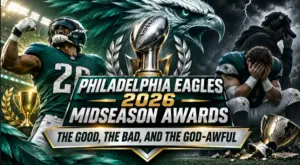
Bleed Green Sports recently published its Philadelphia Eagles 2026 Midseason Awards, recognizing the players, coaches, and executives responsible for Philadelphia’s spectacular collapse. Now we’re expanding that evaluation to all 32 NFL franchises.
Our awards recognize legitimate excellence, unexpected success, extraordinary disappointment, and the people responsible for decisions that should probably require a written explanation to ownership. We’ll finish with our unofficial Bleed Green Sports awards, including a new honor recognizing a particularly special form of executive resilience.
These selections reflect the 2026 season through Sunday’s Week 11 games on November 22, with Cincinnati’s Monday night game against Washington still pending.
The Great: Traditional NFL Awards
Most Valuable Player
Winner: Joe Burrow, Cincinnati Bengals
Runner-Up: Brock Purdy, San Francisco 49ers
Joe Burrow has been the NFL’s best quarterback through the first half of the season, combining extraordinary statistical production with the efficiency necessary to turn Cincinnati into a legitimate championship contender. Through nine games, Burrow has thrown for 2,795 yards and 27 touchdowns against only six interceptions, placing him on a pace that would produce one of the most impressive passing seasons in recent memory.
The most encouraging development has been his ability to operate within a more balanced offense. Cincinnati’s improved defense and running game have reduced the need for Burrow to carry every possession, allowing him to dictate games instead of repeatedly rescuing them.
Brock Purdy receives runner-up honors after guiding San Francisco to a 9-1 record despite significant injuries throughout the roster. Purdy’s production and command of Kyle Shanahan’s offense deserve considerable credit, although Burrow’s individual performance gives him the advantage.
Offensive Player of the Year
Winner: Jahmyr Gibbs, Detroit Lions
Runner-Up: Joe Burrow, Cincinnati Bengals
Jahmyr Gibbs has become one of the NFL’s most dangerous offensive players, combining explosive rushing ability with the receiving skills necessary to threaten defenses from virtually any alignment. Through ten games, Gibbs has accumulated approximately 1,500 yards from scrimmage and 15 touchdowns, production that places him on a historic pace.
His value extends beyond traditional statistics because opposing defenses must account for his speed and versatility on every snap. Detroit’s offense can attack through the middle, stretch the field horizontally, and create explosive plays without depending entirely on quarterback Jared Goff.
Burrow receives runner-up recognition for his extraordinary passing production, although giving Gibbs this award allows us to recognize the league’s most dynamic non-quarterback offensive weapon.
Defensive Player of the Year
Winner: Will Anderson Jr., Houston Texans
Runner-Up: Greg Rousseau, Buffalo Bills
Will Anderson Jr. has remained one of the NFL’s most complete defensive players despite Houston’s disappointing season. His combination of pass-rushing ability, physicality against the run, and relentless effort has made him the foundation of a defense that has struggled collectively to match its preseason reputation.
Anderson consistently commands attention from opposing offensive lines, and his impact extends beyond sacks. His ability to disrupt blocking assignments and generate unfavorable situations for opposing quarterbacks makes him deserving of recognition regardless of Houston’s record.
Greg Rousseau receives runner-up honors for his outstanding performance in Buffalo. His combination of pressure generation and defensive versatility has been instrumental in helping the Bills remain among the NFL’s elite teams.
Offensive Rookie of the Year
Winner: Denzel Boston, Cleveland Browns
Runner-Up: KC Concepcion, Cleveland Browns
Cleveland’s rookie receiving combination has become one of the most encouraging developments of the 2026 season. Denzel Boston earns the award for his ability to produce explosive plays, win contested catches, and provide a dependable receiving target for Deshaun Watson.
Boston entered the NFL with questions about how quickly his physical skills would translate into professional production. He has answered those concerns while helping transform a Browns passing attack that desperately needed additional playmakers.
KC Concepcion earns runner-up honors because of his versatility and consistency. Cleveland deserves considerable credit for selecting two receivers who have made meaningful contributions immediately, giving the organization a young offensive foundation that could remain productive for years.
Defensive Rookie of the Year
Winner: Arvell Reese, New York Giants
Runner-Up: David Bailey, New York Jets
Arvell Reese has immediately established himself as one of the NFL’s most versatile young defenders. His ability to rush the passer, defend the run, and contribute in coverage has made him an important part of New York’s defensive improvement.
Reese’s physical tools were evident before the draft, but his ability to translate those attributes into immediate production has exceeded reasonable rookie expectations. His performances have been impressive enough to place him in conversations extending beyond Defensive Rookie of the Year.
David Bailey receives runner-up honors after becoming one of the Jets’ most productive pass rushers. Bailey’s early success suggests New York has identified a legitimate long-term defensive building block, even if the organization’s collective performance has provided little else to celebrate.
Coach of the Year
Winner: Kyle Shanahan, San Francisco 49ers
Runner-Up: John Harbaugh, New York Giants
Kyle Shanahan has guided San Francisco to a 9-1 record while navigating a remarkable collection of injuries to important offensive and defensive players. The 49ers have continued executing at a high level despite repeatedly adjusting personnel, demonstrating the value of an established system and an experienced coaching staff.
Shanahan deserves particular credit for maintaining offensive production while working around injuries to his receiving corps. The consistency of San Francisco’s preparation and execution has separated the organization from teams that use injuries as a permanent explanation for poor results.
John Harbaugh earns runner-up honors for helping transform the Giants into legitimate playoff contenders. His first season in New York has demonstrated the value of experienced leadership, especially for an organization that entered 2026 with considerable uncertainty.
Comeback Player of the Year
Winner: Patrick Mahomes, Kansas City Chiefs
Runner-Up: Fred Warner, San Francisco 49ers
Patrick Mahomes suffered torn ACL and LCL ligaments in December 2025, creating legitimate questions about his availability and effectiveness entering the 2026 season. His return has been remarkable, particularly considering the difficulty of recovering from major knee surgery while maintaining the mobility and improvisational skills that have defined his career.
Mahomes has helped restore Kansas City to championship contention while adjusting his playing style to accommodate the physical realities of his recovery. His performance has demonstrated the combination of preparation, discipline, and competitive ability that makes him one of the greatest quarterbacks of his generation.
Fred Warner receives runner-up honors after recovering from the serious ankle injury that ended his 2025 season. Warner has returned to performing at an elite level, helping anchor San Francisco’s defense despite the injuries surrounding him.
There is, however, a significant omission from the prevailing Comeback Player discussion.
Joe Burrow should win this award. He missed more than half of the 2025 season and has returned to MVP-caliber form in 2026. Nevertheless, the prevailing awards narrative has largely excluded him from serious consideration, perhaps because he returned late last season, earned a Pro Bowl selection, and has already won Comeback Player of the Year twice. Bleed Green Sports disagrees with that omission, but we’ll follow the established field of contenders and leave Burrow off our ballot as well.
Breakout Player of the Year
Winner: Matthew Golden, Green Bay Packers
Runner-Up: Dallas Turner, Minnesota Vikings
Matthew Golden has emerged as a legitimate receiving weapon in Green Bay, providing the explosiveness and production expected from a player with his considerable physical talent. His development has helped expand the Packers’ offensive possibilities and made him increasingly important to their long-term plans.
Golden’s emergence has been especially encouraging because young receivers frequently struggle to establish consistency within complicated NFL passing systems. His progress suggests that Green Bay has identified another player capable of becoming a foundational part of its offense.
Dallas Turner earns runner-up honors for developing into a disruptive defensive presence in Minnesota. His improved production reflects the combination of physical talent and technical development necessary to become a dependable NFL pass rusher.
Assistant Coach of the Year
Winner: Brian Flores, Minnesota Vikings
Runner-Up: Patrick Graham, Pittsburgh Steelers
Brian Flores has constructed one of the NFL’s most difficult defensive systems to prepare against. Minnesota’s aggressive approach, unpredictable pressure packages, and disciplined execution have repeatedly forced opposing offenses into uncomfortable situations.
Flores deserves credit for developing a defense that succeeds through collective execution while maximizing the abilities of several talented individual players. His unit has remained among the league’s strongest defenses despite the weekly adjustments required to confront different offensive systems.
Patrick Graham receives runner-up honors for improving Pittsburgh’s defense and restoring its ability to pressure opposing quarterbacks. His work has helped keep the Steelers competitive despite an offense that has struggled to produce consistent results.
Executive of the Year
Winner: John Lynch, San Francisco 49ers
Runner-Up: Brandon Beane, Buffalo Bills
John Lynch deserves recognition for constructing a roster capable of surviving significant injuries without experiencing the collapse that frequently accompanies the loss of important starters. San Francisco’s depth, veteran acquisitions, and developing younger players have allowed Shanahan to maintain a championship-caliber operation.
The acquisition of Mike Evans has provided another valuable offensive weapon, while the organization’s broader personnel strategy has helped compensate for injuries throughout the lineup. Building a strong starting roster matters, but constructing one that remains competitive when multiple starters disappear is an entirely different accomplishment.
Brandon Beane receives runner-up recognition for strengthening Buffalo’s roster through targeted acquisitions and defensive adjustments. His work has helped keep the Bills in championship contention while addressing weaknesses that previously limited the organization.
The Good: Excellence Beyond the Traditional Awards
Most Surprising Team
Winner: Cleveland Browns
Runner-Up: New York Giants
The Cleveland Browns have become one of the NFL’s most unexpected success stories. After years of quarterback uncertainty, expensive mistakes, and organizational instability, Cleveland has emerged as a legitimate playoff contender behind Todd Monken, Deshaun Watson, and an impressive collection of young talent.
The Browns’ success is particularly remarkable because the organization entered the season facing substantial skepticism about its offensive direction. Instead, Watson has provided important late-game performances while rookies Denzel Boston and KC Concepcion have immediately strengthened the receiving corps.
The Giants receive runner-up honors for their dramatic improvement under John Harbaugh. New York has moved from another anticipated rebuilding season into meaningful playoff contention, demonstrating how quickly competent coaching and productive young players can change an organization’s trajectory.
Most Improved Team
Winner: Cincinnati Bengals
Runner-Up: New York Giants
Cincinnati entered the season needing more than another extraordinary performance from Joe Burrow. The Bengals required significant defensive improvement, greater consistency, and a roster capable of winning games without asking their quarterback to manufacture a miracle every Sunday.
The acquisition of Dexter Lawrence II has helped transform the defensive front, while improvements elsewhere have allowed Cincinnati to become a more balanced football team. Burrow remains the centerpiece, but the organization is finally providing him with the support necessary to compete consistently against elite opponents.
The Giants receive runner-up recognition for their considerable improvement under Harbaugh. Their emergence has been one of the clearest examples of how coaching changes and young defensive talent can accelerate organizational progress.
Biggest Overachiever
Winner: Brock Purdy, San Francisco 49ers
Runner-Up: Matthew Golden, Green Bay Packers
Brock Purdy continues demonstrating that his value cannot be adequately explained by the talent surrounding him. San Francisco’s injuries have forced him to operate with changing personnel, yet his production and decision-making have remained central to the team’s success.
Purdy has become increasingly comfortable controlling Shanahan’s offense, identifying defensive weaknesses, and executing without requiring ideal circumstances. At some point, consistent success under difficult conditions deserves recognition beyond describing him as the beneficiary of a successful system.
Matthew Golden earns runner-up honors for exceeding expectations in Green Bay. His development has given the Packers an important offensive weapon while establishing him as one of the league’s most encouraging emerging players.
Best Bargain
Winner: Cameron Thomas, Atlanta Falcons
Runner-Up: Kalif Raymond, Chicago Bears
Cameron Thomas represents the type of free-agent acquisition every organization claims to prioritize but relatively few consistently identify. Atlanta signed Thomas to an inexpensive one-year agreement, and he responded by becoming a productive defensive contributor whose performance has substantially exceeded the financial commitment.
Thomas has provided pass-rushing production and dependable availability at a fraction of the price commanded by many established veterans. His success illustrates the importance of identifying players whose potential contributions exceed their market value.
Kalif Raymond receives runner-up honors for providing Chicago with useful receiving production on a relatively modest contract. Neither acquisition required a franchise-altering financial commitment, yet both have delivered returns that several much more expensive signings have failed to match.
Best Position Group
Winner: Detroit Lions Offensive Line
Runner-Up: Minnesota Vikings Linebackers
Detroit’s offensive line remains one of the NFL’s strongest units and a central reason the Lions continue producing explosive offensive performances. The combination of physical run blocking, effective protection, and experienced leadership has helped create favorable conditions for Jahmyr Gibbs and Jared Goff.
Penei Sewell remains the centerpiece of a group that has established itself among the league’s elite. Detroit’s ability to control the line of scrimmage has allowed its offense to dictate games rather than consistently react to defensive pressure.
Minnesota’s linebackers receive runner-up recognition for their importance within Brian Flores’ defensive system. Their versatility and ability to execute multiple responsibilities have been essential to the Vikings’ success.
Best Free Agent Signing
Winner: Mike Evans, San Francisco 49ers
Runner-Up: Nakobe Dean, Las Vegas Raiders
Mike Evans has demonstrated why San Francisco considered him an important addition despite his age. The veteran receiver has provided reliable production, physicality, and an established red-zone presence while helping an injury-depleted receiving corps remain effective.
Evans’ value extends beyond his receptions and touchdowns because his experience allows him to operate efficiently within Shanahan’s system. He has provided Purdy with a dependable target while contributing to an offense that continues performing among the NFL’s best.
Nakobe Dean receives runner-up honors for his defensive contributions in Las Vegas. His signing has provided the Raiders with a productive linebacker capable of making an impact despite the organization’s broader inconsistencies.
Best Trade
Winner: Cincinnati Bengals Acquire Dexter Lawrence II
Runner-Up: Philadelphia Eagles – The A.J. Brown Trade
Cincinnati’s acquisition of Dexter Lawrence II has been one of the most important moves of the offseason. The Bengals needed to improve their defensive front, and Lawrence has provided the interior disruption, physical presence, and experience necessary to address a longstanding weakness.
His arrival has helped create a more balanced roster around Burrow, allowing Cincinnati to compete without depending entirely on its offense. The investment has produced immediate value in the area where the organization most desperately needed improvement.
Philadelphia receives runner-up recognition for trading A.J. Brown to New England in exchange for a 2028 first-round selection and a 2027 fifth-round pick. Brown’s disappointing production and availability in New England have strengthened the argument that the Eagles received valuable future assets while avoiding additional investment in an increasingly complicated relationship.
Best Draft Class
Winner: Cleveland Browns
Runner-Up: New York Giants
Cleveland earns another award for selecting a rookie class that has immediately contributed to the organization’s improvement. Denzel Boston and KC Concepcion have become legitimate offensive weapons, providing the Browns with young receiving talent capable of supporting the offense well beyond the current season.
The remarkable aspect of Cleveland’s draft is the immediate return on its investment. Young players frequently require extended development before becoming meaningful contributors, yet the Browns have received substantial production while competing for a playoff position.
The Giants receive runner-up honors behind the defensive excellence of Arvell Reese and contributions from their other young players. New York’s rookie development has helped accelerate the organization’s improvement under Harbaugh.
The God-Awful: Disappointments, Disasters, and Bad Investments
Most Disappointing Team
Winner: Philadelphia Eagles
Runner-Up: Houston Texans
The Philadelphia Eagles entered 2026 with championship expectations, an expensive roster, and an organization convinced that its aggressive personnel strategy could sustain another championship run. Instead, Philadelphia lost seven consecutive games, benched Jalen Hurts, struggled through multiple quarterback changes, and entered its bye week with a 2-7 record.
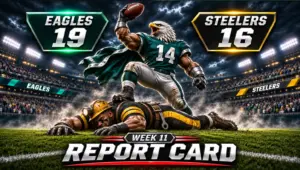
The Eagles finally ended their losing streak with a 19-16 victory over Pittsburgh, but one victory cannot erase the problems that produced two months of organizational embarrassment. Philadelphia’s offensive failures, disappointing acquisitions, and questionable coaching decisions have made the team the NFL’s biggest disappointment relative to expectations.
Houston receives runner-up honors after entering the season with legitimate championship aspirations. The Texans have received outstanding individual performances from Will Anderson Jr. and others, yet their collective results have fallen considerably short of the standard expected from their roster.
Most Regressed Team
Winner: Los Angeles Chargers
Runner-Up: Philadelphia Eagles
The Chargers entered 2026 expecting Jim Harbaugh and newly hired offensive coordinator Mike McDaniel to improve an already competitive team. Instead, Los Angeles opened the season with eight consecutive losses, while Justin Herbert’s performance deteriorated within an offensive system that appeared increasingly incompatible with its personnel.
The team’s struggles have been particularly alarming because the organization invested heavily in building around Herbert. The combination of turnovers, ineffective protection, and inconsistent offensive execution has transformed a presumed contender into one of the league’s most dysfunctional operations.
Philadelphia receives runner-up honors for its dramatic decline from championship expectations. The Eagles’ regression has exposed problems throughout the organization, although their Week 11 victory at least prevented the losing streak from reaching eight games.
Biggest Underachiever
Winner: Justin Herbert, Los Angeles Chargers
Runner-Up: Cam Ward, Tennessee Titans
Justin Herbert entered the season with expectations of becoming an elite quarterback under Mike McDaniel’s direction. Instead, his performance has been defined by turnovers, ineffective offensive execution, and an inability to consistently overcome the weaknesses surrounding him.
Herbert’s physical talent remains obvious, but the results have fallen dramatically short of what Los Angeles expected from its most important player. Coaching and protection failures deserve substantial responsibility, although an established franchise quarterback cannot be entirely insulated from criticism when the offense performs this poorly.
Cam Ward receives runner-up honors after another disappointing stretch in Tennessee. Ward has struggled to establish the consistency expected from a highly regarded young quarterback, although the organization’s broader problems have made his development considerably more difficult.
Biggest Bust
Winner: Jonathan Greenard, Philadelphia Eagles
Runner-Up: John Franklin-Myers, Tennessee Titans
Jonathan Greenard represents one of Philadelphia’s most expensive offseason disappointments. The Eagles surrendered draft capital to acquire him from Minnesota and subsequently agreed to a four-year, $100 million extension, including a reported $50 million fully guaranteed.
Greenard managed only one sack through Philadelphia’s first nine games, a remarkably poor return for a player acquired to strengthen the team’s pass rush. He has shown improvement, including another sack against Pittsburgh in Week 11, but his overall production remains substantially below the expectations created by the organization’s investment.
John Franklin-Myers receives runner-up honors for failing to provide Tennessee with the defensive impact expected from his signing. His disappointing return illustrates how quickly an expensive veteran acquisition can become another problem for an already struggling organization.
Worst Position Group
Winner: Dallas Cowboys Secondary
Runner-Up: Philadelphia Eagles Offensive Line
Dallas has struggled to establish dependable pass coverage, repeatedly placing its defense in unfavorable situations. The secondary’s inconsistency has undermined the Cowboys’ ability to control opposing passing attacks and contributed to a season in which defensive mistakes have frequently placed additional pressure on the offense.
Philadelphia’s offensive line receives runner-up honors because of its dramatic decline from the standard established in previous seasons. The Eagles have struggled with protection, injuries, and inconsistent blocking despite retaining talented veterans, with Jordan Mailata providing one of the few dependable individual performances.
Worst Free Agent Signing
Winner: Hollywood Brown, Philadelphia Eagles
Runner-Up: John Franklin-Myers, Tennessee Titans
Philadelphia signed Hollywood Brown expecting him to provide an experienced receiving threat capable of complementing DeVonta Smith and strengthening the offense following A.J. Brown’s departure. Instead, Brown contributed little meaningful production before the Eagles waived him on November 13.
The failure was particularly damaging because Philadelphia needed dependable receiving options while navigating quarterback instability and an offense that struggled to generate consistent production. Brown failed to provide the veteran reliability expected from his signing, making his departure another reminder of the organization’s unsuccessful offseason.
John Franklin-Myers receives runner-up honors because Tennessee committed substantial resources to a defensive player who has failed to deliver the expected impact. Both acquisitions illustrate the risks of paying veterans for anticipated production that never materializes.
Worst Trade
Winner: Philadelphia Eagles Acquire Jonathan Greenard
Runner-Up: New England Patriots Acquire A.J. Brown
Philadelphia wins this award because the Greenard transaction combined disappointing production with a significant financial commitment and the surrender of valuable draft capital. The Eagles acquired a veteran expected to improve their pass rush, then extended him at a price that assumed consistent high-level production.
The result has been one of the offseason’s most disappointing investments. Philadelphia’s decision has reduced future flexibility while providing limited immediate improvement, and the organization’s broader roster problems make the opportunity cost especially damaging.
New England receives runner-up honors for acquiring A.J. Brown from Philadelphia. The Patriots surrendered a first-round pick and additional compensation for a receiver whose production and availability have fallen short of expectations, creating an uncomfortable comparison with the future assets Philadelphia received.
Worst Draft Class
Winner: Philadelphia Eagles
Runner-Up: Los Angeles Rams
Philadelphia invested eight selections in the 2026 NFL Draft, hoping to replenish an expensive veteran roster with younger, less costly talent. Instead, most of the class has provided little immediate assistance, leaving Makai Lemon and Markel Bell among the few rookies who have offered encouraging contributions.
Lemon has emerged as a productive receiver despite the team’s offensive difficulties, while Bell has demonstrated improvement after being forced into significant playing time. Those individual developments have been insufficient to compensate for the limited contributions elsewhere in the class.
The Rams receive runner-up consideration for failing to produce the immediate return expected from their rookie investment. Their veteran roster and championship ambitions increase the importance of finding inexpensive contributors through the draft.
Worst Contract
Winner: Jalen Hurts, Philadelphia Eagles
Runner-Up: Jonathan Greenard, Philadelphia Eagles
Jalen Hurts’ contract has become one of the most complicated financial problems facing Philadelphia. The organization committed substantial guaranteed money to a quarterback whose performance has deteriorated, leaving the Eagles evaluating their future while carrying significant financial obligations.
As Bleed Green Sports examined in Why the Eagles Will Release Jalen Hurts, the decision extends beyond determining whether Hurts can return to his previous level of play. The organization must evaluate future cash commitments, salary-cap consequences, and the opportunity cost of retaining a quarterback whose role has become increasingly uncertain.
Jonathan Greenard receives runner-up honors because Philadelphia extended him at a premium price before receiving the expected production. The Eagles have managed to place two of their most troubling financial commitments on the same roster, an impressive accomplishment for an organization that prides itself on sophisticated contract management.
Worst Coordinator
Winner: Mike McDaniel, Los Angeles Chargers
Runner-Up: Sean Mannion, Philadelphia Eagles
Mike McDaniel arrived in Los Angeles with a reputation for offensive creativity and the expectation that he could elevate Justin Herbert into the league’s elite tier of quarterbacks. Instead, the Chargers’ offense has struggled with turnovers, ineffective execution, and an inability to generate consistent production.
The failure is especially troubling because McDaniel was hired specifically to address offensive weaknesses. Los Angeles has received results that frequently compare unfavorably with the system it replaced, raising legitimate questions about the decision to make such a significant change.
Sean Mannion receives runner-up honors after struggling in his first season directing Philadelphia’s offense. Bleed Green Sports questioned the decision before the season in The Mannion Honeymoon Is Over!, and the subsequent results have reinforced those concerns.
Worst Head Coach
Winner: Jim Harbaugh, Los Angeles Chargers
Runner-Up: Nick Sirianni, Philadelphia Eagles
Jim Harbaugh entered 2026 with an established reputation for rebuilding football programs and creating disciplined, competitive teams. Instead, the Chargers have become one of the NFL’s greatest disappointments, opening 0-8 and struggling to establish any consistent offensive identity.
Harbaugh’s decision to retain Mike McDaniel’s play-calling responsibilities despite mounting offensive failures has added to the criticism. The organization has continued producing disappointing results while repeating many of the same mistakes, raising serious questions about Harbaugh’s ability to correct the situation.
Nick Sirianni receives runner-up honors for overseeing Philadelphia’s seven-game losing streak and the collapse of an offense expected to compete for another championship. Sirianni has repeatedly accepted responsibility for the team’s failures, although meaningful corrections have been considerably more difficult to identify.
Worst GM Decision
Winner: Howie Roseman, Philadelphia Eagles
Runner-Up: Joe Hortiz, Los Angeles Chargers
Howie Roseman earns this award for constructing a roster whose financial commitments and individual reputations have substantially exceeded its collective production. The Greenard acquisition, disappointing veteran signings, and limited immediate impact from the draft have left Philadelphia facing difficult decisions about its future.
Roseman’s situation is especially concerning because many of the organization’s problems were created through deliberate investments in experienced players. The Eagles committed significant resources expecting immediate championship contention and instead produced a team that entered its bye week with only two victories.
Joe Hortiz receives runner-up honors for the Chargers’ disappointing roster construction and offseason offensive decisions. Los Angeles entered the year expecting improvement, yet the organization has failed to provide the environment necessary for Herbert to succeed.
The Official Bleed Green Sports Awards
The traditional awards recognize outstanding players, coaches, and executives. However, the 2026 season has also provided extraordinary examples of questionable judgment, misplaced optimism, and leadership that deserves recognition for reasons that probably will not appear on an official NFL awards ballot.
These are the Bleed Green Sports awards, recognizing the people and organizations that have made the season memorable in ways they probably never intended.
The “We Won the Offseason!” Award
Winner: Philadelphia Eagles
Runner-Up: Los Angeles Chargers
Philadelphia entered the season celebrating another aggressive offseason filled with veteran acquisitions, contract maneuvering, and expectations of championship contention. The front office assembled a roster that looked impressive on paper, although the actual football games have provided substantially less favorable evidence.
The Eagles’ expensive acquisitions and disappointing draft contributions have produced a remarkable gap between expectations and results. Philadelphia managed to turn an offseason filled with optimism into a regular season that has required extensive explanations from practically everyone involved.
The Chargers receive runner-up honors for entering 2026 convinced that Mike McDaniel would transform Justin Herbert’s offense. The transformation certainly occurred, although Los Angeles probably had a different direction in mind.
The “100% Accountable, 0% Solutions” Award
Winner: Nick Sirianni
Runner-Up: Jim Harbaugh
Nick Sirianni has demonstrated an admirable willingness to accept responsibility for Philadelphia’s failures. Unfortunately, his repeated acknowledgments have produced considerably fewer victories than press conferences, while the same offensive and organizational problems have continued appearing throughout the season.
Seven consecutive losses suggest that accountability has become an established communications strategy rather than a particularly effective method of improving football performance. Sirianni has perfected the difficult art of accepting responsibility without allowing that responsibility to produce meaningful consequences.
Jim Harbaugh receives runner-up recognition for repeatedly defending the Chargers’ offensive direction despite results that have made those defenses increasingly difficult to understand.
The “Everything Is Fine!” Award
Winner: Philadelphia Eagles
Runner-Up: Houston Texans
Philadelphia spent much of the season behaving like an organization convinced that its championship reputation would eventually overcome its increasingly obvious problems. The team changed quarterbacks, struggled to establish offensive consistency, and watched expensive acquisitions deliver disappointing returns while insisting that improvement remained possible.
The Eagles finally won their third game in Week 11, providing enough encouragement to delay the most uncomfortable conversations for another several days. One victory has become an extraordinarily valuable public relations resource for an organization that entered the season expecting approximately a dozen more.
Houston receives runner-up recognition for its own disappointing season. The Texans entered with championship expectations and have spent much of the year attempting to reconcile those expectations with the standings.
The “Most Expensive Paperweight” Award
Winner: Jalen Hurts
Runner-Up: Jonathan Greenard
Jalen Hurts has become an unusually expensive reminder that guaranteed money and guaranteed performance are entirely different concepts. Philadelphia’s quarterback situation has changed dramatically, yet the financial commitments associated with Hurts continue influencing the organization’s future decisions.
His contract represents a substantial investment whose remaining value has become increasingly difficult to justify. The Eagles must now determine how to manage their quarterback position without allowing previous financial decisions to dictate future personnel evaluations.
Jonathan Greenard receives runner-up recognition for his own costly contract. At least Greenard has recently contributed sacks, providing some evidence that Philadelphia’s investment might eventually produce something more valuable than accounting complications.
The “The Cap Is Just a Number” Award
Winner: Howie Roseman
Runner-Up: Les Snead
Howie Roseman has built a reputation for understanding the NFL salary cap and creating financial flexibility through complicated contract structures. Unfortunately, the ability to distribute accounting charges across future seasons does little to improve the value of expensive players who fail to perform.
Philadelphia’s growing collection of questionable commitments has created significant challenges for an organization that must improve several positions simultaneously. Creative accounting remains useful, although football games continue insisting that the players receiving the money should occasionally justify their compensation.
Les Snead receives runner-up honors for the Rams’ aggressive approach to acquiring established talent. Los Angeles has repeatedly demonstrated a willingness to sacrifice future assets for immediate improvement, a strategy that becomes particularly expensive when injuries prevent those investments from delivering their intended value.
The “Trust the Process, Again” Award
Winner: New York Jets
Runner-Up: Tennessee Titans
The New York Jets have once again provided their fans with an opportunity to embrace the future, a destination that has remained considerably more appealing than the present for much of the organization’s recent history. Another season of inconsistent performance has placed additional emphasis on young talent, player development, and the next opportunity to rebuild.
The Jets have identified promising contributors such as David Bailey, providing some legitimate reasons for optimism. Unfortunately, the broader organizational results suggest that rebuilding remains less a temporary strategy than a recurring institutional tradition.
Tennessee receives runner-up recognition for another season defined by quarterback uncertainty, disappointing acquisitions, and the familiar promise that future personnel decisions will eventually solve the organization’s problems.
The “We’re Just One Player Away” Award
Winner: Dallas Cowboys
Runner-Up: Philadelphia Eagles
Dallas continues demonstrating the remarkable ability to maintain expectations of championship contention while carrying significant weaknesses throughout the roster. The organization has enough recognizable talent to encourage optimism, although its results have repeatedly exposed problems that require considerably more than one additional player.
The Cowboys’ defensive struggles have been particularly damaging, creating situations where the offense must compensate for failures elsewhere. Addressing those weaknesses will require organizational discipline and effective personnel decisions, two qualities that have not consistently defined Dallas in recent seasons.
Philadelphia receives runner-up honors because the Eagles entered 2026 believing another collection of veteran acquisitions would sustain championship contention. Their experience has demonstrated that expensive additions cannot automatically compensate for declining performance and ineffective coaching.
The “I’m Too Old for This Shit” Award
Winner: Andy Reid, Kansas City Chiefs
Runner-Up: Vic Fangio, Philadelphia Eagles
Andy Reid has spent decades developing quarterbacks, designing offenses, and building successful football teams. After watching Patrick Mahomes suffer a devastating knee injury in 2025, Reid entered the new season facing the challenge of rebuilding a contender around a quarterback still recovering from major surgery.
Fortunately, Kansas City’s resurgence has provided encouraging evidence that Reid’s experience remains valuable. Nevertheless, the physical demands of another championship pursuit must occasionally make retirement sound like an attractive opportunity to spend more time eating cheeseburgers without being asked about defensive coverages.
Vic Fangio receives runner-up recognition for spending another season attempting to solve Philadelphia’s personnel problems. After decades of coaching defense, Fangio probably expected his greatest challenge to involve sophisticated offensive schemes rather than repeatedly explaining why expensive veterans cannot execute basic responsibilities.
The “I’m Too Young for This Shit” Award
Winner: Sean Mannion, Philadelphia Eagles
Runner-Up: Jesse Minter, Baltimore Ravens
Sean Mannion received responsibility for coordinating an offense expected to compete for a championship despite having no previous experience as an NFL offensive coordinator. His first season has featured multiple quarterbacks, ineffective blocking, frustrated veterans, and an increasingly hostile evaluation from Philadelphia’s fan base.
Mannion’s introduction to the profession has provided an accelerated education in the challenges of leading an NFL offense. Unfortunately, his classroom has been filled with established players, complicated contracts, and an organization that expected immediate success rather than an extended apprenticeship.
Jesse Minter receives runner-up recognition after confronting significant challenges during his first season leading Baltimore. The Ravens’ disappointing results have provided another example of how quickly an exciting coaching opportunity can become an exercise in crisis management.
The “We Watched the Tape” Award
Winner: Jim Harbaugh
Runner-Up: Nick Sirianni
Jim Harbaugh has demonstrated extraordinary faith in the idea that another week of film evaluation will eventually reveal solutions to the Chargers’ offensive problems. Unfortunately, the same turnovers, protection breakdowns, and ineffective execution have continued appearing regardless of how extensively those mistakes are examined.
Los Angeles has provided enough disappointing footage to sustain an entire offseason of additional study. At some point, the organization may discover that the most important lesson from watching the tape is recognizing that its current approach has failed to produce acceptable results.
Nick Sirianni receives runner-up honors because Philadelphia has repeatedly encountered similar problems without consistently correcting them. The Eagles have certainly generated enough material for extensive film sessions, even if the results have rarely suggested that those sessions were particularly productive.
The “I’m Not Fired Yet!” Award
Winner: Aaron Glenn, New York Jets
Runner-Up: Jim Harbaugh, Los Angeles Chargers
Aaron Glenn receives recognition for maintaining his position despite another season of disappointing results and organizational uncertainty. The Jets have struggled to establish consistent performance, leaving their head coach responsible for explaining why another rebuilding effort has produced limited immediate progress.
Glenn’s continued employment provides valuable evidence that some NFL organizations remain capable of extraordinary patience. Whether that patience eventually produces improvement remains uncertain, although the Jets have already demonstrated an impressive tolerance for disappointing football.
Jim Harbaugh receives runner-up honors for surviving the Chargers’ disastrous start. His established reputation continues providing some protection from the consequences of a season that would place many less accomplished coaches under immediate pressure.
The “Saturdays Are Better Than Sundays” Award
Winner: Los Angeles Chargers
Runner-Up: Tennessee Titans
For Chargers fans, Saturday afternoons have become increasingly attractive because college football provides an opportunity to imagine the players who might eventually rescue their franchise. Sunday’s games have offered substantially fewer reasons for optimism, particularly during Los Angeles’ eight-game losing streak to open the season.
The prospect of adding talented young players is encouraging, although the Chargers already possess enough established talent to make their performance especially frustrating. A successful draft might improve the roster, but the organization must also determine how to maximize the players already under contract.
Tennessee receives runner-up recognition because its disappointing season has created another opportunity to begin studying draft prospects before Thanksgiving.
The “Please Stop Putting Us on National Television” Award
Winner: Philadelphia Eagles
Runner-Up: Los Angeles Chargers
The Philadelphia Eagles entered 2026 expecting to showcase a championship contender in front of national audiences. Instead, the organization has repeatedly provided viewers with struggling quarterbacks, ineffective offensive possessions, and enough disappointing execution to make commercial breaks feel like welcome entertainment.
Philadelphia’s extended losing streak transformed national appearances into public examinations of the team’s failures. The defense has provided occasional encouragement, but the offense has frequently made even routine first downs seem like accomplishments worthy of a commemorative ceremony.
Los Angeles receives runner-up recognition because the Chargers have similarly transformed high-profile opportunities into reminders that preseason expectations and regular-season competence are not necessarily connected.
The “Someone Has to Win This Division” Award
Winner: NFC East
Runner-Up: AFC South
The NFC East has provided one of the NFL’s most entertaining examples of competitive mediocrity. While the Giants have emerged as an encouraging surprise, Philadelphia’s collapse, Dallas’ inconsistencies, and Washington’s difficulties have created a division where simply avoiding prolonged incompetence can become a competitive advantage.
The division entered the year with expectations of multiple playoff contenders, yet its results have repeatedly demonstrated how quickly those assumptions can disappear. Somebody will eventually receive a division championship banner, even if several teams appear determined to make that accomplishment as difficult as possible.
The AFC South receives runner-up honors for its own collection of inconsistent performances and disappointing expectations. The division has provided enough uncertainty to keep the playoff race interesting, although several organizations would probably prefer a little less excitement.
The Jensen Huang Award
The Jensen Huang Award recognizes a male executive or leader who has demonstrated extraordinary resilience in overcoming personal controversy, intense media scrutiny, and public outrage while successfully maintaining his position of leadership. It celebrates the remarkable ability to navigate adversity, preserve professional standing, and emerge with his career remarkably unaffected.
Winner: Mike Vrabel, New England Patriots
Mike Vrabel demonstrated an extraordinary commitment to the personal and professional well-being of NFL reporter Dianna Russini. Recognizing the pressures of modern sports journalism, Vrabel generously made himself available for what we can only describe as an exclusive, hands-on personal counseling retreat at a luxurious Arizona resort. While most NFL coaches limit their interactions with reporters to press conferences and occasional telephone calls, Vrabel apparently believes that meaningful professional relationships require a more personal touch.
Unfortunately, the media interpreted his dedication to supporting a colleague rather differently. Russini eventually resigned from her position at The Athletic, while Vrabel courageously continued coaching the Patriots. His willingness to carry on despite the tremendous burden of remaining employed makes him a deserving recipient of this prestigious award.
Runner-Up: Jed York, San Francisco 49ers
Jed York demonstrated that even billionaire NFL owners never forget their roots. Returning to his childhood home state of Ohio, York apparently decided that charitable contributions were more meaningful when delivered personally to individual members of the community. Rather than establish another tax-deductible foundation, he traveled to a mobile home community in East Palestine with $160 in cash, prepared to stimulate the local economy one resident at a time.
Unfortunately, local law enforcement failed to appreciate his unconventional approach to community outreach. What should have been celebrated as an inspiring example of grassroots philanthropy became a regrettable misunderstanding involving an undercover operation, misdemeanor charges, and a courtroom. The NFL subsequently provided York with a six-game opportunity to reflect on his charitable ambitions, accompanied by a $500,000 administrative contribution to the league.
Nevertheless, York’s commitment to maintaining his ownership position has remained unwavering, proving that true leadership begins with helping those closest to home.
Honorable Mention: Kyle Shanahan, San Francisco 49ers
Kyle Shanahan deserves recognition for his enthusiastic embrace of California tourism. During a leisurely July drive through Palo Alto, Shanahan apparently decided that the best way to appreciate the local scenery was to explore the city from an entirely new perspective. Unfortunately, his impromptu sightseeing excursion became considerably more interactive than anticipated when he reached down for a misplaced cellphone and collided with another vehicle.
The ensuing experience provided an unexpected opportunity to appreciate Palo Alto’s emergency services, medical facilities, and administrative procedures. The 49ers even afforded the public an 11-day period of quiet reflection before announcing the accident, while an unfortunate clerical error initially assigned responsibility to the other driver.
Shanahan eventually accepted responsibility for the collision, demonstrating the admirable leadership qualities that make him worthy of honorable mention. His ability to return to coaching while navigating the aftermath of an unexpectedly comprehensive tour of Palo Alto represents precisely the resilience this award was created to recognize.
Final Word: Excellence, Incompetence, and Everything in Between
The first eleven weeks of the 2026 NFL season have demonstrated that individual talent, coaching quality, and organizational decision-making remain closely connected. Cincinnati, San Francisco, Detroit, and several other contenders have benefited from productive players operating within effective systems, while Cleveland and New York have shown how quickly teams can improve when their personnel decisions begin producing results.
Elsewhere, the contrast between financial commitments and actual production has been remarkable. Philadelphia and Los Angeles entered the season expecting to compete at the highest level, yet their failures have raised serious questions about coaching, personnel management, and the organizations responsible for creating their current circumstances.
Perhaps the most encouraging development has been the emergence of young talent throughout the league. Denzel Boston, KC Concepcion, Arvell Reese, David Bailey, and Matthew Golden have provided evidence that successful drafting and player development remain among the most effective ways to construct a competitive football team.
Meanwhile, established veterans such as Joe Burrow, Jahmyr Gibbs, Patrick Mahomes, and Will Anderson Jr. have continued demonstrating the extraordinary individual performances that make the NFL worth watching, even during a season filled with disappointing teams and questionable decisions.
The second half of the season will determine which organizations can sustain their success, which disappointing teams can recover, and which coaches and executives will eventually be held accountable for their failures.
For additional context on how all 32 teams have performed, see the Bleed Green Sports Week 11 NFL Power Rankings.
And for those who have found themselves among the recipients of our less prestigious awards, there is still time to improve. In several cases, however, the most important decisions may belong to the people responsible for determining who returns in 2027.