

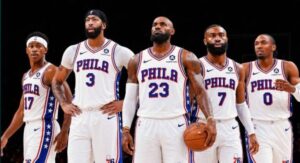


















Joel Embiid picked a particularly interesting time to remind everyone that he can still dominate an NBA basketball game. On Monday night, the former MVP delivered his best performance of the season, scoring 37 points in Philadelphia’s 135-123 victory over the Brooklyn Nets. Less than 24 hours later, news broke that Embiid had hired Bernie Lee of Thread Sports Management as his new agent.
For a player who has represented himself since 2021, the decision immediately raises eyebrows. Lee has an extensive history representing players involved in blockbuster trades, including Embiid’s former Philadelphia teammate, Jimmy Butler. The timing of Butler’s original decision to hire Lee provides an especially interesting precedent.
Jimmy Butler hired Bernie Lee on June 7, 2017. Exactly 15 days later, the Chicago Bulls traded Butler to the Minnesota Timberwolves.
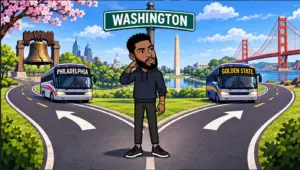
Now Embiid has hired the same agent, just one day after delivering his most impressive performance of the season and hours after Bleed Green Sports published its Anthony Davis Trade Watch, examining Philadelphia and Golden State as potential destinations for the Washington Wizards superstar.
The development creates several intriguing possibilities involving Embiid, Davis, Butler, Stephen Curry, and LeBron James. More importantly, the contracts and future draft assets controlled by these organizations provide potential foundations for three different blockbuster trade scenarios.
One Great Game and an Interesting Decision
On November 16, Embiid delivered the type of performance Philadelphia fans have been waiting to see consistently. Against Brooklyn, he finished with 37 points, five rebounds, one assist, one steal, and two blocks, shooting 13-of-22 from the field and 9-of-10 from the free-throw line in approximately 32 minutes.
According to the 76ers’ official game recap, Embiid scored 24 points in the first half and connected on an important three-pointer late in the fourth quarter to help Philadelphia secure the victory.
It was an encouraging performance for a player whose availability and declining production have generated concerns. Embiid demonstrated that he still possesses the offensive ability, physical strength, and basketball intelligence that made him the NBA’s Most Valuable Player in 2023.
Then came Tuesday’s announcement.
NBA insider Marc Stein reported that Embiid had officially hired Bernie Lee, ending his extended period of self-representation. Lee previously advised Embiid during his 2021 supermax negotiations, providing an established professional relationship between the two.
The hiring could involve future contractual matters or other business considerations. However, Embiid has already negotiated enormous contracts without formal representation, making his decision to hire an experienced agent at this particular moment especially interesting.
Bernie Lee and the Jimmy Butler Connection
Bernie Lee’s relationship with Jimmy Butler provides the most compelling historical comparison.
On June 7, 2017, Hoops Rumors reported that Butler had hired Lee after spending the previous year without an agent. Butler remained under contract with Chicago, although questions concerning his future with the Bulls had already begun circulating.
Just 15 days later, on June 22, Chicago traded Butler and the rights to Justin Patton to Minnesota in exchange for Zach LaVine, Kris Dunn, and the rights to Lauri Markkanen. The Timberwolves officially announced the acquisition the following morning.
Butler’s relationship with Lee continued through several additional moves. Minnesota traded him to Philadelphia in November 2018, where he briefly became Embiid’s teammate. Butler subsequently joined Miami in 2019 through a sign-and-trade arrangement and eventually helped the Heat reach two NBA Finals.
His most recent departure was equally dramatic. Following months of disagreements with Miami regarding his future, multiple suspensions, and a public deterioration of the relationship, Butler was traded to Golden State in February 2025.
Lee remained Butler’s representative throughout those transactions, developing considerable experience navigating difficult relationships between accomplished players and their organizations. That experience could be valuable to Embiid as Philadelphia evaluates its championship future.
Lee also represented former 76ers guard Ben Simmons, although Simmons hired him in March 2023, after Philadelphia had already traded him to Brooklyn. The distinction matters when evaluating Lee’s involvement in previous player movements.
There is currently no evidence that Embiid hired Lee to facilitate a trade, and Butler’s previous transactions involved circumstances unique to each organization. Nevertheless, the historical connection becomes particularly interesting when considering that Lee now represents two players whose enormous contracts could help facilitate a three-team blockbuster.
Why Would Joel Embiid Suddenly Need an Agent?
The most interesting aspect of Joel Embiid hiring Bernie Lee involves understanding why he would make such a decision in the first place. Embiid has spent years successfully representing himself, negotiating contracts worth hundreds of millions of dollars while maintaining control over his professional relationships. His decision to suddenly hire a full-time representative deserves closer examination, particularly considering the circumstances surrounding his current contract and Philadelphia’s championship aspirations.
The obvious explanation would involve preparing for another major contract negotiation. However, Embiid signed a three-year, $193 million extension in September 2024 that includes a player option for the 2028-29 season. His next major contractual decision remains well into the future, and there is no immediate need for a representative to negotiate another enormous extension. More importantly, Lee already advised Embiid during his 2021 supermax negotiations, demonstrating that the two can work together without maintaining a formal agent-client relationship. If Embiid needed assistance with another contract, he already had an established arrangement that worked exceptionally well.
Endorsements and other business opportunities provide another possible explanation, although that argument also has limitations. Embiid has already developed valuable commercial relationships throughout his career, including major endorsement agreements, while operating without a traditional agent. His existing business relationships and professional experience have served him successfully for years. While additional representation could certainly provide benefits, there is little publicly available evidence suggesting an immediate commercial development that would explain this particular change.
A potential trade provides a considerably more compelling explanation.
If Embiid wants to leave Philadelphia, or has been informed that the organization is considering moving him, hiring someone with Lee’s experience would make considerable sense. A blockbuster transaction involving a former MVP and nearly $60 million in annual salary would create an enormous amount of work beyond the actual basketball considerations. Multiple organizations could become involved, potential destinations would need to be evaluated, and conversations involving front offices, contractual obligations, personal preferences, and long-term financial interests could become increasingly complicated.
Embiid has dealt with enough injuries and distractions throughout his career. With Philadelphia attempting to compete for a championship, he has every reason to concentrate on staying healthy and performing at the highest possible level. Hiring Lee would allow him to delegate much of the communication, coordination, and personal negotiations associated with a possible move while NBA executives handle the actual trade agreements between teams.
Lee’s relationship with Jimmy Butler makes the decision even more intriguing. Butler hired Lee in June 2017 and was traded from Chicago just 15 days later. Lee subsequently represented Butler through additional blockbuster moves involving Minnesota, Philadelphia, Miami, and Golden State. He has extensive experience managing the professional interests of established superstars during significant changes in their careers.
Embiid knows Lee, understands his capabilities, and has already benefited from his advice. He also knows Butler personally, having shared the court with him in Philadelphia. Choosing an agent with that particular history, while potential Anthony Davis trade scenarios are already attracting attention, creates a compelling collection of circumstances.
Our assessment is that Embiid’s decision to hire Bernie Lee strongly suggests he is preparing for the possibility of being traded, and perhaps already expects it to happen. His current contract provides financial security, his established commercial relationships have served him well, and his previous arrangement with Lee demonstrates that formal representation was unnecessary for past contract negotiations.
There is no confirmed report that Embiid has requested a trade or that Philadelphia has informed him of plans to move him. Nevertheless, the timing, his existing contractual security, and Lee’s history provide substantial reasons to examine the possibility that a transaction is approaching.
If Embiid anticipates a blockbuster move involving Anthony Davis, hiring Bernie Lee would allow him to concentrate on basketball while an experienced representative manages the complicated professional circumstances surrounding his future.
Trade Scenario No. 1: Philadelphia and Washington Swap Embiid for Anthony Davis
The most straightforward possibility involves Philadelphia and Washington completing a direct exchange of their superstar big men.
Under this hypothetical arrangement, Philadelphia receives Anthony Davis, while Washington receives Joel Embiid and future draft compensation from the 76ers. A possible framework would include Philadelphia’s 2033 first-round selection, with negotiated protections, along with a 2030 first-round pick swap.
The salaries provide a relatively simple foundation. Embiid earns $58.1 million this season, while Davis earns approximately $58.46 million. The difference of roughly $357,000 creates a manageable salary-matching issue, subject to Philadelphia’s apron restrictions.
For Philadelphia, the basketball motivation centers on reuniting Davis with LeBron James. The two stars won the 2020 NBA championship together with the Los Angeles Lakers and developed an established understanding of one another’s offensive tendencies.
Davis would join a roster featuring James, Tyrese Maxey, Jaylen Brown, and VJ Edgecombe, giving Philadelphia another exceptional defensive presence while maintaining significant offensive firepower. His ability to finish around the basket, defend multiple positions, and protect the rim would complement the perimeter abilities of Maxey and Brown.
The challenge would be convincing Washington to accept Embiid’s contract and injury history.
Washington currently possesses a 33-year-old Davis who is averaging 24.5 points and 9.8 rebounds. Acquiring another expensive veteran with comparable durability concerns would provide limited financial relief, especially considering Embiid’s contract extends through a player option for 2028-29.
That makes Philadelphia’s draft compensation particularly important.
The 76ers have already surrendered substantial future draft capital, including their unprotected 2031 first-round selection in the Jaylen Brown transaction. Their 2030 and 2032 first-rounders are also restricted from outright trades by the Stepien Rule, which prevents teams from leaving themselves without first-round selections in consecutive future drafts.
However, Philadelphia retains its 2033 first-round pick and could potentially offer a 2030 pick swap. A future first-round selection that far removed from the current championship window could become particularly valuable if James retires and Philadelphia eventually enters another rebuilding period.
Washington would have to evaluate whether Embiid’s remaining productivity, combined with those future assets, provides sufficient compensation for surrendering Davis. Another consideration involves Embiid’s potential willingness to join a rebuilding organization after spending his entire NBA career in Philadelphia.
His 37-point performance against Brooklyn could make such a deal more appealing if he continues producing at an elite level. Unfortunately for trade enthusiasts, continued excellence could also convince Philadelphia that its best opportunity to win a championship involves keeping Embiid.
The direct swap offers the simplest route to bringing Davis to Philadelphia, but Washington would likely demand meaningful draft compensation for accepting Embiid’s additional long-term financial commitment.
Trade Scenario No. 2: Davis to Philadelphia, Embiid to Golden State, Butler to Washington
A three-team transaction involving Philadelphia, Golden State, and Washington could provide a more interesting solution for all three organizations.
Under this arrangement, Philadelphia receives Anthony Davis, Golden State receives Joel Embiid, and Washington receives Jimmy Butler, a smaller additional contract, and future draft compensation from the Warriors and 76ers.
Golden State would be exchanging its veteran wing for a former MVP center, allowing Stephen Curry to play alongside one of the most accomplished interior scorers of his generation. Philadelphia would reunite James and Davis, while Washington would acquire valuable draft assets and potentially create significant future financial flexibility.
Butler earns approximately $56.83 million this season, compared with Embiid’s $58.1 million. Golden State would need to include at least another $1.27 million in outgoing salary because of its position above the NBA’s first luxury-tax apron. A smaller contract, such as Will Richard’s approximately $2.2 million salary, provides one possible matching component.
That would allow the Warriors to preserve Draymond Green, Kristaps Porziņģis, Moses Moody, Brandin Podziemski, and most of their existing supporting cast.
The proposed draft compensation could involve Golden State’s 2028 and 2032 first-round selections, with protections to be negotiated, plus a 2030 first-round pick swap from Philadelphia to Washington. The precise protections and swap rights would have to account for existing obligations, including Golden State’s protected 2030 first-round commitment to Memphis.
For Washington, the primary attraction would be obtaining future draft capital from a Golden State franchise facing an uncertain future beyond Curry. The Warriors’ first-round selections could become considerably more valuable as their current core ages.
Butler’s contract adds another important consideration. The six-time All-Star is recovering from a torn ACL and remains an expensive veteran, but his current contract expires after this season. Washington could potentially move forward without committing additional long-term money to him, creating greater flexibility around Dybantsa and Young.
For Golden State, acquiring Embiid would immediately transform its offensive identity.
Curry’s extraordinary shooting range forces defenses to defend enormous amounts of space, creating opportunities for teammates near the basket. Embiid would provide elite post scoring, midrange shooting, and the ability to punish smaller defenders when opponents attempt to limit Curry through aggressive perimeter coverage.
With Green organizing the defense and initiating offense, Golden State could build around an intriguing combination of Curry’s shooting, Embiid’s interior dominance, and Green’s versatility.
The Warriors have already demonstrated their willingness to make aggressive transactions during the latter stages of Curry’s career. However, surrendering multiple future first-round selections for a 32-year-old center with significant injury concerns would represent another enormous gamble.
Philadelphia would face a similar decision involving Davis. The organization would have to determine whether reuniting James with his former championship partner represents a meaningful improvement over keeping Embiid.
This version offers Washington a potentially attractive package of future assets while allowing Golden State to acquire Embiid without completely dismantling its supporting cast.
However, there is another possibility that could create an even more impressive superstar combination in Golden State.
Trade Scenario No. 3: Curry, Butler, and Embiid Form a Golden State Big Three
Golden State could potentially construct a three-team transaction that allows the Warriors to acquire Embiid while keeping Jimmy Butler.
This scenario would involve Philadelphia receiving Davis, Golden State acquiring Embiid, and Washington receiving Draymond Green, Kristaps Porziņģis, Moses Moody, and future draft compensation.
The financial framework is especially interesting.
Green earns approximately $27.68 million, Porziņģis approximately $20 million, and Moody $12.5 million. Their combined salaries total approximately $60.18 million, comfortably exceeding Embiid’s $58.1 million salary.
That creates a potential foundation for Golden State to remain within its salary-matching restrictions while retaining Curry and Butler.
The proposed draft compensation could include Golden State’s protected 2028 first-round selection, a 2032 first-round pick swap, and a 2030 first-round pick swap from Philadelphia. Washington would also receive Moody, a younger player with an established NBA role, as part of the return.
Golden State could offer additional draft compensation if Washington demanded more, although the Warriors would have to balance those demands against the risks associated with acquiring Embiid.
There are meaningful obstacles beyond salary matching. Green signed a one-year contract during the offseason and has trade-consent protection associated with his Bird rights, meaning he would have to approve the move. Porziņģis has also stepped away from basketball while dealing with health issues, although November reporting indicated that Golden State intended to keep his contract available for trade discussions.
Washington would therefore have to value the combination of Moody, future selections, and the financial flexibility associated with the veteran contracts it receives.
The reward for Golden State could be enormous.
A healthy lineup featuring Stephen Curry, Jimmy Butler, and Joel Embiid would possess three accomplished offensive players with different strengths. Curry would continue creating space through his perimeter shooting, Butler would provide physical wing scoring and playmaking, and Embiid would become the centerpiece of the interior offense.
Golden State could attack opponents through several different combinations, making it more difficult for playoff defenses to concentrate on limiting Curry. Embiid’s ability to draw double-teams would create additional shooting opportunities, while Butler could operate as another offensive creator when opponents force the ball away from Curry.
Defensively, the Warriors would sacrifice Green’s intelligence, versatility, and organizational leadership. Embiid would provide substantial rim protection, while Butler’s defensive abilities could help compensate for some of Green’s absence once he returns from his ACL injury.
The injury concerns would be significant. Embiid has struggled with availability throughout his career, and Butler’s recovery introduces considerable uncertainty about when all three stars could actually share the floor.
Still, the possibility of assembling Curry, Butler, and Embiid would be difficult for Golden State’s front office to dismiss without serious consideration.
There is also an extraordinary connection between the players involved.
Bernie Lee represents both Embiid and Butler.
Two former Philadelphia teammates, both represented by the same agent, could theoretically reunite alongside Stephen Curry in Golden State. Such a transaction would require cooperation among three front offices, several players, and an agent representing two important participants.
Lee’s relationship with both players provides an interesting connection, although it does not establish that either player is pursuing a trade. Their individual contractual interests would still have to be protected.
Of the three proposed scenarios, this version would give Golden State the most impressive potential collection of offensive superstars. The financial and roster sacrifices would also be substantial, particularly with Green having spent his entire career as Curry’s championship partner.
Washington Could Be the Biggest Winner
The Wizards have an opportunity to approach these discussions from a fundamentally different position than Philadelphia or Golden State.
As explained in our Anthony Davis Trade Watch, Washington acquired Davis from Dallas in February while surrendering two first-round selections, three second-round picks, and several players. The franchise believed his presence could accelerate the development of a roster featuring Trae Young and AJ Dybantsa.
The early results have been disappointing. Washington is 4-11 and riding an eight-game losing streak, ranking 26th in the latest Bleed Green Sports NBA Power Rankings.
Meanwhile, Davis continues producing at an impressive level, giving Washington a potentially valuable asset to offer organizations seeking another superstar.
Each proposed trade presents Washington with a different opportunity.
A direct Embiid-for-Davis exchange would give the Wizards another established superstar and additional future draft compensation. The organization would have to decide whether Embiid’s longer financial commitment fits its rebuilding timeline.
The Butler-centered three-team transaction offers the clearest route toward future flexibility. Washington could receive first-round selections from Golden State while avoiding the additional guaranteed years associated with Embiid’s contract. The long-term value of those selections could increase significantly as Curry approaches retirement.
The alternative three-team arrangement provides a combination of younger talent, veteran salary flexibility, and future draft assets. Moody could become a useful contributor, while Green’s expiring contract and Porziņģis’ limited future guarantee could provide opportunities to restructure Washington’s payroll.
The draft compensation would ultimately determine which offer becomes most attractive.
The Wizards already invested substantial resources to acquire Davis and have publicly maintained their interest in keeping him. Any decision to move him would require management to conclude that the assets received outweigh his ability to help develop their younger roster.
However, the potential value of future Golden State draft selections deserves particular attention. Curry will turn 39 in March, and the franchise’s championship core is approaching a transition that could significantly affect its competitiveness later in the decade.
Washington could potentially acquire selections that become increasingly valuable long after Davis’ current contract expires.
The Salary Cap and Draft Pick Complications
All three scenarios remain hypothetical frameworks. Their final structure would depend on salary matching, existing pick obligations, roster requirements, player consent where applicable, and the NBA’s collective bargaining agreement.
For the 2026-27 season, the NBA established a $209.015 million first luxury-tax apron and a $221.686 million second apron. Golden State is operating above the first apron and very close to the second, making its salary-matching decisions particularly important.
The league’s official salary-cap announcement establishes those financial thresholds. Current contract information provides the basic numbers necessary to examine the proposed transactions, although the complete structures would require formal trade validation.
The draft-pick limitations are equally important.
Golden State owes a protected 2030 first-round selection to Memphis, affecting how other future picks can be traded. Philadelphia has already committed its 2031 first-round selection to Boston, while separate obligations involving its 2028 first-rounder further limit its flexibility.
According to PhillyVoice’s detailed draft-pick tracker, Philadelphia currently retains its 2033 first-round pick, making that selection particularly interesting in a potential Davis transaction.
These restrictions explain why future pick swaps, conditional selections, and carefully structured protections would likely become important components of any agreement.
For teams carrying substantial veteran salaries, the ability to satisfy those conditions can determine whether an attractive basketball proposal becomes a realistic transaction.
The Final Word: Bernie Lee Arrives at an Interesting Time
Joel Embiid delivered his most impressive performance of the season on Monday night, demonstrating that he remains capable of dominating an NBA basketball game. On Tuesday, he hired Bernie Lee, an experienced agent who has represented Jimmy Butler throughout several of the league’s most prominent player transactions.
The historical comparison is remarkable. Butler hired Lee on June 7, 2017, and was traded from Chicago just 15 days later. Embiid has now made the same decision while his name is being discussed as a possible component of an Anthony Davis transaction.
Philadelphia’s 12-3 start provides compelling reasons to maintain its current roster. However, the organization’s championship ambitions, James’ age, and Embiid’s injury history create equally legitimate reasons to evaluate potential alternatives.
A direct exchange with Washington could reunite James and Davis. A three-team transaction could send Embiid to Golden State while providing Washington with valuable draft assets. An alternative involving Green, Porziņģis, and Moody could allow Curry, Butler, and Embiid to form one of the NBA’s most intriguing superstar combinations.
Each proposal presents significant financial, organizational, and basketball considerations. Washington’s willingness to move Davis remains uncertain, while Philadelphia and Golden State would have to determine how much future draft capital they are prepared to sacrifice.
There is currently no confirmed indication that Embiid has requested a trade or that any of these specific transactions are being negotiated. The agent change could prove entirely unrelated to his future in Philadelphia.
Nevertheless, the circumstances have produced a fascinating coincidence involving two former teammates, their shared agent, an aging Warriors championship core, and a rebuilding Washington franchise holding one of basketball’s most accomplished big men.
Jimmy Butler needed only 15 days between hiring Bernie Lee and being traded out of Chicago. If Embiid follows that timeline, December 2, 2026, becomes a particularly interesting date to circle on the NBA calendar.
And if Embiid’s next destination ultimately becomes Golden State, the possibility of reuniting with Butler alongside Stephen Curry would make this story considerably more interesting.