




Updated: September 6th, 2026. The season recap covers 2025; personnel sections look ahead to 2026. Predictions, Projections and Complete Standings are included.
Leadership and Coordinators
- Owner: Sheila Ford Hamp — Principal Owner and Chair Hamp continues to back the Dan Campbell–Brad Holmes partnership, but a 9–8 step backward restored urgency after consecutive division titles.
- Decision Maker: Brad Holmes Executive Vice President and General Manager Holmes has built one of the league’s strongest young cores. His 2026 plan focused on restoring offensive-line depth, adding competition and finding more pass-rush help across from Aidan Hutchinson.
- Head Coach: Dan Campbell Campbell’s identity still fits the roster: aggressive, physical and emotionally resilient. His challenge is to recapture the precision that made Detroit an elite team in 2023 and 2024 without losing that edge.
- Offensive Coordinator: Drew Petzing Petzing takes over an offense that remained explosive but became less balanced and less protected. He inherits an elite group of skill players and must rebuild the run-game and play-action marriage around a younger line.
- Defensive Coordinator: Kelvin Sheppard Sheppard returns after a season in which injuries and coverage breakdowns undermined a productive pass rush. He has more front-seven competition in 2026 but begins the year without safeties Brian Branch and Kerby Joseph.
- Special Teams Coordinator: Dave Fipp Greg Dortch adds return experience, while Jake Bates returns after making 27 field goals in 2025.
2025 Season Recap
Detroit’s 2025 season showed how quickly a contender’s margin can disappear. After winning the NFC North in 2023 and 2024—and going 15–2 in the latter season—the Lions fell to 9–8 and missed the playoffs. Detroit was considered the best team in the NFL to miss the playoffs.
They scored 481 points to lead the division in points scored and produced elite individual seasons across the offense. Yet injuries (again), protection problems and defensive inconsistency left a talented roster chasing the steadiness it had previously taken for granted.
The offense remained capable of overwhelming opponents. Jared Goff completed 68 percent of his passes for 4,564 yards, 34 touchdowns and eight interceptions, producing a 105.5 passer rating. Amon-Ra St. Brown caught 117 passes for 1,401 yards and 11 touchdowns. Jameson Williams added 1,117 yards at 17.2 yards per reception, giving Detroit a true vertical complement. Jahmyr Gibbs rushed for 1,223 yards and 13 touchdowns, caught 77 passes for 616 yards and scored five more times as a receiver. Few teams could match that collection of efficiency, speed and after-catch creation.
The raw production obscured a change in how hard the offense had to work. Detroit allowed 38 sacks of Goff after its line had set the standard for the roster in earlier seasons. The retirement of Frank Ragnow before 2025 changed the center of the unit, injuries forced further adjustments and the offense became more reliant on Goff’s accuracy and its playmakers winning immediately. Detroit still gained 6,344 yards and scored 57 touchdowns, but its late-season path narrowed when opponents could create pressure without sacrificing coverage.
Gibbs’ emergence as a complete centerpiece was the clearest positive. He averaged five yards per carry, created explosive runs and became even more dangerous when isolated against linebackers. David Montgomery remained productive with 716 rushing yards and eight touchdowns, but Gibbs had moved beyond a change-of-pace role. His versatility gave the Lions an answer against almost every defensive structure and influenced the decision to make him the undisputed lead back for 2026.
The defense recorded 49 sacks, led by Aidan Hutchinson’s 14.5 and Al-Quadin Muhammad’s 11. Jack Campbell developed into a first-team All-Pro, while Hutchinson and St. Brown earned second-team recognition and Penei Sewell again received first-team honors. Those achievements confirm that Detroit did not lack top-end talent. The issue was connecting the stars with enough healthy, dependable depth. The Lions allowed 413 points and 4,027 net passing yards. Explosive completions and coverage communication repeatedly erased the value of the pass rush.
Injuries compounded the volatility. Detroit’s secondary was shuffled, and the problem carried into the new season: Kerby Joseph and Brian Branch will begin 2026 on the reserve/PUP list. The defense could create negative plays but did not consistently get off the field after them. Opponents converted 79 third downs, and Detroit’s plus-four turnover margin was not large enough to cover the coverage and tackling lapses.
The playoff race ended on Christmas Day in Minnesota. The Lions committed six turnovers in a 23–10 loss to the Vikings, falling to 8–8 and being eliminated before Week 18. That game compressed the entire disappointing season into one afternoon: the talent was visible, but possession after possession was surrendered through mistakes. Detroit responded by beating NFC North champion Chicago 19–16 in the finale. Goff drove the Lions into position for Jake Bates’ walk-off 42-yard field goal, and St. Brown finished with 11 catches for 139 yards.
The finale offered pride, not a remedy. Detroit had swept Chicago but went only 2–4 in the division, and nine wins were not enough in a conference that sent three other NFC North teams into or near the playoff race. Holmes and Campbell concluded that the roster did not require an overhaul. They added younger competition, rebuilt parts of the line and diversified the secondary. The 2026 Lions still have championship-caliber stars. Their season depends on whether the supporting structure can again make those stars decisive rather than merely spectacular.
2025 NFC North Standing
- 1. Chicago Bears — 11–6 (2–4 division) — Lost DR PF: 441 · PA: 415
- 2. Green Bay Packers — 9–7–1 (4–2 division) — Lost WC PF: 391 · PA: 360
- 3. Minnesota Vikings — 9–8 (4–2 division) — Missed Playoffs PF: 344 · PA: 333
- 4. Detroit Lions — 9–8 (2–4 division) — Missed Playoffs PF: 481 · PA: 413
Detroit led the division in points scored, but that did not prevent the Lions from finishing in the NFC North’s basement. Elite offense could not overcome the severe inconsistency that plagued the entire team.
Notable 2026 Player Additions
- C Cade Mays Mays enters as the new stabilizer in the middle of a reworked line. His strength, awareness and ability to handle interior movement are essential to restoring the run game’s old physical identity.
- RB Isiah Pacheco Pacheco brings decisive, violent running behind Gibbs. He can absorb short-yardage and early-down work while allowing Detroit to deploy Gibbs creatively.
- EDGE D.J. Wonnum Wonnum adds length and an experienced rush profile opposite Hutchinson. Detroit needs his pressure to prevent protections from tilting entirely toward its star edge defender.
- CB Roger McCreary McCreary has experience outside and in the slot. His coverage versatility gives Sheppard options while the secondary manages injuries and evaluates young corners.
- DB Christian Izien Izien can play nickel, either safety spot and special teams. That flexibility is valuable with Branch and Joseph unavailable to open the season.
- TE Tyler Conklin Conklin provides a dependable veteran complement to Sam LaPorta and Brock Wright. His route awareness gives Petzing another answer in multi-tight-end personnel.
- WR Greg Dortch Dortch adds return ability and a quick underneath target. He can help replace Kalif Raymond’s specialist role without forcing major offensive volume.
Notable 2026 Player Losses
- RB David Montgomery (trade, Texans): Montgomery’s power, pass protection and red-zone reliability were central to Detroit’s backfield identity. Pacheco is the direct stylistic replacement, while Gibbs becomes the clear lead option.
- LB Alex Anzalone Anzalone supplied communication and three-down experience beside Jack Campbell. Malcolm Rodriguez, Damone Clark and rookie Jimmy Rolder must replace those snaps collectively.
- OT Taylor Decker Decker’s departure ends a long run as the line’s left-side anchor. Penei Sewell is expected to move to left tackle, reshaping the entire unit.
- CB Terrion Arnold Arnold’s exit opens a starting competition opposite D.J. Reed. Detroit is betting that McCreary, Ennis Rakestraw Jr. and rookie Keith Abney II can produce steadier coverage.
- CB Amik Robertson Robertson’s toughness and slot experience leave with Arnold, increasing the importance of Izien and McCreary.
- EDGE Al-Quadin Muhammad Muhammad’s 11 sacks were a major part of Detroit’s 2025 pressure total. Wonnum and rookie Derrick Moore must replace that production rather than merely occupy the role.
2026 Draft Class
- Round 1, Pick 17 — OT Blake Miller, Clemson An athletic, experienced tackle with the movement skills for Detroit’s run concepts. He can compete immediately on the right side as Sewell transitions to left tackle.
- Round 2, Pick 44 — EDGE Derrick Moore, Michigan A powerful edge defender who finished his college career with a 10-sack season. He has a direct path into the rotation opposite Hutchinson.
- Round 4, Pick 118 — LB Jimmy Rolder, Michigan A physical linebacker with size, range and special-teams value. He can develop behind Campbell while contributing in early-down packages.
- Round 5, Pick 157 — CB Keith Abney II, Arizona State A productive cover corner with ball skills and competitive toughness. The unsettled No. 2 corner job creates an opportunity for him to play early.
- Round 5, Pick 168 — WR Kendrick Law, Kentucky A strong, versatile receiver who can work through contact and contribute on special teams. His blocking fits Detroit’s offensive identity.
- Round 6, Pick 205 — DL Skyler Gill-Howard, Texas Tech A powerful interior lineman who adds mass and developmental upside to a deeper rotation.
- Round 7, Pick 222 — DL Tyre West, Tennessee An inside-outside defensive lineman whose motor and versatility give him several routes to rotational work.
2026 Spotlight Watch
- Hot Seat — Kelvin Sheppard Detroit’s defense produced 49 sacks and multiple All-Pro performances yet allowed 413 points. With two starting safeties unavailable early, Sheppard must prevent the same coverage breakdowns from placing the offense in weekly shootouts.
- Breakout Watch — Isaac TeSlaa TeSlaa caught only 16 passes as a rookie, but six went for touchdowns and he averaged 14.9 yards per reception. A larger role as the third receiver can turn his size, contested-catch ability and red-zone feel into dependable weekly production.
- Bust Watch — D.J. Wonnum Wonnum’s assignment is straightforward: punish protections that devote extra help to Hutchinson and hold the edge against the run. If he cannot provide consistent pressure, the Lions may again have impressive sack totals without a stable complementary rush.
- Team Superstar — Aidan Hutchinson Hutchinson returned to elite production with 14.5 sacks and second-team All-Pro honors. His power, effort and versatility shape every protection Detroit faces; the defense’s ceiling rises sharply when the rest of the front converts the opportunities he creates.
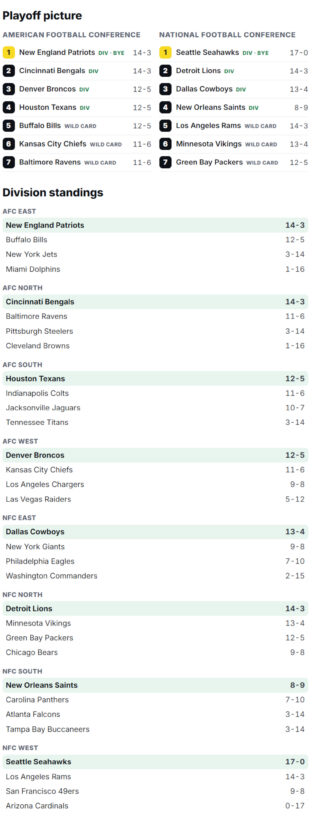
We have the Detroit Lions bouncing back in a major way in 2026. They are projected to finish 2026 with the NFC’s 2 seed after going 14-3 during the regular season.
Below is the complete 2026 regular season projections.
Sources
- NFL: Final 2025 division standings
- Detroit Lions: 2025 team statistics
- Detroit Lions: Week 18 victory at Chicago
- Detroit Lions: Brad Holmes profile and 2025 honors
- Detroit Lions: 2026 coaching staff
- Detroit Lions: 2026 free-agent additions
- Detroit Lions: Initial 2026 roster
- Detroit Lions: 2026 draft review