




Updated: September 5th, 2026. The season recap covers 2025; personnel sections look ahead to 2026. Covers Predictions, Projections and Complete Standings
Leadership and Coordinators
- Owner: Art Rooney II President. Rooney represents the family ownership structure and remains Pittsburgh’s senior organizational voice. The move from Mike Tomlin to Mike McCarthy was a rare franchise-level reset.
- Decision Maker: Omar Khan General Manager Khan controls roster construction with assistant GM Andy Weidl and the personnel staff. His current plan blends an aging win-now quarterback with a younger offensive line and a developmental successor.
- Head Coach: Mike McCarthy McCarthy became the Steelers’ 17th head coach and only their fourth since 1969. His offensive background, game-management experience and relationship with Aaron Rodgers make immediate playoff progress the standard.
- Offensive Coordinator: Brian Angelichio The former Vikings tight ends coach and passing-game coordinator enters his first season in the role. Expect layered play action, tight-end involvement and concepts familiar to McCarthy and Rodgers.
- Defensive Coordinator: Patrick Graham Graham brings seven consecutive years of coordinator experience and a flexible, matchup-specific approach. His challenge is integrating new secondary pieces while keeping the front disruptive.
- Special Teams Coordinator: Danny Crossman Crossman enters his 23rd NFL season and was hired partly to sharpen the return and coverage phases. Drafting Kaden Wetjen gives him a premier college returner.
2025 Season Recap
Pittsburgh won the AFC North at 10–7, going 5–1 in the division and earning a home playoff game, but another Wild Card defeat ensured the season ended in dissatisfaction. The Steelers scored 397 points and allowed 387, a narrow differential that accurately describes a team that won through experience, situational resilience and rivalry dominance rather than sustained statistical control.
Aaron Rodgers started 16 games and gave the offense a steadier floor, completing 327 passes for 3,322 yards, 24 touchdowns and seven interceptions. His command reduced reckless possessions and helped Pittsburgh survive uneven stretches, but the offense still lacked enough explosiveness and protection consistency against top opponents. DK Metcalf supplied the primary vertical and isolation threat. Kenneth Gainwell’s versatility earned team MVP recognition from teammates, while the young offensive line continued an uneven transition.
The defense remained the club’s identity. T.J. Watt dictated protections, Cameron Heyward remained a tone-setting interior presence, and young linemen Keeanu Benton and Derrick Harmon gave the front a viable succession plan. The secondary was more complicated. Jalen Ramsey added star power and flexibility, but injuries and changing combinations prevented the group from becoming fully settled. Pittsburgh could still create negative plays and short fields; it was less reliable when opponents stayed ahead of the chains.
The decisive advantage came inside the AFC North. A 5–1 record allowed Pittsburgh to separate from Baltimore despite only a plus-10 overall point differential. The Steelers survived a late wobble and beat the Ravens in the winner-take-all finale to claim the division. Yet the playoff loss reinforced the central criticism of the late Tomlin era: respectable regular seasons were no longer turning into postseason advancement.
The Wild Card loss clarified that the coaching change was about ceiling rather than competence. Pittsburgh had not become dysfunctional; it had become predictable in outcome—competitive through January’s opening weekend, but unable to impose itself once the opposition narrowed the matchup. McCarthy inherits a sound base and an explicit demand to do more with it.
Pittsburgh understood divisional games, protected the football and repeatedly found enough high-leverage defensive plays to win close contests. Against the broader playoff field, however, the offense did not consistently create separation on the scoreboard, leaving too little margin when the defense failed to generate a takeaway or sack at the right moment. The 10–7 record was legitimate, but the narrow point differential and quick postseason exit showed why ownership viewed continuity as insufficient.
That result ended one of the NFL’s longest coaching tenures. McCarthy’s arrival does not signal a rebuild in the conventional sense. Rodgers returned for another year; Khan traded for Michael Pittman Jr., signed Rico Dowdle, reinforced the secondary and retained core defenders. At the same time, Pittsburgh drafted quarterback Drew Allar in Round 3 and continued building a young line with Max Iheanachor and Gennings Dunker.
The 2026 roster therefore carries two timelines. The immediate group is designed to win with Rodgers, Metcalf, Pittman, Watt and Heyward. The developmental layer—Allar, Iheanachor, Broderick Jones, Zach Frazier, Harmon and Benton—is meant to prevent a cliff after the veterans depart. McCarthy will be judged not for preserving the Steelers’ familiar winning floor, but for lifting the offense and advancing in January.
2025 Division Standing
- 1. Pittsburgh Steelers — 10–7 (5–1 division) — Lost WC PF: 397 · PA: 387
- 2. Baltimore Ravens — 8–9 (3–3 division) — Missed Playoffs PF: 424 · PA: 398
- 3. Cincinnati Bengals — 6–11 (3–3 division) — Missed Playoffs PF: 414 · PA: 492
- 4. Cleveland Browns — 5–12 (2–4 division) — Missed Playoffs PF: 279 · PA: 379
Pittsburgh finished in first place in the NFC North. Its 5–1 division record was the decisive separator, and the Week 18 win over Baltimore secured the title before a Wild Card exit vs the Houston Texans.
Notable 2026 Player Additions
- WR Michael Pittman Jr. (trade, Indianapolis Colts) Pittman’s size, route reliability and 80-catch 2025 season give Rodgers a dependable complement to Metcalf.
- RB Rico Dowdle (free agency, Carolina Panthers) Dowdle arrives after consecutive 1,000-yard rushing seasons. His familiarity with McCarthy and three-down competence should stabilize the backfield.
- CB Jamel Dean (free agency, Tampa Bay Buccaneers) Dean’s size and outside coverage experience strengthen a secondary undergoing schematic change. Availability has been the recurring risk.
- S Jaquan Brisker (free agency, Chicago Bears) Brisker is an aggressive box safety with 342 career tackles and pressure value. His physical style fits Pittsburgh, though prior injury history requires monitoring.
- DT Sebastian Joseph-Day (free agency, Tennessee Titans) Joseph-Day adds experienced early-down mass and rotational flexibility to a front balancing veteran and young contributors.
- QB Aaron Rodgers (re-signed) Rodgers returned after a 24-touchdown, seven-interception season. He remains the immediate starter while Allar develops.
Notable 2026 Player Losses
- RB Kenneth Gainwell (Tampa Bay Buccaneers) Pittsburgh loses its 2025 team MVP and a versatile receiving back. Dowdle must replace both rushing volume and third-down dependability.
- S Kyle Dugger (Cincinnati Bengals) Dugger’s physicality and matchup utility now move to a division rival. Brisker and the reworked safety group must absorb those snaps.
- G Isaac Seumalo (Arizona Cardinals) Seumalo’s veteran steadiness leaves a young line with less insulation. Drafting Dunker directly addresses the depth and competition created by his exit.
- TE Jonnu Smith (released) Smith’s release removes an athletic receiving option but creates a clearer role for Darnell Washington and McCarthy’s preferred personnel packages.
2026 Draft Class
- Round 1, Pick 21 — OT Max Iheanachor, Arizona State Iheanachor did not allow a sack in his senior season and offers length and athletic upside. He joins a young line with a realistic path to early starting work.
- Round 2, Pick 47 — WR Germie Bernard, Alabama Bernard is a polished, competitive target who can work inside or outside. Pittman and Metcalf reduce immediate pressure while he develops.
- Round 3, Pick 76 — QB Drew Allar, Penn State Allar brings prototypical size, arm strength and extensive starting experience. Sitting behind Rodgers gives him time to improve anticipation and pressure response.
- Round 3, Pick 85 — CB Daylen Everette, Georgia Everette offers SEC experience, length and press-man traits. He can begin in sub-packages and on special teams.
- Round 3, Pick 96 — G Gennings Dunker, Iowa Dunker’s power, pad level and guard-tackle flexibility fit a line being built for long-term continuity.
- Round 4, Pick 121 — WR/RET Kaden Wetjen, Iowa Wetjen produced six collegiate return touchdowns and enters as a premier dual-return candidate. His offensive role will begin with manufactured touches.
- Round 5, Pick 169 — FB Riley Nowakowski, Indiana The H-back/fullback caught 32 passes in 2025 and offers alignment flexibility, blocking grit and special-teams value.
- Round 6, Pick 210 — DE Gabriel Rubio, Notre Dame Rubio is a long, stout interior lineman with run-game utility. A 2025 injury and limited starting résumé make him a developmental rotation piece.
- Round 7, Pick 224 — S Robert Spears-Jennings, Oklahoma Spears-Jennings can play in the box or in high zones and brings 178 career tackles. Versatility gives him a viable special-teams route.
- Round 7, Pick 230 — RB/WR Eli Heidenreich, Navy The Pittsburgh native is an unusual hybrid runner-receiver whose intelligence and versatility suit specialty packages. His military commitment and positional projection are developmental variables.
2026 Spotlight Watch
- Hot Seat — Mike McCarthy Pittsburgh changed coaches to change postseason outcomes. With Rodgers back and significant veteran additions, merely posting another winning record will not satisfy the mandate.
- Breakout Watch — Derrick Harmon The 2025 first-round tackle has the power and movement skills to become a three-down disruptor. A leap would ease the defense’s transition from its aging core.
- Bust Watch — Max Iheanachor Iheanachor made a good early impression before an upper-body injury interrupted his camp and cost him important reps. If the missed time prevents him from claiming a role or sharpening his technique, Pittsburgh’s protection plan becomes harder to execute.
- Team Superstar — T.J. Watt Watt remains the defense’s pressure engine and the opponent’s protection priority. His ability to create game-changing plays is central to Pittsburgh’s championship case.
Prediction
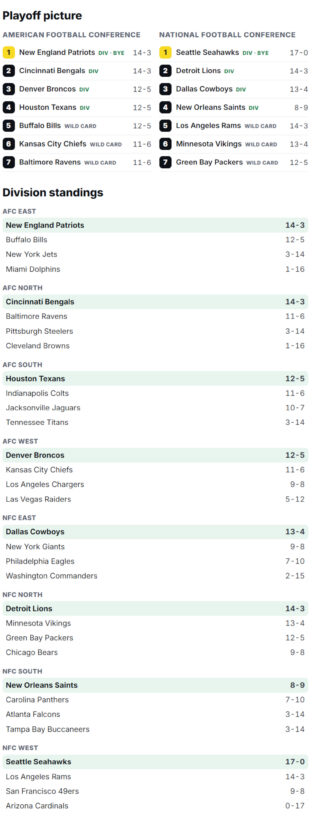
The reunion of Aaron Rodgers, and his former Green Bay head coach, Mike McCarthy, doesn’t end well for Pittsburgh as they are projected to finish 3rd in the NFC North and miss the playoffs due to their abysmal 3-14 record.
If Drew Allar can start and win some games, it will be interesting to see if the Steelers would be willing to pass up on one of the highly touted quarterbacks in the 2027 NFL draft, and stick with Allar at their quarterback for 2027.
Below is the complete 2026 regular season projections.