



Updated: August 31 2026. The season recap covers 2025; personnel sections look ahead to 2026. Prediction and Projections have been added on 8-31-26.
Leadership and Coordinators
- Owner: Stephen Ross Ross authorized a full reset after years of expensive but incomplete contention. The 2026 approach accepts short-term pain in exchange for a younger roster and a unified football structure.
- Decision Maker: Jon-Eric Sullivan – General Manager The first-time GM arrived after two decades in Green Bay’s personnel department. His opening offseason emphasized draft volume, line play, cap correction and players who fit a more physical identity.
- Head Coach: Jeff Hafley Miami hired the former Packers defensive coordinator and Boston College head coach to replace Mike McDaniel. Hafley’s central task is cultural as well as tactical: build a tougher, more dependable team after repeated late-season fades.
- Offensive Coordinator: Bobby Slowik Slowik was already in Miami as a senior passing-game assistant and now takes control of an offense being rebuilt around mobility, play action and a drastically different receiving corps.
- Defensive Coordinator: Sean Duggan The former Packers linebackers coach follows Hafley to Miami. He inherits a younger defense that must replace several established names while improving a unit that allowed 424 points.
- Special Teams Coordinator: Chris Tabor Tabor crossed the division after coordinating Buffalo’s special teams. He brings extensive NFL experience to a unit also replacing longtime kicker Jason Sanders.
2025 Season Recap
The 2025 Dolphins were supposed to determine whether the Mike McDaniel–Chris Grier construction could recover its earlier explosiveness. Instead, the season became the closing argument for dismantling it. Miami finished 7–10, missed the playoffs for a second consecutive year and extended its postseason-victory drought beyond a quarter-century. The record was mediocre; the way the season unfolded was more damaging. Miami started 2–7, lost most of its games against playoff-caliber opposition and ended the year with sweeping changes at general manager, head coach and quarterback.
The offense lost its defining speed almost immediately. Tyreek Hill suffered a season-ending quadriceps injury in Week 4 and finished with only 265 receiving yards. Jaylen Waddle became the primary receiver and led the team with 910 yards, but opponents no longer had to defend the same two-sided vertical stress that had made McDaniel’s early Miami offenses distinctive. The line remained a recurring limitation, and the offense too often failed when obvious passing situations allowed defenses to attack its protection rules.
Tua Tagovailoa’s season captured the larger stagnation. He completed 67.7 percent of his passes and threw 20 touchdowns, but his 15 interceptions and repeated difficulties against stronger defenses undermined the efficiency argument that had supported the offense. Miami benched him in December for rookie Quinn Ewers after playoff elimination. Ewers completed 55 of 83 passes for 622 yards with three touchdowns and three interceptions in limited work. The audition did not establish him as the next franchise quarterback, but it made clear that the organization was prepared to reconsider its most important position.
De’Von Achane was the bright spot that survived the collapse around him. He rushed for 1,350 yards at 5.7 yards per attempt and produced 1,838 yards from scrimmage, functioning as both an explosive runner and a high-value receiver. His ability to create space without ideal blocking kept Miami competitive and made him one of the few offensive players the new regime could confidently build around. The team later extended him, signaling that the reset would not discard every premium talent.
Defensively, Miami never developed a stable identity. The Dolphins surrendered 424 points and frequently struggled to hold up against quality offenses. Injuries, a thin secondary and uneven front-seven play contributed to the decline. The October trade of edge rusher Jaelan Phillips to Philadelphia confirmed that the organization was already shifting toward the future. General manager Chris Grier had been dismissed on Halloween, ending a long tenure defined by aggressive trades, star contracts and persistent weaknesses in the trenches and depth chart.
Miami briefly complicated the story by winning four consecutive games after the 2–7 start. That streak created a narrow path back into the race, but it proved more tease than turnaround. A decisive Week 15 loss at Pittsburgh eliminated the Dolphins, Tagovailoa was benched two days later, and New England closed Miami’s season with a 38–10 defeat. The Dolphins went 1–6 against playoff teams, suffered seven double-digit losses and finished only 2–6 on the road. McDaniel was fired after compiling a 35–33 regular-season record across four years.
The result was not a routine coaching change. Miami concluded that its expensive, speed-based contender had reached the end of its cycle. Grier, McDaniel, Tagovailoa, Hill and Waddle were all gone by the following offseason, while the club absorbed an extraordinary dead-cap burden. The 2025 season matters because it removed the illusion that the Dolphins were one healthy star away. For 2026, success will be measured less by immediate contention than by whether Sullivan and Hafley establish a sustainable foundation.
2025 AFC East Standing
- 1. New England Patriots — 14–3 (5–1 division) — Lost SB PF: 490 · PA: 320
- 2. Buffalo Bills — 12–5 (4–2 division) — Lost DR PF: 481 · PA: 365
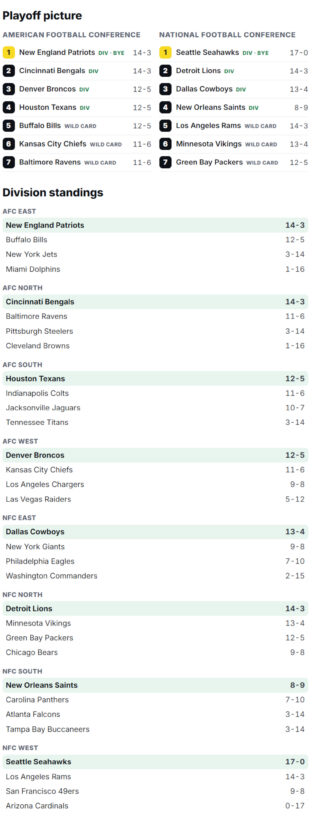
- 3. Miami Dolphins — 7–10 (3–3 division) — Missed Playoffs PF: 347 · PA: 424
- 4. New York Jets — 3–14 (0–6 division) — Missed Playoffs PF: 300 · PA: 503
Miami split its six division games but finished five games behind Buffalo and seven behind New England. The even division record could not compensate for a 3–9 conference mark.
Notable 2026 Player Additions
- QB Malik Willis The former Packer gets the first opportunity to lead the new offense. His mobility fits Slowik’s play-action background, but he must prove he can operate a full NFL passing game rather than a limited package.
- WR Jalen Tolbert and WR Tutu Atwell Tolbert offers size and outside experience; Atwell restores some of the speed lost with Hill and Waddle. Both move into larger roles than they held with their previous clubs.
- S Lonnie Johnson Jr Johnson provides veteran size and versatility for a secondary undergoing major turnover.
- The 13-player draft class Miami deliberately used volume to replenish an aging, expensive roster. First-rounders Kadyn Proctor and Chris Johnson headline a group built to improve the lines, coverage units and long-term cost structure.
Notable 2026 Player Losses
- QB Tua Tagovailoa Released and later signed by Atlanta, Tagovailoa leaves behind major dead money and an unresolved debate over what Miami might have achieved with better protection and health.
- WR Tyreek Hill Hill’s release formally ends the offense’s speed era. His 2025 injury reduced the immediate on-field loss, but replacing his threat changes how every defense aligns.
- WR Jaylen Waddle Miami traded Waddle to Denver for a package led by first- and third-round picks. The return supported the rebuild, but the team surrendered a 27-year-old receiver capable of No. 1 production.
- EDGE Bradley Chubb Chubb joined Buffalo after his release. His 8.5 sacks must now be replaced while Miami faces him twice a year.
- S Minkah Fitzpatrick Miami moved the veteran safety to the Jets, continuing its exchange of established talent for flexibility and youth.
- K Jason Sanders Sanders’ departure creates a real special-teams question after eight seasons of familiarity.
2026 Draft Class
- Round 1, Pick 12 — OT Kadyn Proctor, Alabama A massive foundational blocker with an immediate path to a starting tackle job. His development is central to fixing Miami’s protection problem.
- Round 1, Pick 27 — CB Chris Johnson, San Diego State A high-upside cover corner expected to grow into a leading role in Hafley’s defense.
- Round 2, Pick 43 — LB Jacob Rodriguez, Texas Tech An instinctive, productive linebacker who can compete for early snaps and help establish the new defense’s tone.
- Round 3, Pick 75 — WR Caleb Douglas, Texas Tech A vertical outside target with starting opportunity in a rebuilt receiver room.
- Round 3, Pick 87 — TE Will Kacmarek, Ohio State A two-way tight end whose blocking and underneath receiving fit a more physical offense.
- Round 3, Pick 94 — WR Chris Bell, Louisville A strong run-after-catch option who can develop into a dependable possession target.
- Round 4, Pick 130 — EDGE/LB Trey Moore, Texas A versatile pressure player who can contribute in sub-packages while refining a permanent role.
- Round 5, Pick 138 — LB Kyle Louis, Pittsburgh A fast, undersized linebacker suited to coverage and special teams.
- Round 5, Pick 158 — S Michael Taaffe, Texas An instinctive safety with leadership traits and a realistic path to rotational defensive snaps.
- Round 5, Pick 177 — WR Kevin Coleman Jr., Missouri A slot and return option whose special-teams value may secure an early roster role.
- Round 5, Pick 180 — TE Seydou Traore, Mississippi State A developmental move tight end who gives Slowik another flexible formation piece.
- Round 6, Pick 200 — G D.J. Campbell, Texas
An experienced right guard who started 43 college games and can compete in a line room needing depth. - Round 7, Pick 238 — EDGE Max Llewellyn, Iowa
A high-effort developmental rusher whose initial value may come on special teams.
2026 Spotlight Watch
- Hot Seat — Malik Willis Hafley and Sullivan have job security entering Year 1, so the most immediate pressure falls on Willis. He has a rare starting opportunity; if the passing offense stalls, Miami can pivot to Ewers and resume its quarterback search in 2027.
- Breakout Watch — De’Von Achane Achane already produced star-level yardage, but a larger leadership role and an offense designed around his versatility could push him into broader national recognition. Durability and workload management are the only restraints.
- Bust Watch — Kadyn Proctor The label reflects expectation, not a negative verdict. A first-round tackle in a rebuild must become a long-term starter; conditioning, pass-set consistency and the speed of NFL edge rushers will test Proctor immediately.
- Team Star — De’Von Achane With the veteran stars gone, Achane is the undeniable centerpiece. His speed, receiving value and efficiency give Miami a player who can change games while the rest of the offense develops.
Prediction
After being initially (relatively) high on the Dolphins, our expectations plummeted from the preseason games and news coming from the Dolphin’s training camp. We have the Dolphins finishing with the 2nd worst record in the NFL with a 1-16 record and looking to draft their next franchise QB in the 2027 Draft.